Who am I?
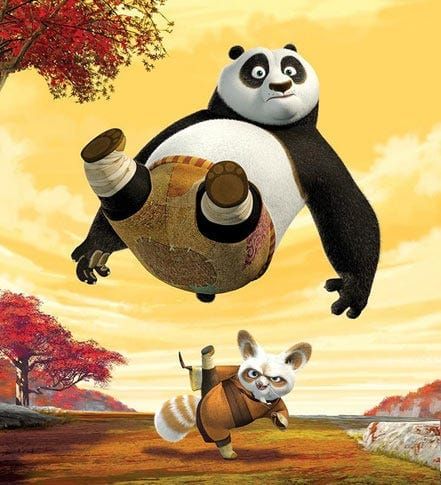
I just saw Kung Fu Panda 2 this weekend with Luke. The focus of the Themeline (the emotional plot of the story) was a question of Po’s identity. In the first movie, we learn that Po, a panda bear played by Jack Black, is the ‘son’ of Mr. Ping (James Hong), who happens to be a goose. Obviously something is amiss with the basic biology of this arrangement. The sequel delves into that backstory — where Po came from, how he ended up in Ping’s care.[And by the way, the movie once again blows out of the water Hollywood’s supposed antipathy toward flashbacks as KP2 is filled with them including a critical sequence late in Act Two which is comprised almost entirely of recollection scenes from Po’s past].
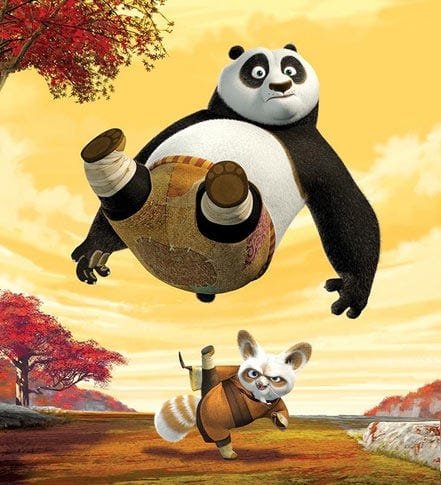
The backstory is framed by this actual line of Po dialogue: “Who am I?” It’s a reminder that the theme of self-identity is one present in a majority of movies, arguably perhaps in every film. That should come as no surprise. We look to stories not only for entertainment, but also for a context in which to feel feelings and think thoughts. Projected into the movie’s characters, their experiences become our experiences, thus enabling us to safely play around with issues of identity.
It’s intriguing that another animated movie this year Rango also goes straight at the issue of ‘who am I’ as part of the Protagonist’s metamorphosis. Rango (Johnny Depp) is a chameleon who fancies himself to be an actor, two factors that heighten the scope of the character’s self-identity issues. At FADE IN, he lives in an acquarium, the extent of his Ordinary World, until an accident sets him free. Wandering through the desert, Rango eventually ends up in a Western town called Dirt, and there he creates a new persona, taking on a fanciful backstory and the responsibilities of being sheriff.
As in most good stories, Rango rides high for a while, then things come crashing down, bad guys and all, and so off he goes, escaping who he had tried to become by trudging back out into the desert. Delirious from the heat and just after a miraculous crossing of a two-lane highway, cars and trucks whizzing by him, he stumbles across a lone Figure who looks and sounds an awful lot like Clint Eastwood in all his dusty dry spaghetti western glory. Here is their dialogue:
[spots the Figure]
Rango: The Spirit of the West.
[approaches Figure]
Rango: Excuse me, Mr. Spirit, sir?
[Figure digging in the dirt holds up an item he’s found]
Figure: Ah, there’s a beaut. Sometimes you gotta dig deep to find what you’re looking for. [to Rango] So you made it?
Rango: Is this heaven?
Figure: If it were, we’d be eating Pop Tarts with Kim Novak.
Rango: Yeah, no kidding. What’re you doing out here?
Figure: Searchin’, same as you.
Rango: I don’t even know what I’m looking for anymore. I don’t even know who I am. They used to call you “the man with no name.”
Figure: These days they got a name for just about everything. It doesn’t matter what they call ya’. It’s the deeds that make the man.
[walks back to golf cart]
Rango: Yeah, but my deeds just made things worse. I’m a fraud, a phony. My friends believed in me, but they need some kind of hero.
Figure: Then be a hero.
Rango: Oh, no. No-no. You don’t understand. I’m not even supposed to be here.
Figure: That’s right. You came a long way to find something that isn’t out here. Don’t you see? It’s not about you. It’s about them.
Rango: But I can’t go back.
Figure: Don’t know you’ve got a choice, son.
[uses finger to draw a rectangle in cart window, framing Rango in it]
Figure: No man can walk out of his own story.
[Figure drives away in golf cart]
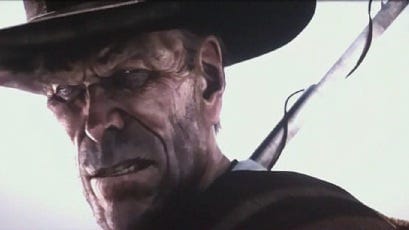
This Mentor figure — the Spirit of the West — gives Rango some existential advice, speaking directly to the chameleon’s question of self-identity. I don’t even know who I am. Just like Po’s question, Who am I?
And a rock-hard truth that speaks to both characters: “No man can walk out of his own story.”
True that. Each of us has our own Beginning, Middle and End. So, too, do the characters we write. Our stories, fictional or otherwise, give us each a structure within which to make sense of who we are — and create who we are to become.
In movies, the universe intervenes in a Protagonist’s life, forcing them out of their Ordinary World into a New World. While encountering challenges and overcoming obstacles, the P is compelled to change. And in changing, they get in touch with all aspects of their psyche, including some which are tied to the core of their being. Thus the question of ‘who am I’ — at least in most movies — results in the Protagonist’s metamorphosis toward Unity, embracing true parts of their Self, and by the end of the story beginning to live an Authentic Life.
Want to know why Joseph Campbell and Carl Jung are so relevant to screenwriting and storytelling in general? Because their observations about The Human Story are grounded in the universal lifelong pursuit we all have of understanding that most basic question: Who am I?
Takeaway: Consider the story you’re currently writing. Do your characters deal with issues of self-identity? Consciously or not, directly or obliquely, more than likely you’ve got this dynamic at play. Maybe there’s something to be mined by digging into your characters on an existential level.
If you have not seen Rango, you absolutely must. To me, it’s the movie of the year thus far. Utterly amazing that a Hollywood studio greenlit this unique, oddball and ultimately deeply thoughtful movie. For a revealing interview with the movie’s director and visionary Gore Verbinski, go here.
Comment Archive