From Cast Away [written by William Broyles, Jr.].
Setup: After surviving on an island for years, Chuck [Tom Hanks] sets sail in a makeshift raft, accompanied only by his faithful friend Wilson… a volleyball.
EXT. OCEAN - DAY - LATER
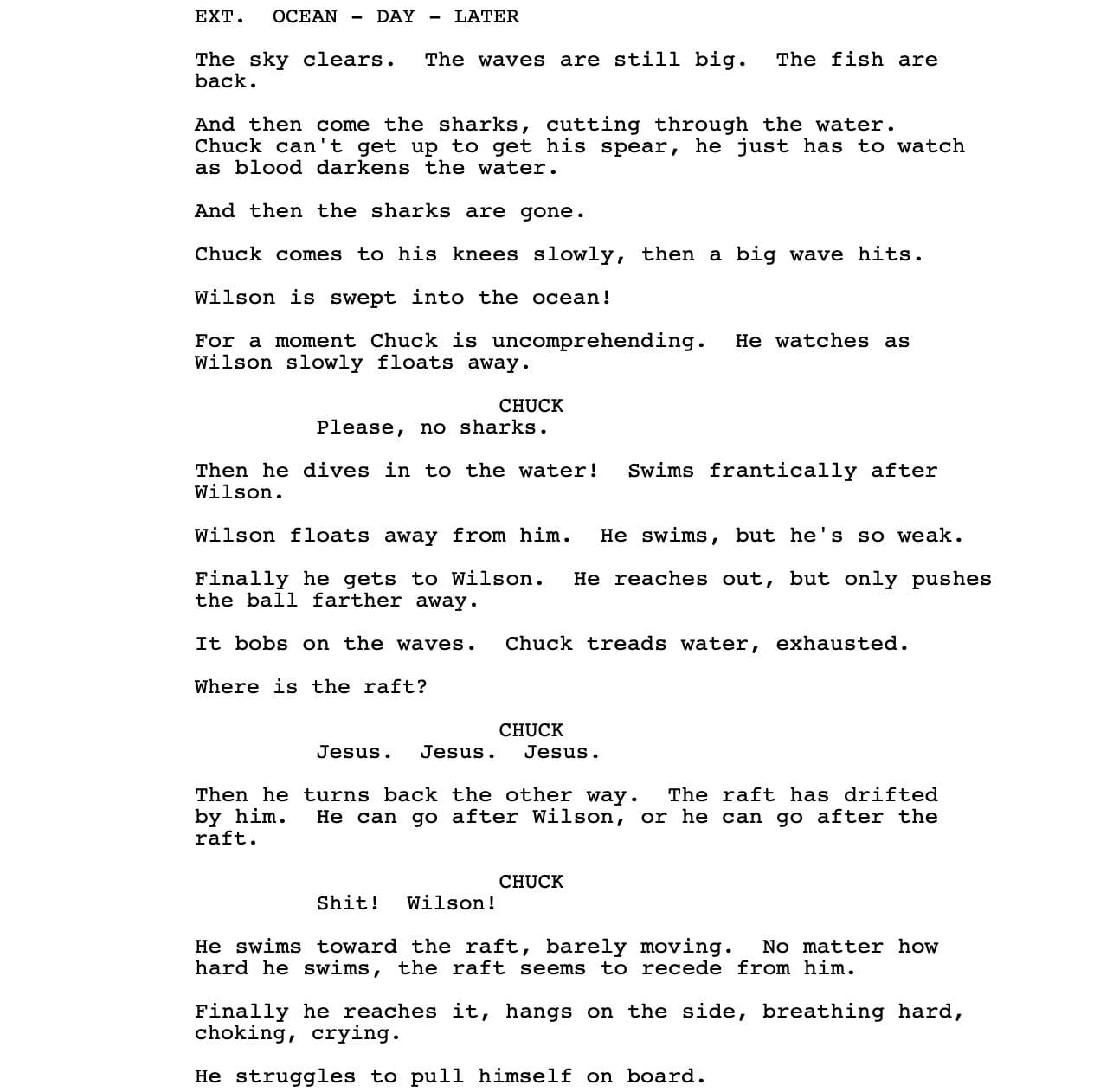
The sky clears. The waves are still big. The fish are back.
And then come the sharks, cutting through the water. Chuck
can't get up to get his spear, he just has to watch as blood
darkens the water.
And then the sharks are gone.
Chuck comes to his knees slowly, then a big wave hits.
Wilson is swept into the ocean!
For a moment Chuck is uncomprehending. He watches as Wilson
slowly floats away.
CHUCK
Please, no sharks.
Then he dives in to the water! Swims frantically after
Wilson.
Wilson floats away from him. He swims, but he's so weak.
Finally he gets to Wilson. He reaches out, but only pushes
the ball farther away.
It bobs on the waves. Chuck treads water, exhausted.
Where is the raft?
CHUCK
Jesus. Jesus. Jesus.
Then he turns back the other way. The raft has drifted by
him. He can go after Wilson, or he can go after the raft.
CHUCK
Shit! Wilson!
He swims toward the raft, barely moving. No matter how hard
he swims, the raft seems to recede from him.
Finally he reaches it, hangs on the side, breathing hard,
choking, crying.
He struggles to pull himself on board.
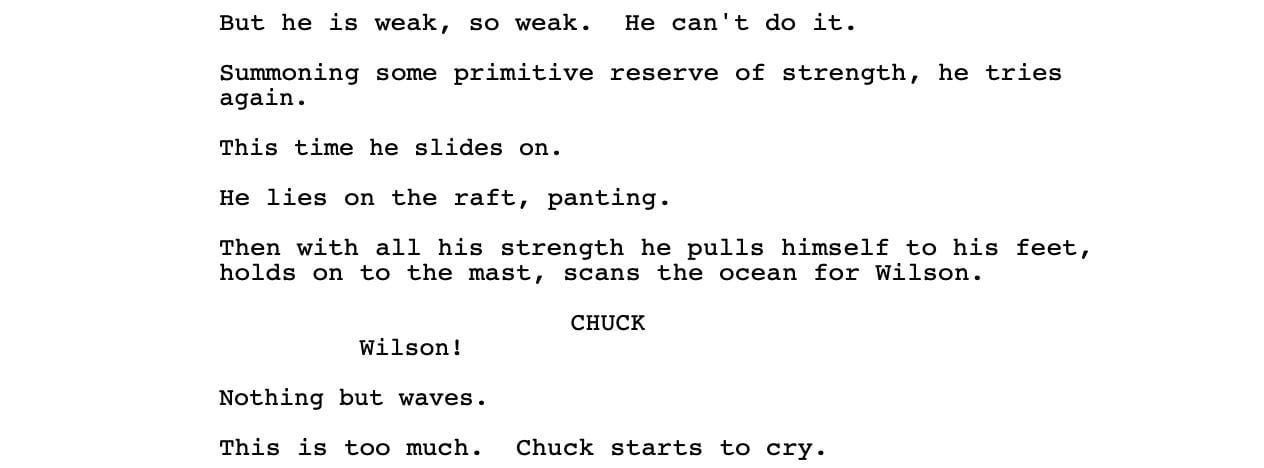
But he is weak, so weak. He can't do it.
Summoning some primitive reserve of strength, he tries again.
This time he slides on.
He lies on the raft, panting.
Then with all his strength he pulls himself to his feet,
holds on to the mast, scans the ocean for Wilson.
CHUCK
Wilson!
Nothing but waves.
This is too much. Chuck starts to cry.
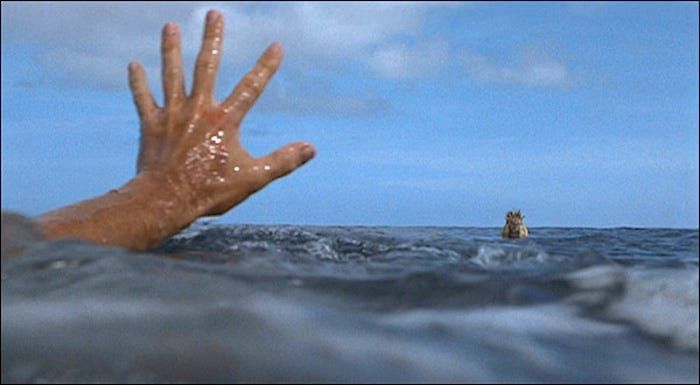
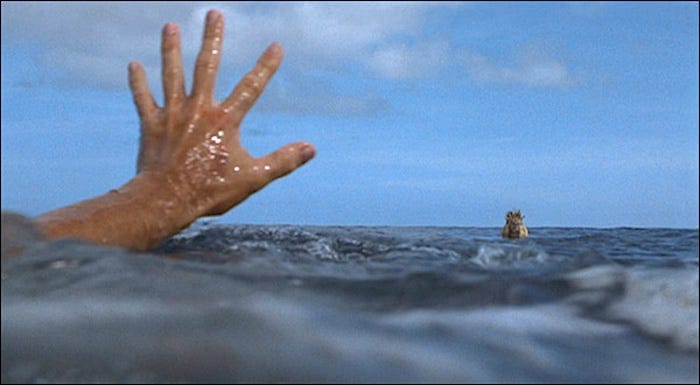
Here is the scene from the movie:
Questions to ask to analyze the scene:
* What elements in the movie scene are the same as the script?
* What elements in the movie scene are different than the script?
* Regarding the differences, put yourself in the mindset of the filmmakers and speculate: Why did they make the changes they did?
* How did the changes improve the scene?
* Alternatively are there elements in the script, not present in the movie, that are better than the final version of the scene?
* Note each camera shot in the movie version. Which of them does the script suggest via sluglines or scene description?
* How does the script convey a sense of the scene’s tone, feel, and pace through scene description and dialogue?
* What ‘magic’ exists in the movie that is not indicated in the words of the script? How do you suppose that magic emerged?
I’ll see you in comments for a discussion of this scene from Cast Away.
One of the single best things you can do to learn the craft of screenwriting is to read the script while watching the movie. After all a screenplay is a blueprint to make a movie and it’s that magic of what happens between printed page and final print that can inform how you approach writing scenes. That is the purpose of Script to Screen, a weekly series on GITS where we analyze a memorable movie scene and the script pages that inspired it.