Script To Screen: “Fargo”
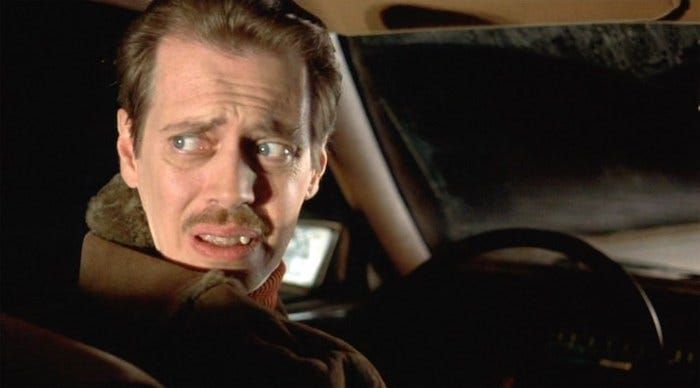
October 3rd, 2012 by ScottHere is a terrific scene from a terrific movie, the 1996 film Fargo, screenplay by Ethan Coen and Joel Coen for which they won an Academy Award.
Setup: Carl (Steve Buscemi) and Grimsrud (Peter Stormare), who have kidnapped Jean (Kristin Rudrüd) and stashed her in the back seat of their car, are driving on a North Dakota highway when something happens…
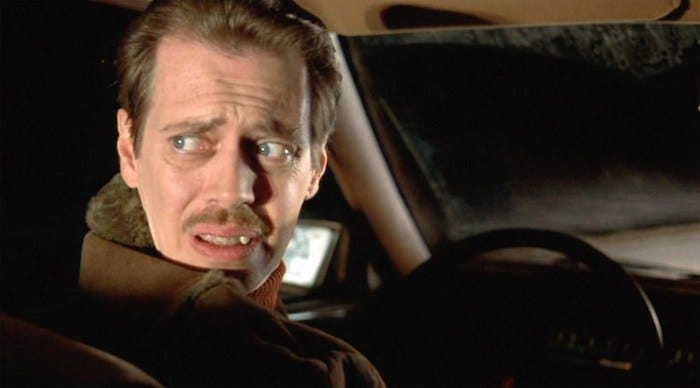
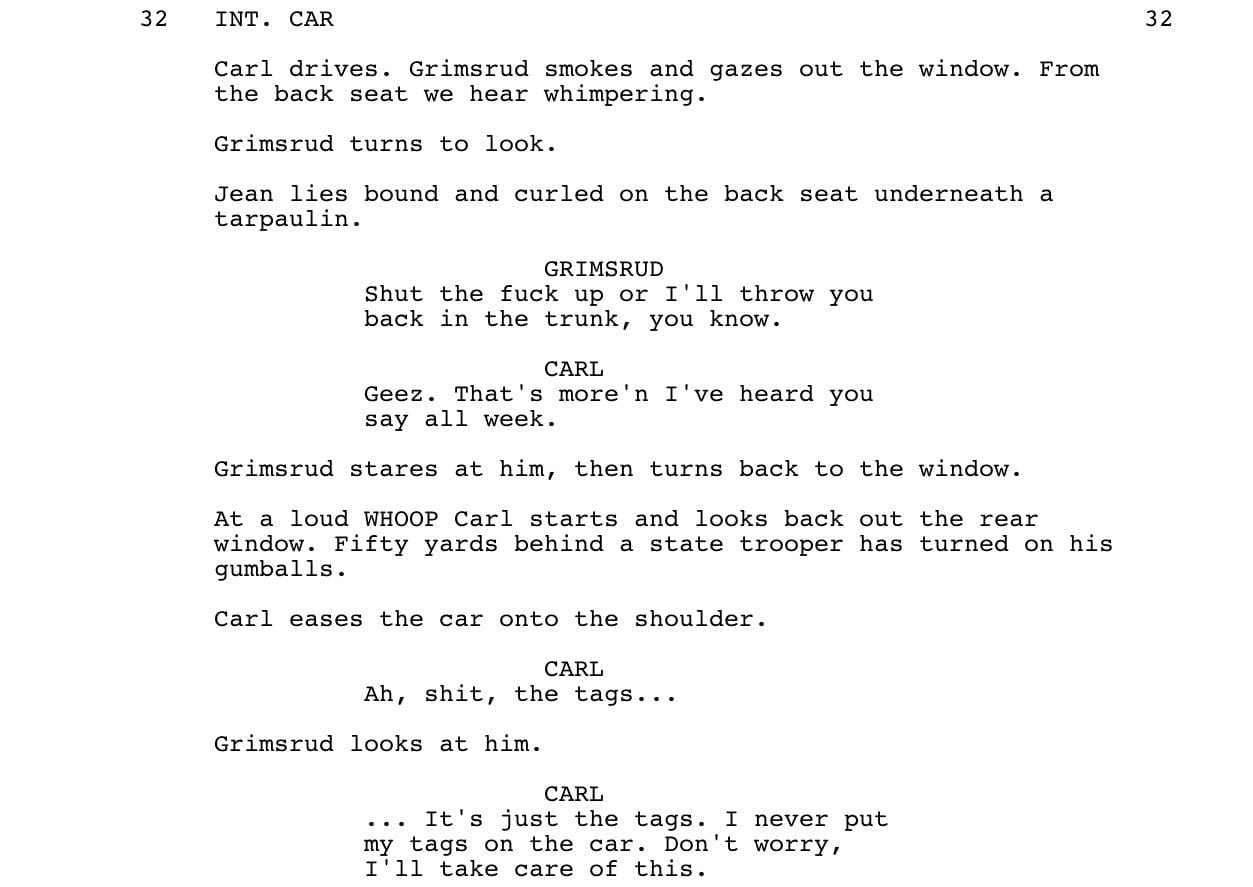
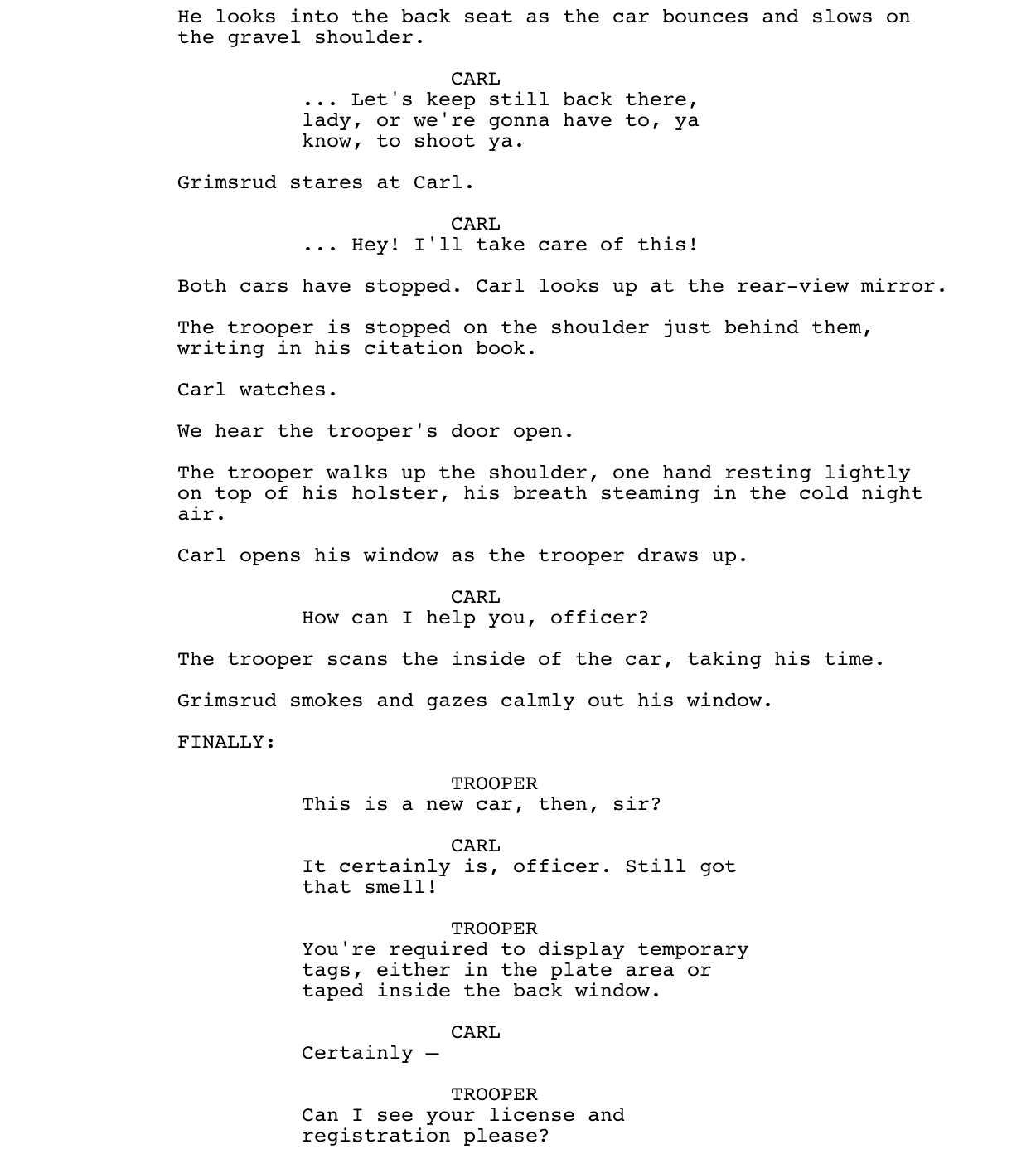
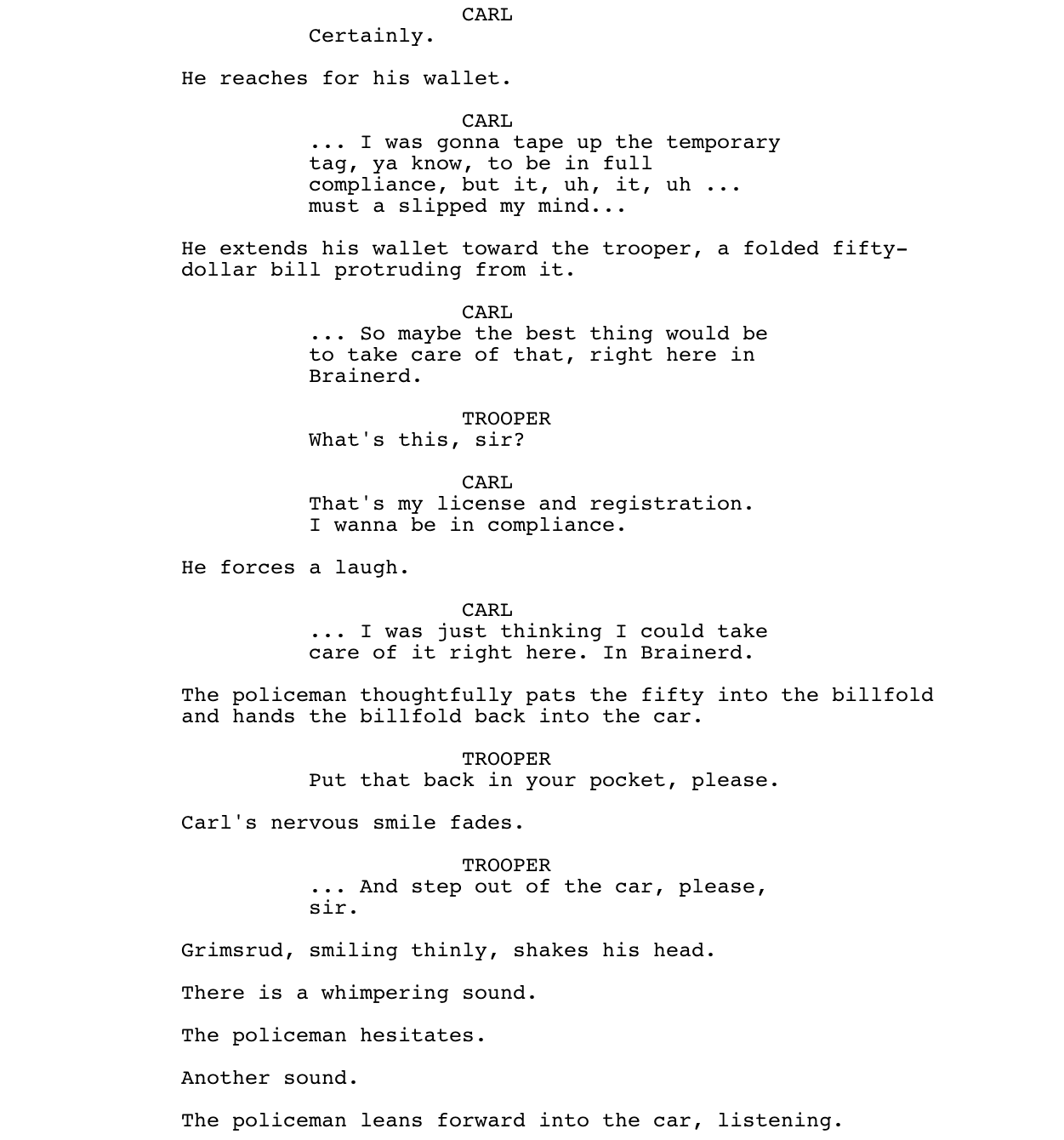
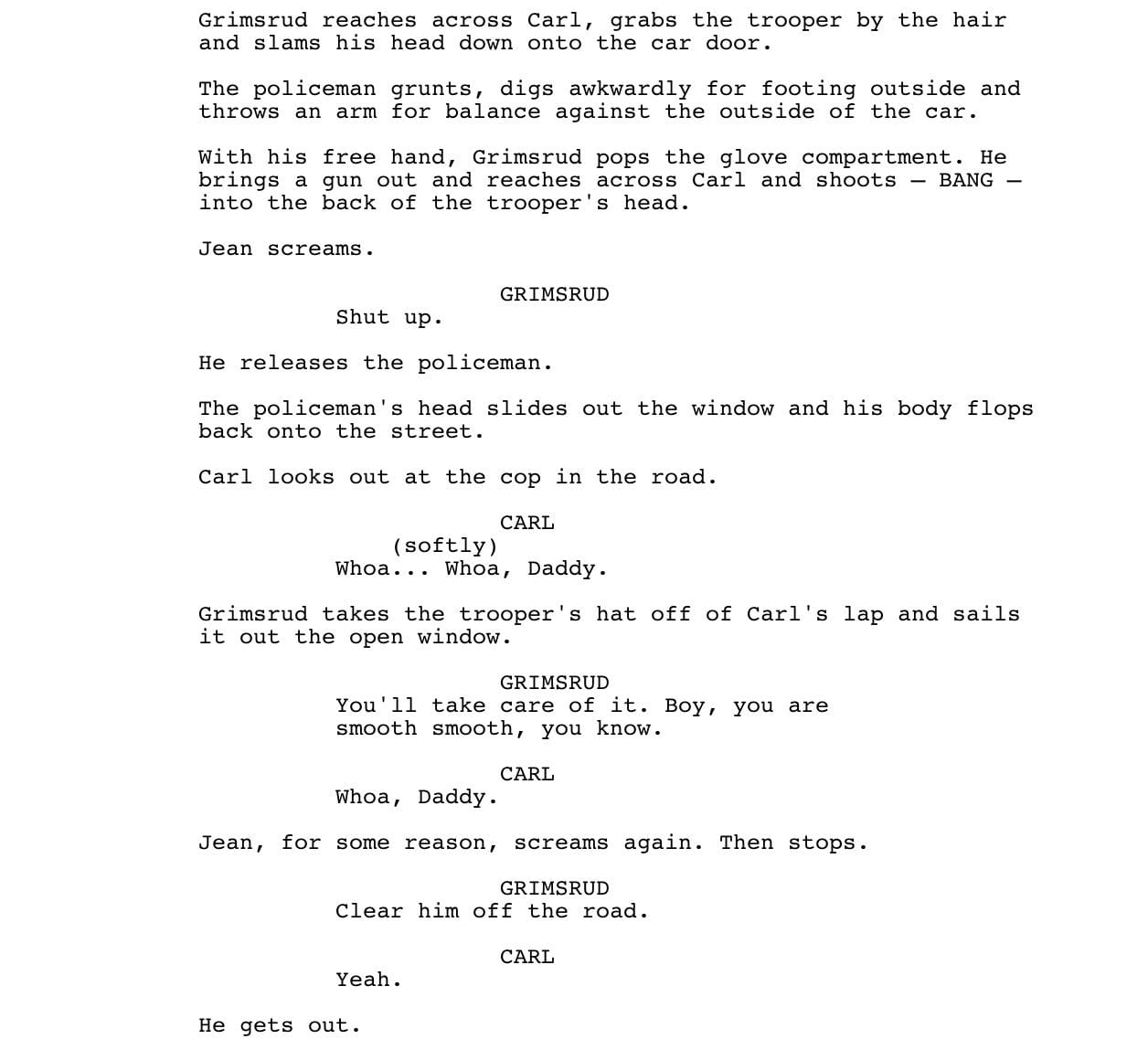
INT. CAR Carl drives. Grimsrud smokes and gazes out the window. From the back seat we hear whimpering. Grimsrud turns to look. Jean lies bound and curled on the back seat underneath a tarpaulin. GRIMSRUD Shut the fuck up or I'll throw you back in the trunk, you know. CARL Geez. That's more'n I've heard you say all week. Grimsrud stares at him, then turns back to the window. At a loud WHOOP Carl starts and looks back out the rear window. Fifty yards behind a state trooper has turned on his gumballs. Carl eases the car onto the shoulder. CARL Ah, shit, the tags... Grimsrud looks at him. CARL ... It's just the tags. I never put my tags on the car. Don't worry, I'll take care of this. He looks into the back seat as the car bounces and slows on the gravel shoulder. CARL ... Let's keep still back there, lady, or we're gonna have to, ya know, to shoot ya. Grimsrud stares at Carl. CARL ... Hey! I'll take care of this! Both cars have stopped. Carl looks up at the rear-view mirror. The trooper is stopped on the shoulder just behind them, writing in his citation book. Carl watches. We hear the trooper's door open. The trooper walks up the shoulder, one hand resting lightly on top of his holster, his breath steaming in the cold night air. Carl opens his window as the trooper draws up. CARL How can I help you, officer? The trooper scans the inside of the car, taking his time. Grimsrud smokes and gazes calmly out his window. Finally: TROOPER This is a new car, then, sir? CARL It certainly is, officer. Still got that smell! TROOPER You're required to display temporary tags, either in the plate area or taped inside the back window. CARL Certainly - TROOPER Can I see your license and registration please? CARL Certainly. He reaches for his wallet. CARL ... I was gonna tape up the temporary tag, ya know, to be in full compliance, but it, uh, it, uh ... must a slipped my mind... He extends his wallet toward the trooper, a folded fifty- dollar bill protruding from it. CARL ... So maybe the best thing would be to take care of that, right here in Brainerd. TROOPER What's this, sir? CARL That's my license and regis- tration. I wanna be in compliance. He forces a laugh. CARL ... I was just thinking I could take care of it right here. In Brainerd. The policeman thoughtfully pats the fifty into the billfold and hands the billfold back into the car. TROOPER Put that back in your pocket, please. Carl's nervous smile fades. TROOPER ... And step out of the car, please, sir. Grimsrud, smiling thinly, shakes his head. There is a whimpering sound. The policeman hesitates. Another sound. The policeman leans forward into the car, listening. Grimsrud reaches across Carl, grabs the trooper by the hair and slams his head down onto the car door. The policeman grunts, digs awkwardly for footing outside and throws an arm for balance against the outside of the car. With his free hand, Grimsrud pops the glove compartment. He brings a gun out and reaches across Carl and shoots - BANG - into the back of the trooper's head. Jean screams. GRIMSRUD Shut up. He releases the policeman. The policeman's head slides out the window and his body flops back onto the street. Carl looks out at the cop in the road. CARL (softly) Whoa... Whoa, Daddy. Grimsrud takes the trooper's hat off of Carl's lap and sails it out the open window. GRIMSRUD You'll take care of it. Boy, you are smooth smooth, you know. CARL Whoa, Daddy.
Here is the movie version of the scene:
Questions to ask to analyze the scene:
* What elements in the movie scene are the same as the script?
* What elements in the movie scene are different than the script?
* Regarding the differences, put yourself in the mindset of the filmmakers and speculate: Why did they make the changes they did?
* How did the changes improve the scene?
* Alternatively are there elements in the script, not present in the movie, that are better than the final version of the scene?
* Note each camera shot in the movie version. Which of them does the script suggest via sluglines or scene description?
* How does the script convey a sense of the scene’s tone, feel, and pace through scene description and dialogue?
* What ‘magic’ exists in the movie that is not indicated in the words of the script? How do you suppose that magic emerged?
I’ll see you in comments for a discussion of this scene from Fargo.
One of the single best things you can do to learn the craft of screenwriting is to read the script while watching the movie. After all a screenplay is a blueprint to make a movie and it’s that magic of what happens between printed page and final print that can inform how you approach writing scenes. That is the purpose of Script to Screen, a weekly series on GITS where we analyze a memorable movie scene and the script pages that inspired it.