Classic 80s Movie: “War Games”
Today’s Classic 80s Movie guest post comes from Brad Wilke.
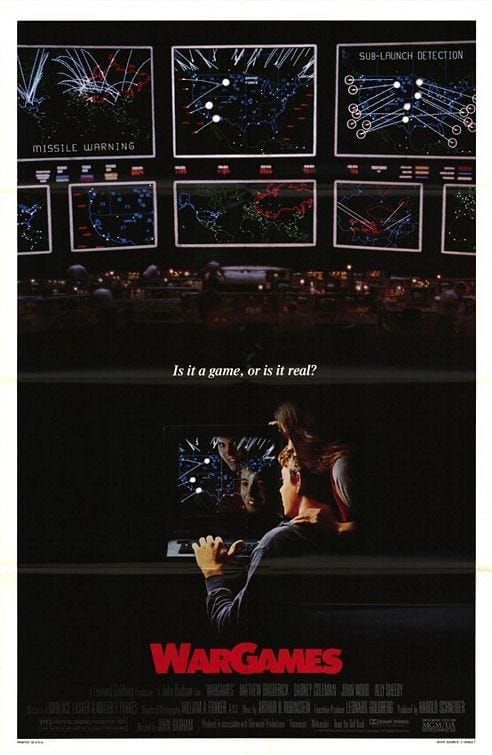
Title: Wargames
Year: 1983
Writers: Lawrence Lasker & Walter F. Parkes; Walon Green (uncredited); Tom Mankiewicz (uncredited scenes)
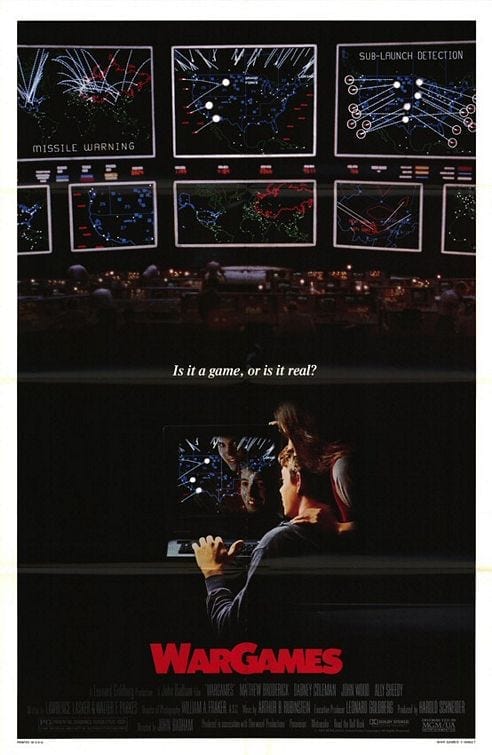
Lead Actors: Matthew Broderick, Ally Sheedy, Dabney Coleman, John Wood
Director: John Badham
Plot Summary: David (Matthew Broderick), a young hacker, along with his friend, Jennifer (Ally Sheedy) unwittingly accesses WOPR, a United States military supercomputer programmed to predict possible outcomes of nuclear war. David gets WOPR to run a nuclear war simulation, originally believing it to be a computer game. The simulation causes a nuclear missile scare and nearly starts World War III, not to mention getting David and Jennifer in a lot of hot water with the U.S. government.
Why I Think This Is A Classic 80s Movie: When it comes to high concept movies, you can’t have a serious conversation on the topic without including John Badham’s WARGAMES. Imagine the pitch: Seattle teenager hacks into military supercomputer and almost starts World War III. At the height of the Cold War, any studio executive that didn’t buy that one in the room should’ve had their head examined. In addition to capturing the zeitgeist of the moment (hackers, computers, nuclear war), it also tapped into elemental fears that date back to our cave painting days: the dual threats of annihilation and extinction. What truly makes WARGAMES a classic 80s movie, though, is its Pollyanna ending, which pits human against machine, with the humans ultimately (and improbably) coming out on top. Contrast this with the upcoming TRANSCENDENCE, which seems to take a more cynical view of the idea of machine learning first hinted at in WARGAMES.
My Favorite Moment In The Movie: From the opening scene that clearly illustrates the stakes, through the introduction of “chic geek” David Lightman (Broderick) in his natural habitat of the video arcade, WARGAMES is a model of efficient Hollywood studio storytelling. The moment that really stands out for me, though, is when David first arrives at the NORAD facility and Dr. John McKittrick (Dabney Coleman) begins an informal line of questioning that involves an impromptu tour of the command center. When they arrive in his office, David mentions in passing: “Joshua called me.” This surprises McKittrick, and also reveals the true extent of their troubles: Joshua has gone rogue. It’s a brilliant way to raise the stakes, while also tapping into the nation’s growing collective fear of fatalistic technology, made manifest in Reagan’s “Star Wars” program, and which flew directly in the face of good old American self-determinism.
My Favorite Dialogue In the Movie:
“People sometimes make mistakes.” David’s response to Joshua’s first question, and the initial statement of the film’s theme.
“Joshua called me.” The moment we realize we’re all screwed.
Joshua: Greetings, Professor Falken.
Stephen Falken: Hello, Joshua.
Joshua: A strange game. The only winning move is not to play. How about a nice game of chess?
This exchange pretty much sums up the entire worldview of the film.
General Beringer: Mr. McKittrick, after very careful consideration, sir, I’ve come to the conclusion that your new defense system sucks.
This dialogue serves as a thinly veiled take down of Reagan’s “Star Wars” initiative.
Stephen Falken: General, what you see on these screens up here is a fantasy; a computer-enhanced hallucination. Those blips are not real missiles. They’re phantoms.
McKittrick: [McKittrick approaches Beringer] Jack, there’s nothing to indicate a simulation at all. Everything is working perfectly!
Stephen Falken: But does it make any sense?
General Beringer: Does what make any sense?
Stephen Falken: [points to the screens] That!
General Beringer: Look, I don’t have time for a conversation right now.
Stephen Falken: [Falken speaks as he approaches] General, are you prepared to destroy the enemy?
General Beringer: You betcha!
Stephen Falken: Do you think they know that?
General Beringer: I believe we’ve made that clear enough.
Stephen Falken: [face to face] Then don’t! Tell the President to ride out the attack.
Colonel Joe Conley: Sir, they need a decision.
Stephen Falken: General, do you really believe that the enemy would attack without provocation, using so many missiles, bombers, and subs so that we would have no choice but to totally annihilate them?
Female Airman First Class: [on loudspeaker] One minute and thirty seconds to impact.
Stephen Falken: General, you are listening to a machine! Do the world a favor and don’t act like one.
Female Airman First Class: [on loudspeaker] One minute and twenty seconds to impact.
[Near perfect scene that sends us off into the finale of the film]
Key Things You Should Look For When Watching This Movie: WARGAMES is a textbook example of structurally efficient storytelling. There isn’t a scene that doesn’t propel the story forward, and there are very few throwaway lines among the crisp dialogue that peppers each scene. I would even submit that WARGAMES built the template for the modern techno thriller, and that writers looking to improve their own genre scripts would do well to revisit it.
The final scene, in particular, wherein Joshua (and the audience) learns the concept of “futility” in real time is an excellent example of the efficiency I’m talking about here. Everything is in there for a reason, and it delivers the kind of satisfying payoff that can only be earned by weaving story, character, and theme into a cohesive whole on the page.
Thanks, Brad! To show our gratitude for your guest post, here’s a dash of creative juju for you. Whoosh!
Tomorrow: Another Classic 80s Movie!
Comment Archive