Great Character: Cameron Frye (“Ferris Bueller’s Day Off”)
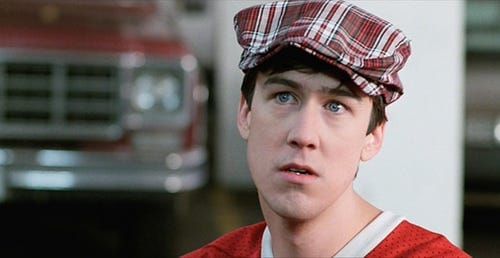
This month we are looking at memorable teenagers in John Hughes movies. Today guest poster Jason Cuthbert considers another notable character from a Hughes’ film: Cameron Frye from the 1986 movie Ferris Bueller’s Day Off.
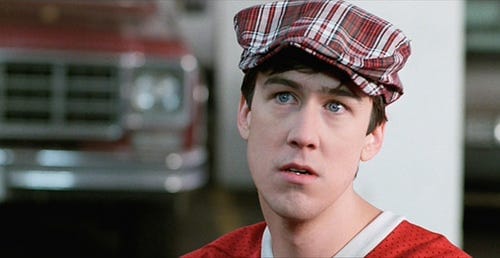
Before Alan Ruck’s acting career accelerated in Speed, spun ahead in Twister and made a recognizable turn on television with Spin City, he triumphantly played the prerequisite poster child for depressed suburban youth as Cameron Frye in John Hughes’ (screenwriter, director, producer) magnetic pop culture monolith Ferris Bueller’s Day Off.
Matthew Broderick’s enchanting school skipper Ferris Bueller may have become the seismic epicenter for teen freedom. But Ferris’ groggy killjoy companion Cameron provided a relatable “Who am I?” and an emotional injury waiting to heal to balance the film’s comedic Chicago gallivanting. To make Alan Ruck’s portrayal of high-schooler Cameron Frye even more impressive is the fact that during the production schedule for Ferris Bueller’s Day Off — Ruck was approaching 30 years old.
Ferris Bueller’s Day Off plot summary from IMDB:
A high school wise guy is determined to have a day off from school, despite of what the principal thinks of that.
Ferris Bueller and Cameron Frye are both taking a sick day from school throughout the entire length of this movie — but only Cameron is truthfully ill. If Cameron could have gotten past his passive aggressive lack of confidence for one moment, he would have been able to remain in the tranquil comfort of his bed, strengthening his immune system. But he seems to have reluctantly allowed Ferris to do all of the thinking for him. Ironically, his surname “Frye” means “free,” according to its British Anglo-Saxon roots. Free is exactly what Ferris is and what Cameron wishes he were.
http://www.youtube.com/watch?v=rIqWSPUh2rY
Cameron is physically sick, but also emotionally sick: sick of the uncertainty of his future, sick of his inability to defend himself and sick of his father’s lack of love. All of these virus-like attributes are the corrupted source code to Cameron’s programmed personal prison. This pain is expressed as Cameron quietly compares his bitter existence to the permanent smirk worn by Ferris during his carefree catwalk through life.
Cameron and Ferris are childhood friends who apparently veered off in opposite paths on the map to popularity. Ferris has ubiquitous acceptance, a pair of affectionate parents, a vivacious girlfriend, a bold strategic mindset and a knack for winning. Cameron has a used car. The unequal social comparisons to Ferris seem to be driving Cameron nutty, especially considering Cameron is the one harping on them.
Cameron’s own excessive worrying is another key contributor to his drab outlook on life. Lets also not forget his submissive surrender of his own needs to pacify others. He worries about his health, but he leaves the house to hang out with Ferris. He worries about getting in trouble at school, but he lies to the Dean of Students. He worries about ruining his father’s rare Ferrari, but he joyrides with it anyway — caving into the whims of his peer group role model.
CAMERON: You hit me. Look don’t make me participate in your stupid crap if you don’t like the way I do it. You make me get out of bed, you make me come over here. You make me make a phony phone call to Edward Rooney? The man could squash my nuts into oblivion. And-and-and then, and then, you deliberately hurt my feelings.
Has Cameron’s father’s apparent singular love for material things created a “What’s wrong with me?” complex in Cameron, making him feel unworthy of respect and nurturing relationships? There is a definite anxiety that controls Cameron’s interactions, an omniscient fear of his father’s reactions and an inability to make firm decisions.
Cameron even pretends to be completely catatonic, a forewarning of his unhinged implosion taking shape. In hindsight, it comes off as an impromptu pop quiz for Ferris and his girlfriend Sloane, with the test question being: “Do you guys really care about me and my well-being, or just about this flash car I’m carting you around in?” This would be similar to the question that Cameron is itching to ask his dad.
CAMERON: [while kicking his father’s car] Who do you love? Who do you love? You love a car!
Ferris is the type to make things happen, while Cameron lets things happen. This crippling flaw provides Cameron with the most developed and comprehensible character arc out of every individual in the movie — his search for courage.
Cameron seems to be cherry-picking the characteristics of Ferris that he most admires and is slowly fusing them into the bravery required to save himself from himself. Cameron may not have the chutzpah to boldly argue his way into a reserved table at an extravagant eatery like his precocious pal, but he sure would like to argue some respect out of his not-so-dear old dad.
CAMERON: I am not going to sit on my ass as the events that affect me unfold to determine the course of my life. I’m going to take a stand. I’m going to defend it. Right or wrong, I’m going to defend it.
After the self-destructive disaster between Cameron’s violent feet and his father’s beloved sport car, there is an unsettling sense of the true suffocation that Cameron has been repressing. He is crying out, performing a dress rehearsal to prepare himself for the inevitable main event confrontation with his father. Everything that he has never given himself the opportunity to say is bubbling up out of its burial.
http://www.youtube.com/watch?v=OX1Yj-fhiTA
Cameron’s growth spurt expands from being meek to inheriting the Earth, or at least his particular placement on it. But aside from the self-healing, Cameron has also inspired many valid debates and analyses that have circulated among the Go Into The Story community as to what his character represents in the tapestry of Ferris Bueller’s Day Off.
It has been argued that Cameron is the true protagonist, due to being the foremost character that undergoes any sort of change [see here].
There is also an incredibly awesome idea that maybe Cameron never left his bed at all, and that Ferris is just his alter ego, the version of himself that he longs to become [see here].
For his emotional wounds that he reveals for us to examine, his fear of fear itself and his epiphany that his happiness has value — Cameron Frye is a GREAT CHARACTER in John Hughes imaginative high school yearbook.
Such a great movie. Such a great character. And the presence of Cameron’s character is a full-on blast at so-called screenwriting ‘rules’ and conventional wisdom by raising the question Jason noted above: Who is the Protagonist of the movie? It would certainly seem to be Ferris, central figure and all that… and by the way, his name is featured in the movie’s title. However he doesn’t change. Cameron does. And that is one of the typical ways we are supposed to think about Protagonists.
Personally I love the theory that Ferris is Cameron’s alter ego. Then the movie stands as a comedic prophecy of future films like Fight Club, a possibility that only adds to the amazing legacy left by John Hughes.
Thanks once again to Jason for an excellent column! You may follow him on Twitter: @A2Jason. And while you’re at it, head to comments to provide your thoughts on Cameron, Ferris and this terrific film.
Comment Archive