Interview (Part 1): Writer-Director Tze Chun (“Cold Comes the Night”)

Tze Chun is a talented young filmmaker who first gained attention with his indie drama Children of Invention. Indiewire describes his latest movie Cold Comes the Night, starring Alice Eve and Bryan Cranston, as a “tightly wound noir thriller.” Having screened the movie myself, I concur wholeheartedly. It opens in theaters and on VOD on January 10.
I caught up with Tze as he was driving from LA to San Diego for a screening of Cold Comes the Night. We had a great conversation covering how he wound his way into filmmaking, three of his movies, and his thoughts on the craft of screenwriting. Here is Part 1 of the interview:
Scott: You were born in Chicago and raised in Boston. Could you describe your background about how movies became a part of your life?
Chun: My mother always loved movies and we watched a lot of movies growing up. She was raised as an orphan in Singapore. There’s one story I look back on now. When she was a little girl, growing up in a house full of orphans, the only time an adult would hold her or show affection was when they would go to see a movie. This was Singapore in the 60’s, and the way movie theaters would work is that adults would basically pay for one seat and put the kids on their lap. So, I think my mom always thought of movies as happiness. She wanted us kids to feel the same way. A lot of our family time growing up was about getting lost in the movies.
Actually, though, I started off as an artist and wanted to be a comic book artist growing up. I always loved visual art. There was one time that our English teacher, a guy named Mr. Zilliax, in the ninth grade, showed us The Graduate on VHS. He would play The Graduate and pause it every few seconds and point out things like the writing, art direction, the editing, staging, the use of colors, the symbolism. Though I’d grown up watching a lot of movies, it was the first time I had actually seen all the potential to be creative within the medium. There was something very exciting about it.
From that point on, I borrowed a little Hi-8 camcorder and made movies with my friends. We would get together on weekends and I would stay up editing in the A/V department after hours. That was how I started. But the eye‑opening experience was that class.
Scott: You mention that in your background, you were first interested in painting and you worked as a visual artist? In fact, you did the original artwork for the poster for Half‑Nelson.
Chun: That’s right. Anna Boden (the co-writer and co-director of Half Nelson) and I were the same year at Columbia. Actually, I think she started ahead of me but then she took a year off. I had been doing portrait paintings for the first couple years out of school to make a living. You know, family portraits and portraits of people’s kids or whatever. Anna and Ryan (Fleck, co-writer and co-director of Half Nelson) had talked about doing a painted poster for Half Nelson. I told her I would do it if she would edit my short film Windowbreaker, which I was kind of struggling with. She did, and the short went to Sundance in ’07. So it was a good trade, for me at least [laughter].
Anna and Ryan thought there was no way Thinkfilm (their distributor) would use that painted poster in the actual marketing campaign since the distributor had used a painted poster for the first movie they released and it did really poorly. But, I guess that they liked that one. I still draw and paint every once in a while. Actually, I painted some alternate posters for Cold Comes the Night that you can find online.
Scott: You went to college at Columbia University. What was your major there?
Chun: I was film studies. Film studies at Columbia is all film history. There was only one production class. That was okay. I love film history, and as an undergrad, I just made my own projects with friends. I wrote and directed a couple short films and couple feature films while I was at Columbia, and it was good practice.
Scott: So, in a sense, you were just learning it on your own?
Chun: Yeah. I tend to create things better on my own, not within the framework of school. In high school I taught myself how to use cameras and how to do linear editing. And in college I met a couple other kids who taught me how to use Adobe Premiere and Final Cut. There was something attractive to the freedom of the DIY approach. No one’s looking over your shoulder and you’re not gonna get graded, so you get to take more chances.
Scott: Let’s talk about Windowbreaker, the 2006 short‑film you wrote and directed. That was an official selection in the 2007 Sundance Film Festival. The IMDB summary: “A string of break‑ins create a wave of paranoia in a small town suburbia.” Really, the focus is more on these two kids. What was the genesis of this project?
Chun: After college, I didn’t want to go to grad school, which was just so expensive. It’s really astronomical at this point. So, I just made a schedule for myself. While I was doing portrait commissions and DVD authoring for money, I also decided to make a no‑budget short film every six months and try to write a feature film every nine months. Windowbreaker was actually the eleventh film that I made during that period of time of about 3–4 years, when I was just constantly making short films.
Right before I made Windowbreaker, a theater company had committed to financing a short film I co-wrote and was going to direct called Cold Feet, Wet Dreams, and the Kitchen Sink. I was hoping Cold Feet was going to be my “calling‑card short film” meaning a slick, high production value short film. It had action and comedy and special effects, and we were shooting it on 35mm. It just took forever to put together because none of us knew what we were doing and we were worried about squandering the 12k or whatever the budget was, which was a lot of money for all of us at the time. After a couple months I started to get frustrated. Coming from painting, sometimes the logistical aspect of film can be maddening. When can we rent this or that and for how much, and when will the actors and crew be available, etc. When you’re a painter all you need is a canvas and a brush, and it’s a very personal, small experience, and so that’s what I wanted to get back to with Windowbreaker.
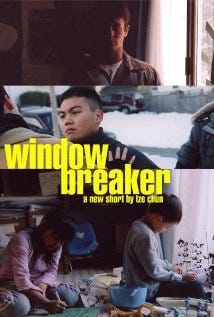
With Windowbreaker, I decided that I was going to shoot a movie over two weekends in my childhood home. My mom and some neighborhood kids were going to be in the movie, and we would shoot from a script that was just a bunch of one paragraph scene descriptions. I wasn’t going to write dialogue, it was going to be completely improvised. The lighting kit was fifty dollars or seventy dollars or something for each weekend. I just wanted to make something small and personal. I thought, because of how small the budget was, it was never going to do anything for me. But, it ended up playing at Sundance, and that was the first time anyone ever paid attention to me.
Scott: At IMDB Pro, the budget is listed at all of 600 dollars.
Chun: Yeah, that’s right. Most of the cost was Chinatown bus tickets from NYC and pizza lunches. The crew was me operating camera, my producer Bryan Wilson, who both operated boom and acted in the movie, and then my wife’s little sister who was in high school at the time and her best friend, who were our PAs. The only big ticket item was we had to rent two disco lights that we put on top of a car to make it look like a cop car.
After we got into Sundance though, our budget tripled [laughter]. We had shot the movie on MiniDV and had to spend twelve-hundred bucks to step the movie up to HD so they could project it.
Scott: It speaks to the value of DIY filmmaking right?
Chun: You know, to be honest with you, it was just so much fun to shoot because there was nothing at stake. I was completely relaxed. It was educational for me to know that sometimes the best work comes when you have the least to work with and keep things as simple as possible.
Here is Tze’s short film Windowbreaker:
Tomorrow in Part 2, Tze talks about how Windowbreaker served as the inspiration for his first full-length feature film Children of Invention.
Tze is represented by WME.
You may check out the Facebook page for Cold Comes the Night here.
Comment Archive