“True Detective” primer
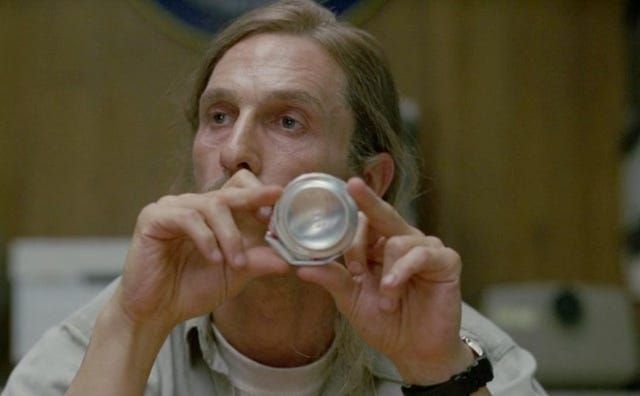
So I’ve caught the “True Detective” bug. Created and written by Nic Pizzolatto, starring Matthew McConaughey and Woody Harrelson, and directed by Cary Fukunaga, it is some eye-popping, dialogue-rich, mind-blowing, crazy-ass shit. As I’ve been chasing down every article and interview I could find on the HBO series, I thought I’d aggregate them into a sort of primer for readers.
SPOILER ALERT! DO NOT CLICK ‘MORE’ UNLESS YOU ARE PREPARED TO LEARN SOME KEY PLOT DEVELOPMENTS.
In this interview, Pizzolatto talks about the genesis of the series:
True Detective is a series which draws the viewer in with big names but the story and format are ultimately the star. How did you convince HBO to let you produce the eight-part series as essentially a single movie: One director, one plot per season?
It began around 2004 — when the Sopranos and The Wire and Deadwood were all on HBO. I was working on my graduate degree in writing prose and I began to feel that those shows were answering my need for fiction much better and with more vitality, then the contemporary novels I was reading. So, that kind of started this desire to do it but I didn’t understand how to break into movies and TV, so when my novel got optioned I asked my agents how to go about doing that and they said I needed to write scripts. In July of 2010 I wrote six scripts and one of them was the pilot for True Detective. I held onto it for about a year and a half and didn’t sell it until I knew we could make it the way I wanted and be able to attain the proper amount of creative control to make sure it turned out well.
How much of the series was completed before you sold it to HBO?
I wrote two episodes and started trying to put together a package. We looked at a lot of directors before we ended up going with Cary Fukunaga. The next step was casting Matthew [as the stoic loner detective Rust Cohle]. And immediately after we were able to cast Woody [as loose family man Detective Martin Hart] and then we took it out and pitched it. At that point we had a pretty complete package so that made sure we would be able to maintain a certain amount of control.
From this article in the Guardian:
A thriller unlike any other, True Detective is melancholic, dense with symbolism, and features astonishing performances from its leading duo, who play a pair of detectives searching for a possible serial killer. The show feels less like a standard TV procedural, and more like a crime novel come to vivid life. Pizzolatto switches the action between 1995, when his two detectives (blustery family man Harrelson, obsessive loner McConaughey) are investigating the ritualistic murder of a young runaway, and 2012, when those same detectives, now long since out of the force, are being interviewed in connection with a new death. The big question is: why have their lives fallen apart so dramatically? “I wanted to look at the relationship between these men and how it changed,” says Pizzolatto. “I wasn’t interested in doing what everyone else was doing. The point wasn’t to write another serial-killer show.”
From io9:
Two episodes into the series, True Detective dropped a reference to one of the strangest, most compelling tales in the canon of weird fiction: Robert W. Chambers’ The King in Yellow, a collection of short stories published in 1895. Knowing this book is key to understanding the dark mystery at the heart of this series.
The i09 article goes into some depth about the connection between the series and the book, so it is well worth the read.
If you go here, /film provides links to several HBO video featurettes like this one:
The /film article also provides a link to download the book “The King in Yellow”. [It was free on Monday, now you have to pay for it.]
Episode 5 is the one that is Pizzolatto’s favorite and after watching it, I can see why. Through the first four episodes, Cohle has demonstrated a propensity to wade into a particularly dark form of metaphysics, but only in short bursts of esoteric observations. In last week’s episode, he goes on a lengthy monologue that is both all exposition… and all fascination. In it, he presents a whole world view. Here is some of the dialogue:
“It’s like, in this universe, we process time linearly. Forward. But outside of our space-time, from what would be a fourth-dimensional perspective, time wouldn’t exist. And from that vantage, could we attain it, we’d see — “
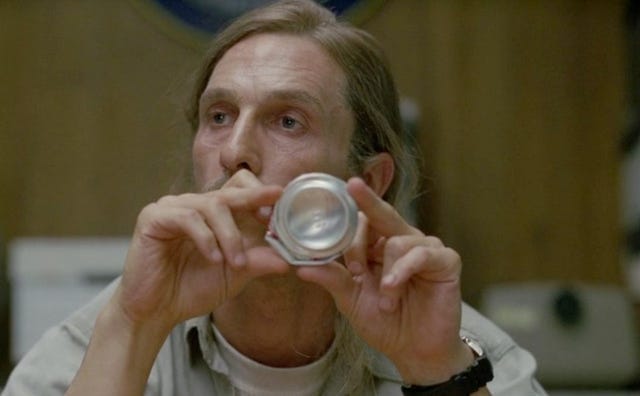
He crushes a can of Lone Star between his palms
— “our space-time look flattened, like a seamless sculpture. Matter in a super-position — ever place it ever occupied. Our sentience just cycling through our lives like carts on a track. See, everything outside our dimension — that’s eternity. Eternity looking down on us. Now, to us, it’s a sphere. But to them, it’s a circle.”
“This is a world where nothing is solved. Someone once told me time is a flat circle. Everything we’ve ever done or will do we’re gonna do over and over and over again.”
“So death created time to kill the things that time trapped in the endless ring of pain where there is no sound or vision only blackness.”
There are several articles dissecting Cohle’s words and potential meaning of the episode. Here are some of the key ones:
From the Daily Beast article, Pizzolatto explains Cohle’s metaphysics this way:
“Cohle describes the possibility of other dimensions existing, and he says that’s what eternity is,” Pizzolatto continued. “He says that if somehow you existed outside of time, you’d be able to see the whole of our dimension as one superstructure with matter superimposed at ever position it had ever occupied. He says that the nature of the universe is your consciousness, and it just keeps cycling along the same point in that superstructure: when you die, you’re reborn into yourself again, and you just keep living the same life over and over. He also explains that from a higher mathematical vantage point, our dimension would seem less dimensional. It would look flattened, almost.”
Pizzolatto took a bite of his branzino. “Now, think about all the things Cohle is talking about,” he said as he finished chewing. “Is he a man railing against an uncaring god? Or is he a character in a TV show railing against his audience? Aren’t we the creatures of that higher dimension? The creatures who can see the totality of his world? After all, we get to see all eight episodes of his life. On a flat screen. And we can watch him live that same life over and over again, the exact same way.”
For a guy like me who has been obsessed with theology, spirituality and the cosmos my entire conscious life, following that interest through a religious studies degree at UVA, then an M.Div. from Yale, I find all of this stuff utterly compelling… and a helluva lot of fun.
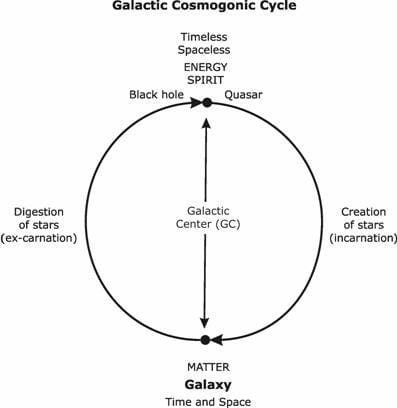
But there’s another way to look at a circle as a representation of one’s life-experience: The Cosmogonic Cycle. And that has many iterations such as these:
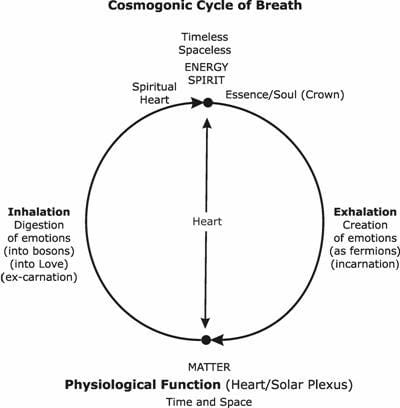
Leading to this:
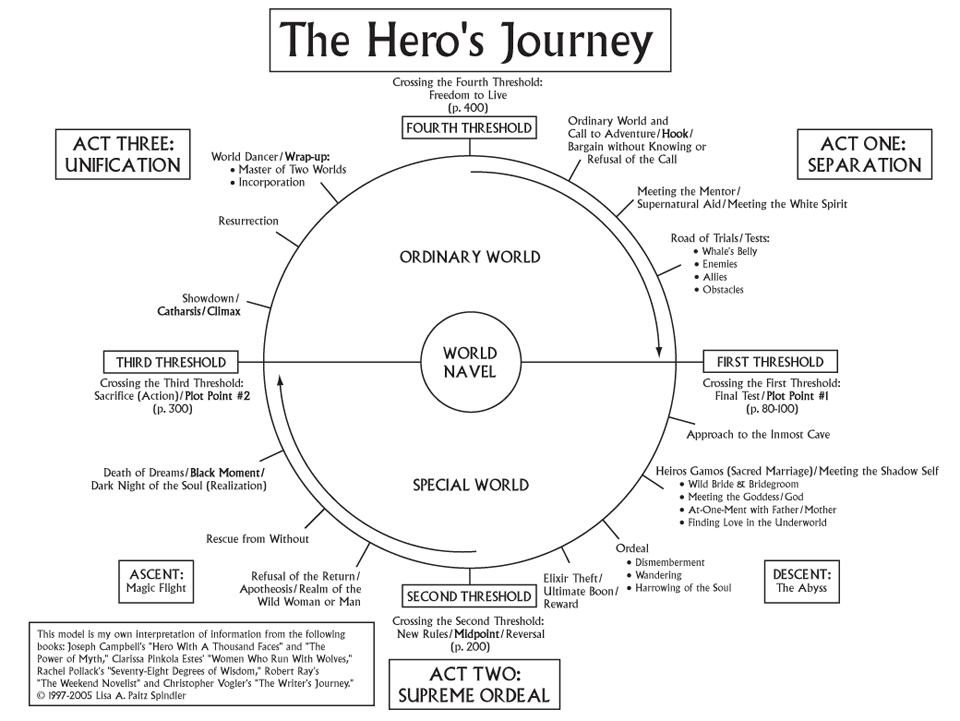
What is startling in comparison between reality as a circle as described by Cohle and the Cosmogonic Cycle as embraced by Joseph Campbell in The Hero’s Journey is they are diametrically opposed with regard to one key dynamic: Metamorphosis.
Cohle is arguing that we repeat the same cycle over and over, there is no such thing as change. By contrast, Campbell said the entire thematic point of The Hero’s Journey is metamorphosis (he uses the word transformation). The Hero starts out in the Ordinary World, accepts the Call To Adventure, goes through all sorts of trials and tribulations that test him/her, and through that process causes their True Self / Authentic Nature to emerge from within, so that when they return home, closing out the circle of their adventure, they are a transformed individual.
Two divergent views of life as a circle.
At the end of Episode 5 in “True Detective,” we are left with Cohle staring at this:

In the External World of the plot, it is likely a clue. But what is its symbolic meaning? Is Cohle staring into the abyss of a changeless cycle, humanity trapped in a never-ending horror show? Does the darkness in the center represent the black hole that exists in Cohle’s soul tied to tragedies that have or will occur in his life? What does he see here?
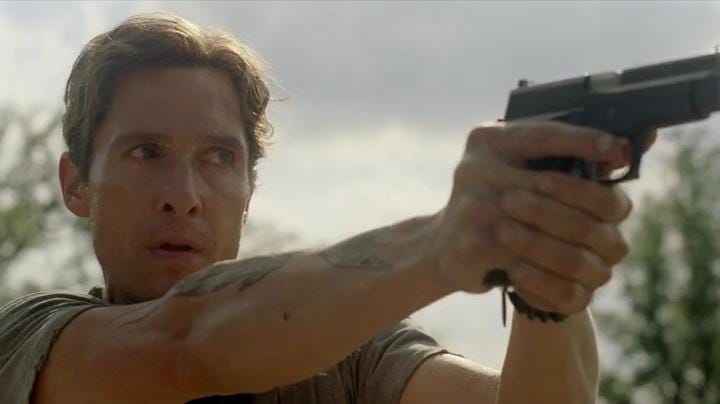
Finally there’s this. Here is a photo of Cohle from the past:
Here is a photo of Cohle in the present:
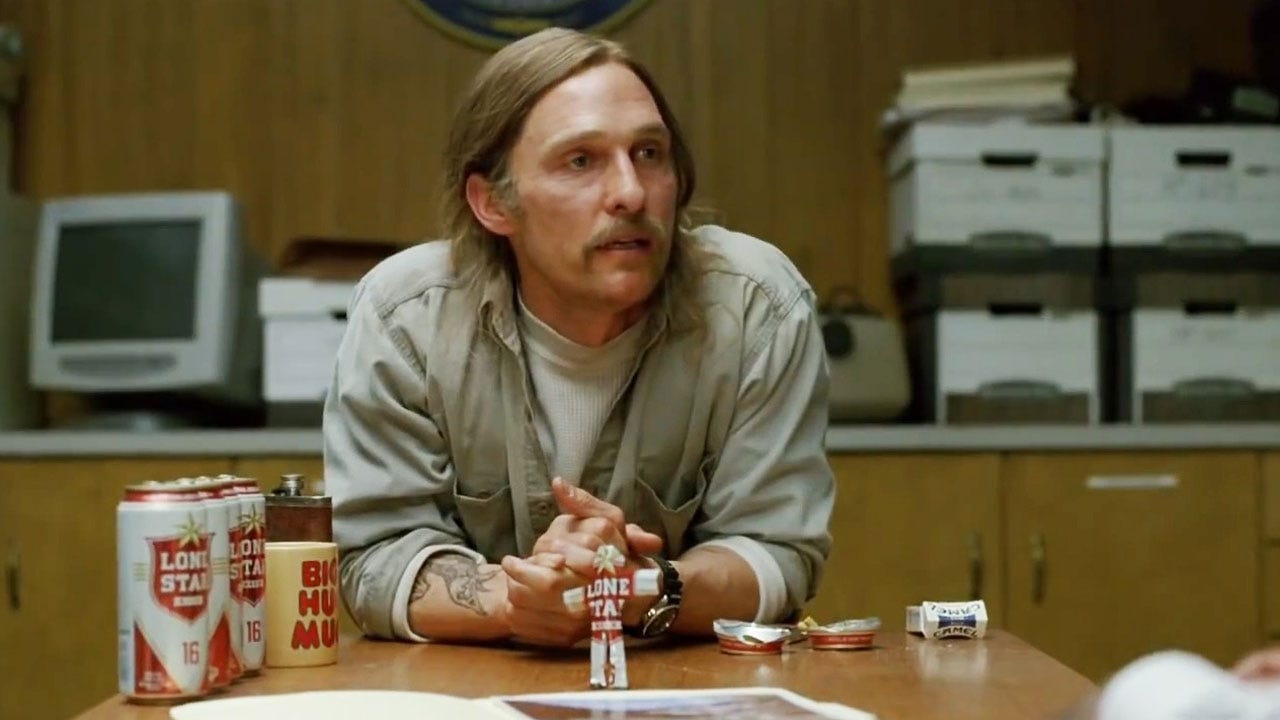
The simple fact is Cohle has changed. Yes, he’s gotten older, there is nothing that can stop the physical act of aging, nor is that necessarily a sign of an alteration within his psyche. On the other hand, it would at least appear Cohle has given into the ‘dark’ side of his personal metaphysics — smoking like a chimney, getting drunk on his days off — and he has spiraled downward. And while that may not be pleasant to see, it does represent metamorphosis.
Unless, of course, he is putting on an act…
I welcome your thoughts, observations, and questions about “True Detective.”
UPDATE: Vulture with a brand new article: Who is the Yellow King?
UPDATE #2: HT to mattgreiner for providing a link to this WSJ article: Writer Nic Pizzolatto on Thomas Ligotti and the Weird Secrets of ‘True Detective’. In it, Pizzolatto talks about another book, “The Conspiracy Against the Human Race” written by Thomas Ligotti. A quote from Pizzolatto:
When did you first hear of and read Ligotti?
I first heard of Ligotti maybe six years ago, when Laird Barron’s first collection alerted me to this whole world of new weird fiction that I hadn’t known existed. I started looking around for the best contemporary stuff to read, and in any discussion of that kind, the name “Ligotti” comes up first. I couldn’t find any of his books in print, and their used prices were prohibitive for me at the time. But I located a couple at libraries, and his nightmare lyricism was enthralling and visionary.
What work of his do you find the most influential? Are you more attracted to his fiction or his nonfictional writing? Have you read his nonfiction book, “The Conspiracy Against the Human Race”?
I read “The Conspiracy Against the Human Race” and found it incredibly powerful writing. For me as a reader, it was less impactful as philosophy than as one writer’s ultimate confessional: an absolute horror story, where the self is the monster. In episode one [of “True Detective”] there are two lines in particular (and it would have been nothing to re-word them) that were specifically phrased in such a way as to signal Ligotti admirers. Which, of course, you got.
The philosophy Cohle promotes in the show’s earliest episodes is a kind of anti-natalist nihilism, and in that regard all cats should be unbagged: “Confessions of an Antinatalist,” “Nihil Unbound,” “In the Dust of this Planet,” “Better to Have Never Been,” and lots of Cioran were all on the reading list. This is before I came out to Hollywood, but I knew that in my next work I would have a detective who was (or thought he was) a nihilist. I’d already been reading E.M. Cioran for years and consider him one of my all-time favorite and, oddly, most nourishing writers. As an aphorist, Cioran has no rivals other than perhaps Nietzsche, and many of his philosophies are echoed by Ligotti. But Ligotti is far more disturbing than Cioran, who is actually very funny. In exploring these philosophies, nobody I’ve read has expressed the idea of humanity as aberration more powerfully than Cioran and Ligotti.
If you have any other links of note re “True Detective,” please post in comments.
UPDATE #3: A great overview on the series from Grantland [HT to plinytheelder for the link].
And I found this About True Detective featurette put out by HBO which includes Pizzolatto on camera talking about the series:
Pizzolatto: “The fundamental idea behind the series is take the populist genre of investigative procedural and use it as an investigation into the human character.”
UPDATE #4: Go here for the “True Detective” title sequence… with cats [video].
AV Club: Beyond “True Detective”: 17 Long Takes Worth Your Attention
New Yorker: Cool Story, Bro: The shallow, cheap talk of “True Detective”
UPDATE #5: More articles as the series moves into Act Three (Episodes 7 and 8).
Indiewire: “True Detective” and the Horror of Folk Art
Vanity Fair: Who is The Yellow King?
Flavorwire: Is “True Detective” misogynist?
UPDATE #6: Entertainment Weekly interview with Pizzolatto in advance of Episode 7:
EW: Let’s cut to the chase. Should we suspect Rust or Marty of the murders they’ve been investigating?
NIC PIZZOLTTO: By episode 7, it’s clear if Cohle or Hart is guilty. I knew some of the audience would suspect Cohle strongly. I knew others would predict a more far-reaching, mind-bending game at work. I hope they are all surprised, but feel in hindsight that that the outcome was inevitable.
You’ve cultivated so much palpable dread that some are convinced that supernatural forces are at work.
Like Cthulhu is going to rise up and take control of the world of True Detective?
Ummm… is it?
I hope the audience will be pleasantly surprised by the naturalism of the entire story. If you look at the series so far, what seems supernatural actually has real-world causes, like Cohle’s hallucinations, or even the nature of the crime. It has occult portents, but there is nothing supernatural about it.
Read the rest of the interview here.
UPDATE #7: This is a good read from Slate: “A World in Which Nothing is Solved.” Thesis: “True Detective” is not really a whodunit. It’s an exploration of storytelling.
And this: “The Best of the Weirdest ‘True Detective’ Theories”.
UPDATE #8: Vulture with its overview and analysis of Episode 7.
Here is the very best video spoof of the series:
Rolling Stone: McConaughey Reveals the Four Stages of ‘True Detective’ Rustin Cohle
Esquire: True Detective’s Mystifying Kurt Vonnegut Connection
True Detective opening credits… done Law & Order style:
Finally a short story online: AN INHABITANT OF CARCOSA by Ambrose G. Bierce.
The final episode this Sunday.
UPDATE #9: Did you like the last episode of “The Killing”, Season 1? You know, the one where nothing got resolved? Neither did I. Guess who co-wrote that episode? Yep. Nick Pizzolatto. Make you worry about the last episode of Season 1 of “True Detective”? No need. TheWrap has this article in which Pizzolatto says point blank: “…one of the reasons I wanted to do an anthology format is I like stories with endings.”
Comment Archive