Interview [Part 2]: Lisa Joy
![Interview [Part 2]: Lisa Joy](https://storage.ghost.io/c/8f/29/8f29b0a7-49e5-431c-a9bb-3ade9c0a785e/content/images/size/w2000/2026/08/0_AIeG5rp0M5geceWB.jpg)
“Scott, you are the only screenwriting teacher I’ve ever had.” This is what Lisa Joy shared with me when we had dinner together in L.A. last fall to celebrate the recent sale of her spec script “Reminiscence” which Legendary Pictures acquired in a deal worth a reported $1.75M. In addition to her screenwriting, Lisa has been on staff and written for TV (“Pushing Daisies,” “Burn Notice”), created a graphic novel “Athena” which has been developed for TV, and co-wrote the pilot with her husband Jonathan Nolan for a TV series adaptation of the classic 1973 science fiction movie Westworld for HBO in association with J.J. Abrams and Bad Robot, and producer Jerry Weintraub.
I was thrilled when Lisa agreed to an interview, not only because of the mark she is making in Hollywood, but also because she is a genuine human being: smart and insightful, but also grounded and generous in spirit. Yes, there are people like that in Hollywood… and Lisa is one of them.
In Part 2, Lisa describes how she broke into Hollywood as a writer and the personal risk she took in making that plunge:
Scott: So you dip your toe into writing, but then you go to Harvard Law School, right?
Lisa: Yeah. I’m basically the most risk averse person that has ever lived in the universe.
Scott: While you’re there, I get this email from you with this script you’d written. I’m thinking, “Lisa’s at Harvard Law School, yet she’s finding time to write this screenplay?”
Lisa: Right.
Scott: How in the world did you find the time to do that?
Lisa: It was the same thing as when I was working in Universal and working in consulting, I had to have a little thing to myself because it was just how I had fun. Other people jog or do yoga or hang out in their free time. I wrote. It didn’t feel like work. Although writer’s block is truly always horrible, no matter what.
As for the script itself, I co-wrote it with a friend, Suzanne Wrubel. It was lampooning some of the more ridiculous aspects of getting an education at Harvard. In some ways, it was a way of surviving law school. I think I wrote two scripts there. I also wrote a legal procedural TV pilot for a class I took with Scott Turow.
Scott: The Scott Turow?
Lisa: Yes. Now let me be clear. This was hilarious. I took a class with Scott Turow. It was a tutorial, which basically means that it’s one on one and you write a paper and they give you a grade.
I never once spoke to you or heard from Scott Turow. There are basically two emails documenting our relationship. The first was me asking him if I could write a script for him as a tutorial kind of thing.
He said, “Well, I suppose so.” Then I sent him the script. Then eventually, I got a grade for the class, but that was the entire tutorial. It was like three points of contact and all of them somewhat unilateral.
Scott: If I’m a hands-on teacher, he’s a hands-off teacher.
Lisa: Yes, he’s a hands-off teacher. I think he was like, “What is this person doing? She should be studying for torts or something much more important than this.” But he did humor me, and I believe I did get class credit for it.
Scott: We were having conversations during this time, too, because eventually, you get a job in a corporate law environment.
Lisa: Yeah.
Scott: Yet you’re writing these scripts. So you’ve got this fork-in-the-road here. How did you end up making the choice, “I’ve got to go for the writing?”
Lisa: To me, I really never thought that it was possible I would become a working writer. It’s truly, if you told me I was going to become an astronaut who colonized Mars, that would be about the equivalent feasibility for me.
Maybe it’s because I’m first generation American. Neither of my parents are from this country. It’s not the career path that a lot of immigrant families believe their child will have. The focus was on something more stable like medicine or law, or at least in my family it was. I don’t know. Other immigrant families may be different.
But in my family, it was like they struggled very hard to have their tiny piece of the American dream. All they wanted for me was to be secure. Literally, to have health insurance and a job that paid enough to get a house one day.
Anything else, like artistic ambitions just seemed very out there. That was somebody else’s game, you know? That was something that was out of the realm of how we were thinking and I was taught to think.
Even when I was writing screenplays, I always just figured it would be for myself. I actually had all these plans to record my own scripts and, I don’t know, play them at family gatherings or something.
As for my first break, I have one of these crazy stories where I owe a lot to my friends for having this happen, but by the time I finally felt ready to show a script to anyone in terms of asking for a job…What happened was the consulting company I used to work for had paid for me to attend Harvard. That was the only way in which I could have afforded to go.
In return for them sending me to Harvard, it’s like indentured servitude. I was supposed to come back and work two years for them so that my loan would be forgiven. That was my plan after graduating from law school.
But first I want to pass the bar and all that stuff. While I’m studying for the bar, I kind of freaked out and thought, “Well, this is the rest of my life. I can see it happening. It’s unfolding in front of me.” I passed the bar exam and then I go back to this consulting firm. I buy a lot of suits, and I go to work every day, and I travel quite a bit. If I’m lucky, I have time to write evenings and weekends.
And something about that vision of my future just terrified me because I didn’t think that it would necessarily fulfill me. So I started to write a spec script with the full force of all of my existential fear behind, compelling me forward to write. I’m studying for the bar during the day and then at night I’m writing a spec script.
I’m thinking, “I can’t be a coward on this. I have to send this one out. I’m going to send it to some friends I have who work in the entertainment business, and see if I can get any job whatsoever.”
I ended up writing a “Veronica Mars” episode and I showed it to my friend Michael Green, who’s a screenwriter. I said, “Do you think maybe I could get a job as an assistant on the show?” Or, something like that. He said, “Maybe. Let me read the script and see.”
He passed it along to Bryan Fuller. Literally, within a week… I had actually just started a project in San Francisco, consulting for a high tech company, and I was working with a client… I get this phone call and it is, basically, I’m hearing from, “Pushing Daisies,” and they’re saying, “You got the job.”
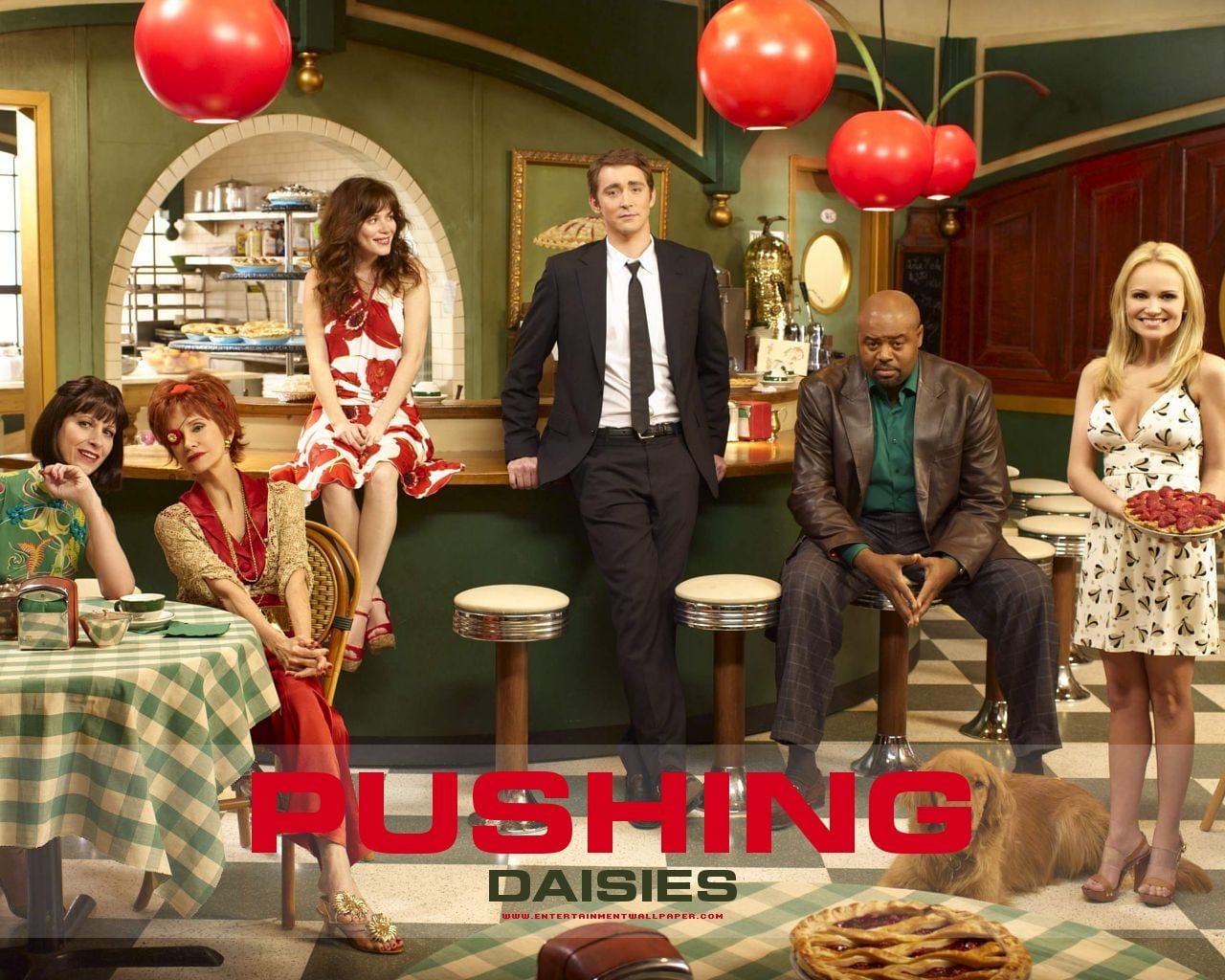
It was the only script I’d ever really written, and finished, and sent out and I got the job. It was completely insane. I remember thinking, “OK, that sounds great. I’m going to wrap up this study. It should take a few weeks and then I’ll quit my consulting company.” They said, “No, no, no, no. You start tomorrow.”
It was this surreal thing where I had to walk out of this board meeting and say, “I have to take a flight back to LA, and furthermore I have to quit this job.” It was at once the most irresponsible thing I’ve ever done, but it was the pursuit of a dream that was so dear to me that it truly was a no‑brainer to me.
It was crazy because I had to pay back all my student loans in one fell swoop which involved some begging and borrowing. But it was one of those things where I just knew that I loved writing, if I got the chance to do it, I just didn’t really question it.
It was such a rare chance to work on something I loved, to work with Bryan Fuller, who I was a huge fan of, and to get a taste of the dream. I knew that even if nothing came of it, I would never regret giving it a shot. I was willing to work as an assistant, so to get a job directly working on staff as a writer, was beyond anything I could have hoped for. I took a leap of faith.
Scott: I want to talk to you about, “Pushing Daisies,” a bit. But I’m sitting here listening to this, Lisa, and it’s utterly astonishing. You had an interest in poetry. You had very little exposure to TV or movies because of your upbringing. You took a couple of classes with me, and I think that’s probably the extent of your formal education in screenwriting.
The rest of it is just your passion, your talent and you were obviously working hard because you were writing these things while doing everything else including law school. When you look back, does it feel like that was destiny at work?
Lisa: It certainly didn’t have to happen in any way. I think that having success in terms of being able to make a living as a writer, I would love to say that it’s all just talent, but I think it’s a lot of other things besides that. First and foremost, it’s extremely hard work and the ability to take rejection, and to take adversity and to just keep writing.
For me that was really easy because the thing that I always did when I felt rejected, or put down, or sad, or confused is — I always retreated to writing anyway. It was my safe place to go. So in some ways it fueled itself.
The odds of making it as a screenwriter always seem daunting… If you took every single person that said, “I want to be a writer,” in Hollywood, everybody who ever said that, then the percentage of people who actually make it in terms of actually being a working writer would be extraordinarily small.
But then, if you took the percentage of people who said, “I want to be a writer,” and wrote something, then the percentage gets a little higher of people who are successful. Then if you take the percentage of people who say, “I want to be a writer,” and wrote several things, and kept on refining them and kept on working at them, then the percentage gets higher yet.
By the time you get to, and this is the last step and the step that took me the longest, the time you find a person who said, “I want to be a writer,” and then writes several things and then actually submits those things to people, and bothers their friends and such, and sends them out to agents — then the odds don’t look so bad.
I was willing to work as an assistant. I was willing to proofread anything any friend ever gave me just because I love reading, and some of those friends happened to be screenwriters themselves, and some of them happened not to be screenwriters at the time, but they ended up becoming them anyway by the same kind of sheer willpower and passion.
I would say it wasn’t destined, but it is something that I love and it’s something that I try to work at, and I’m lucky that I’m able to do something I feel so passionately about.
When I first sold the script, my future script, “Reminiscence,” I remember that day just being incredibly grateful for all the people who had given me a chance at making it in such a difficult industry. I called them all up, or I wrote them all, including you, to thank them because it wouldn’t have been possible without them.
I remember I told Michael Green, who was the first person to pass along my resume to Bryan Fuller who gave me my first job and I told him, “Without you I never would have been a writer.”
He pointed out, “That’s not true. You were always going to be a writer. You couldn’t stop writing. No one was reading what you were writing, but you were always writing, and now you have something to show for it.”
But I did feel even before any of that happened, I did feel that for me writing was its own reward. It’s something I would have done for my own private joy regardless of the reception. I think I would have continued to do it that way. Is that destiny or is it just obsession?
Tomorrow in Part 3, Lisa shares some key things she learned about writing from her experiences working on two TV series, and background on her new HBO series “Westworld” as well as “Reminiscence,” the spec script she wrote which sold to Legendary Pictures.
For Part 1, go here.
Lisa is repped by UTA.
Please feel free to stop by comments with any questions you may have. Lisa has kindly agreed to answer some of them. I’ll pass along the best of the bunch.
Comment Archive