Interview: Stephanie Shannon (2013 Nicholl Winner, 2013 Black List) — Part 3
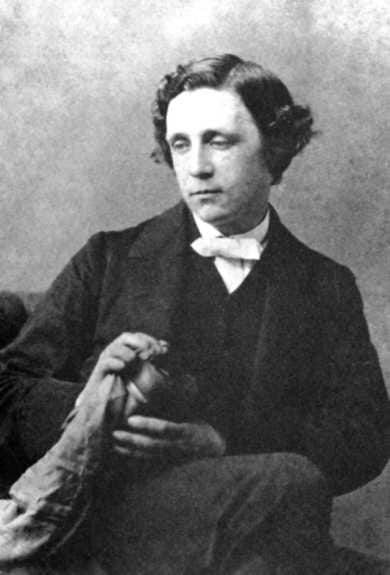
Stephanie Shannon not only is one of five recipients of the 2013 Academy Nicholl Fellowships in Screenwriting, she did it with her very first full-length screenplay: “Queen of Hearts.” Beyond that, the script landed on the 2013 Black List. Therefore I was pleased to have the opportunity to talk with Stephanie about her background, the script and her take on the craft as she has developed as a writer.
Today in Part 3, Stephanie reveals what inspired her to write “Queen of Hearts” and how she worked with the story’s Protagonist Charles Dodgson a.k.a. Lewis Carroll:
Scott: Let’s talk about your script, “Queen of Hearts.” Here’s the logline. “Inspired by true events. This is a story of ‘Alice in Wonderland’ and ‘Through the Looking Glass’ author, Lewis Carroll, AKA Charles L. Dodgson, and his relationship with the real Alice Liddell and her family may have inspired one of the world’s most beloved pieces of children’s literature.” Let’s start right at the beginning. What was the inspiration for this story?
Stephanie: I’ve always been a big Anglophile from a very young age. My whole family is from Texas. I grew up in Dallas, so there’s no reason for me to be so obsessed with England, but I was. My mom and I had never been out of the country. We had never traveled, but as a gift to me, I guess it was eighth grade graduation, she and I went on a mother-daughter trip to England.
We went to Oxford, which is one of the places I had always wanted to see. I just fell in love with it. While I was there, a groundskeeper showed me where the graves of Alice’s sisters were. It was the first time that I knew that they were real people, that the story was based on a real girl. I just thought that was such a cool story. When I went to film school, I did a study abroad program in Prague where I had to direct a 35 millimeter short, and I decided to make that the subject of my short. The short was about Lewis Carroll attending a tea party in the dean’s garden, and it turns into the mad tea party. I thought it would be really interesting to make that into a feature. The more research I did, I found so many interesting paths through the story. One of the things that really fascinated me was that Charles’ diary has all these gaps in it where people have razored out certain sections, but no one really knows who did it.
There was this mysterious break in his relationship with the family. No one really knows what happened. I read a theory that he was having an affair with her mother. I thought that was such a cool idea, so I took that and ran with it.
Scott: I would like for you to describe, if you could, real briefly in a couple lines or whatever, each of the key characters in terms of the personality and maybe in terms of what their function is in the story. Charles Dodgson, a.k.a. Lewis Carroll, how do you think about that character in terms of the story?
Stephanie: If you read about him historically, a lot of people think he was shy, had a stutter, could only talk in the company of children. I wanted to make him a little bit more confident, a likable, approachable person. I think he’s a really interesting contradiction, because he was a mathematics professor. His whole professional life was centered around his love of logic and math, and yet he created the first example of nonsense literature.
He really pioneered a new form of children’s literature that embraced the nonsensical and just the complete opposite of what you would think a mathematics professor would come up with. In a different way, it makes perfect sense, because he was so great at puzzles and word play.
His mind worked in such a fascinatingly different way, that the fact that this great piece of literature came out of this reserved mathematician’s mind is really cool to me. I just wanted to explore who that character was and what would have motivated him to have that burst of creative genius.
Scott: I was struck by that too, because I did some research in reading your script. He did have this seemingly bifurcated thing going on. There’s the professional academic life in terms of teaching math and logic. Yet, like you say, the stories, he was the progenitor of this whole idea of nonsense literature.
It sounds like the point of connection you made there is that he liked puzzles. He was good at that sort of thing, and then that was kind of a common ground between those two aspects of his personality?
Stephanie: Yeah, I’d like to think that, at least in my story, that he always, inside of him, was more creative and spontaneous and special than he or his Victorian society allowed him to be on the outside. The Alice books are a way for him to, through what he was already doing professionally, which was math, was a way for him to express that side of himself that otherwise people wouldn’t have understood.
The society he was in was this very rigid, structured, Victorian society with all these expectations. Imagination, especially in children, wasn’t necessarily encouraged as much as it is today. A lot of that is thanks to him.
It was like this amazing, nonsensical, magical world of Alice was always inside him, but it required a combination of falling in love and breaking free of his expectations and allowing himself to be who he really was to let it truly come to fruition.
I think there’s something of that in everybody. Like with me, I wanted to be a writer, but I thought it wasn’t practical. But, turns out it was something I could do. If you really embrace who you are, these amazing, wonderful things can happen. For him, he wrote this amazing piece of literature. For me, I was able to write a script that opened a lot of doors. I think everyone has that potential if they’re willing to let go of fear and expectation and tap into that part of themselves.
Tomorrow in Part 4, Stephanie delves more deeply into “Queen of Hearts,” examining the relationship between Dodgson and two females: A mother named Lornia and a young daughter named Alice.
For Part 1, go here.
Part 2, here.
Please stop by comments to thank Stephanie for her time and ask any questions you may have.
Stephanie is repped by CAA and Brillstein Entertainment Partners.
Twitter: @stephshanz.
Comment Archive