Interview: Lindsay Devlin (“Devil’s Due”) — Part 2
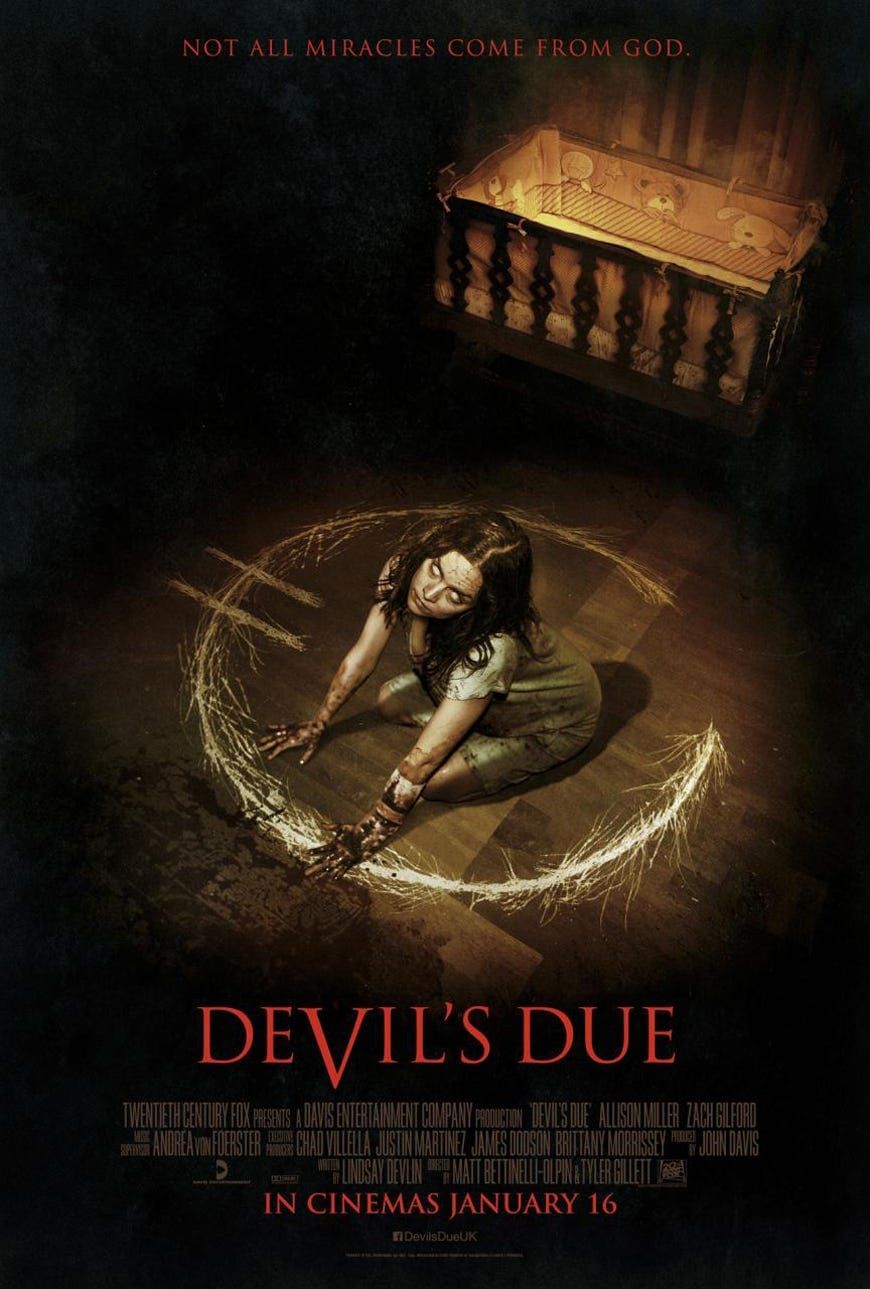
January has turned out to be a reliable month for Hollywood with regard to one genre in particular: Horror. This year was no different when Twentieth Century Fox released Devil’s Due, a movie that thus far has brought in over four times its production budget in box office revenues.
The movie’s success is one reason I was excited to interview its screenwriter Lindsay Devlin. Another reason is her extensive background working in Hollywood on the story development side of things.
Lindsay and I had a terrific conversation, and I’m pleased to share her many insights into the craft of screenwriting and the movie business, along with her creative process with the film Devil’s Due.
Today in Part 2, Lindsay digs into some of the key story dynamics at work in Devil’s Due and shares some thoughts about how the two lead characters, Samantha and Zach, came into being:
Scott: Let’s talk about Devil’s Due. Here’s a plot summary provided by 20th Century Fox:
“After a mysterious last night on their honeymoon, a newlywed couple finds themselves dealing with an earlier than planned pregnancy while recording everything for posterity, the husband begins to notice odd behavior in his wife that they initially write off to nerves. As the months pass, it becomes evident that the dark changes to her body and mind have a much more sinister origin.”
First off, are you a big fan of horror and psychological thrillers?
Lindsay: I would say, psychological thrillers and supernatural dramas. I’ve never been a huge fan of what I would call “straight horror”, the more slasher/gore kind of horror. I think when I was younger, and going to slumber parties, and wanted to be scared out of my mind, I liked those, but less so now.
But I’ve always been drawn to the more psychological, atmospheric supernatural.
Scott: What was the inspiration? You talk about the kernel of those ideas that you would look for when you worked at the creative group at CAA. What was the kernel here that inspired you to write Devil’s Due?
Lindsay: It was a dream I had, about a year and a half ago. I had a nightmare that I was pregnant and that it turned out to be something had possessed the baby. It was a very, just terrifying and visceral dream. I had just gotten married at the time, we were just starting to think about starting a family.
A lot of my friends were pregnant or just had babies and were sort of confessing the stuff that nobody tells you about. That you’re not always glowing, you’re not always happy, it can be very scary and your body goes through crazy things. Your relationship goes through crazy things.
I think that sort of all swirling around plus the dream, started me thinking about how we really hadn’t seen a movie about the terrors of pregnancy since “Rosemary’s Baby”, which is almost 50 years ago now. Modern day couples deal with pregnancies so much different than they did in the ‘60s.
The men, the fathers are so much more present. And with technology, they’re always chronicling things. People on Facebook post their ultrasound pictures. It’s a very public thing these days. Yet I still felt like people weren’t talking about the fears. I think, I approached it as an allegory to the fears that the couples go through.
Scott: As I was reading the script, I thought it was such a great arena to work with. First of all, from a writing standpoint, you’ve got the actual progress of the pregnancy which acts like a ticking clock. You’re building to a big ending, you know where you’re going which is the delivery. How conscious were you about that aspect of the story’s potential featuring pregnancy?
Lindsay: It was an evolution, because my very first instinct based on my dream was to actually start mid‑pregnancy with the couple. My very first pitch that I initially sold was about a couple who was already a few months into the pregnancy and went away on a “baby‑moon”, and felt like something possessed the baby while they were gone. Then you pick up mid‑pregnancy on.
Through discussions with the producer and with the directors, we realized it’s better to start from the couple getting married to really see where they start, and then follow them all the way through with that absolutely major ticking clock and the deterioration psychologically of the mother and the father. We all were certainly very conscious of it as a story device, and as you said a natural ticking clock.
It was a challenge to not make it feel too episodic because you’re checking in with them as the time progresses, through seasons and as the pregnancy progresses. But, I think with found footage, you have that advantage of people kind of chronicling on and off. There certainly were challenges with it, but it was a fun challenge to do that.
Scott: Another aspect about pregnancy is if you look at a target audience of teens and young adults, they pretty much, if they’re single, live with the shadow of fear that at any time they get involved in sexual activity with a partner, there’s that question looming in the back of their minds: What if I or she gets pregnant?
So, in a way, beyond just sort of the allegory of couples or couples actually wanting to have children, isn’t that fear of pregnancy at work here, too?
Lindsay: Absolutely. We would always joke that this would be really good birth control for young people. I saw a lot of Tweets from the 16 or 17 year old set who saw the film saying “I will never get pregnant, ever.” {laughs} We might have done our job. I don’t know if you saw part of the marketing that Fox did was they had condoms with Devil’s Due on them.
Scott: I didn’t know that, but I saw the baby in the stroller thing, that was amazing. [Note: Over 44 million views on YouTube].
http://www.youtube.com/watch?v=PUKMUZ4tlJg
Lindsay: They also had Devil’s Due condoms that they passed out at sporting events. Hilarious.
So yes, I think you’re right that it taps into several different aspects of fear of pregnancy, whether you want to go through it but are still scared of how to get through it, versus what if I’m not ready to get someone pregnant, or accidentally get pregnant.
I think pregnancy is kind of an interesting, terrifying thing for a lot of people. A lot of ages, and both sexes. In Rosemary’s Baby, it was truly her point of view, and was sort of the terror she goes through. We liked the idea of giving equal weight to the couple, both having their own fears and experiences through this.
Scott: Let’s talk about the couple. You’ve got Samantha, who’s played by Allison Miller, and Zach, played by Zach Gilford. How would you describe each of them at the beginning of the story? What is it about them as individuals and a couple you made it interesting for you to work with them as characters?
Lindsay: My initial idea for Samantha, which pretty much stayed as it is in the finished film, was the idea of a girl who didn’t have a family, who grew up bouncing around foster care. The idea of motherhood is very foreign and very scary to her. We played around with different iterations of that, and I think it works for her character.
I also liked playing into the more modern idea that a lot of women these days are very trepidatious about pregnancy and don’t feel prepared, especially because many are waiting longer and having careers and their own lives.
And then someone like Zach, who’s the polar opposite. He has a super close‑knit, happy, loving family who chronicled everything. He has all these pictures and videos of his childhood. She’s got nothing. We really liked the contrast and dichotomy of those two characters. As a writer, I really liked having those portraits to start from.
Then, over time, you see Samantha warm to the idea of becoming a mother and think, “OK, I finally get to have the family I never had.”
You root for that. Then it’s this tragic breakdown of seeing that her fears do come full circle. And Zach just really trying, I wouldn’t say he changes so much in terms of his point of view of being a father, he really just tries to keep them together. His paranoia is the big thing that kicks in at the mid‑point.
We talked a lot about the idea that he, at first, doubts his wife’s sanity and he thinks it’s just the pregnancy, the hormones, the typical strange pregnancy behavior. Then it switches to, “Oh God, something’s really wrong with my wife,” and then the full blown, by the end, knowledge that there really, truly is something going on and it’s bigger than he can even handle.
There was a lot of territory to play with, we thought.
For Part 1 of the interview, go here.
Tomorrow in Part 3, Lindsay talks about the challenge every screenwriter faces: How to wrangle Act Two, the middle of the story and the rationale behind the found footage aspect of Devil’s Due.
Lindsay is repped by UTA and Mosaic.
Twitter: @DevlinLindsay.
Comment Archive