Classic 90s Movie: “Leon: The Professional”

May is Classic 90s Movie month. Today’s guest post comes from Chris Neumann.
Movie Title: Leon: The Professional or Leon (Europe), The Professional (USA)
Year: 1994
Writers: Luc Besson
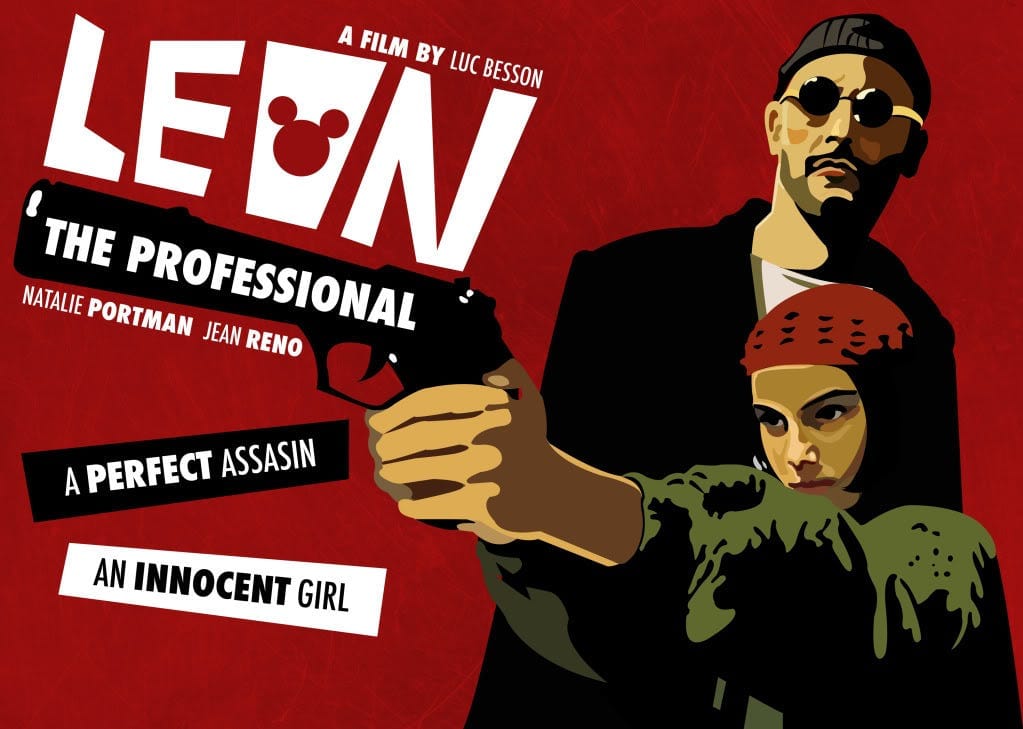
Lead Actors: Jean Reno, Gary Oldman, Natalie Portman, Danny Aiello
Director: Luc Besson
IMDB Plot Summary: A professional assassin rescues a young girl whose family were killed in a police raid.
Why I Think This Is A Classic 90s Movie: Was this a monster hit when it came out? A phenomenon? If it was, I don’t remember it.
Unlike Jurassic Park, or Titanic, or The Matrix, I don’t think people have a common memory of Leon, it’s one of those that we all sort of discovered at different times, most likely on pan-and-scan VHS tapes or on TV. And the DVD version (which re-integrated footage and the whole romantic subplot which was cut from the theatrical cut) didn’t come out until the early 2000s, so I’m not sure how much this flick actually qualifies as a “90s flick.”
“Leon” definitely belongs in the 90s, it takes the staples that got big in the 90s: low-budget crime/action movies with an attitude, usually in a confined location, and gave the whole thing a stylish, European, bande desinee-inspired twist that made it stand out of the crowd. And it’s a classic because you can’t deny the impact this movie had: we wouldn’t have Hit Girl without Natalie Portman as an assassin-in-training (which itself was a step up from John Conner handling guns in Terminator 2), the anime and upcoming live-action adaptation of “Kite” draws inspiration from Leon, and the influence continues to trickle up, from characters in other properties sharing names to Sgt Angel’s Japanese Peace Lily in “Hot Fuzz.”
The story does a great job of avoiding the “big” stuff in favor of the smaller, more intimate story. We don’t delve into what the whole of the Italian mafia is doing in the film, or about how wide Stansfeld’s drug empire goes, his motivations… all the movie focuses on is Leon and Mathilda. It’s a relationship story with action sequences, and even those are more small-scale and intimate, until the destructive finale. I remember the VHS tape saying this flick “makes Speed look like a ride to grandma’s house,” but the movie isn’t balls-to-the-wall action, it’s teeth-grindingly intense instead. Whether the characters are lying to get into a hotel or hiding from the mobsters on the other side of a wooden door, there’s this uneasy feeling that they could get discovered at any moment, and that the world can come crashing down on them. And knowing all the weapons Leon has at his disposal, we know they’ll go out with a bang and a bloody mess. A killer doesn’t live at the end of a movie. We know, instinctively, that the relationship between Leon and Mathilda, regardless of how fiercely it’s protected, will be broken, we’re anticipating that the whole way through. Especially as the movie goes on: we see Leon at the start as a cold, efficient assassin, but his friendship with Mathilda starts to thaw him out, he becomes happy, he starts thinking about the future, filling out his missing pieces (“I know how to read now”), he basically comes to life. You can only die when you’re alive.
Eric Serra’s score throughout the film creates this fascinating mood, it’s almost otherworldly, which is perfect for a melting pot like New York. Instead of the urban/rap/whatever that we’d usually hear in a movie set in New York in the 90s, we’re hearing flutes, tortured strings, anything in Serra’s toolbox to pull us into this world. Heck, Bjork is in the soundtrack for this flick!
My Favorite Moment In The Movie: There are so many to choose from.
Seeing Leon watch Gene Kelly roller skate around in the movie theater, that look of just pure childlike joy on his face. It’s a scene that doesn’t seem to pay off in a practical way, and it can’t have been more than a quarter of a page on the script, but it says volumes about just how innocent his character is. Apparently, Luc Besson would keep telling Jean Reno “you are FOURTEEN years old” when Reno wasn’t sure how to play a scene, but while the actor had to be told this, the audience just needed to see this moment, and we knew.
My Favorite Dialogue In the Movie:
Leon: Mathilda, don’t ever do anything like that again or I’mm break your head. You got that?
Mathilda: Okay.
Leon: I don’t work like that. It’s not professional. There is rules.
Mathilda: Okay.
Leon: AND STOP SAYING “OKAY” ALL THE TIME, OKAY?
Mathilda: Okay.
Leon: Good.
I’ve noticed, and this might not have been intentional, but the actors’ speech patterns enhance their dialogue. Leon doesn’t speak perfect english, so everything he says is more succinct and direct. It demands attention. Natalie Portman speaks with this monotone, which makes everything she says sound more mature, disaffected, and mysterious, almost like an old school femme fatale.
Key Things You Should Look For When Watching This Movie: You may not catch it, but while the exteriors were all shot in New York, the interiors were all shot in France.
There are a couple matching shots between this movie and Besson’s next film, “The Fifth Element.” The opening shot tracking over the water matches the shot of the asteroid field in “Element” (as well as the gravel road in the beginning of “La Femme Nikita.”) Leeloo in “Fifth Element” pretty much mimics Mathilda’s plea for help in Leon’s peephole. Besson’s fiancee at the time, Maiwenn, plays the young hooker at the start of “Leon” and the blue opera singer in “Element.”
You might also catch that the fake name that they check into the hotel with is “Mr MacGuffin.”
Thanks, Chris! To show our gratitude for your guest post, here’s a dash of creative juju for you. Whoosh!
We already have a set of 80s Movies. This month we cover 90s movies. So thanks to all of you for your participation in this project, creating a resource for writers, movies they should watch to help learn the craft of screenwriting!
Comment Archive