Classic 90s Movie: “Wag the Dog”
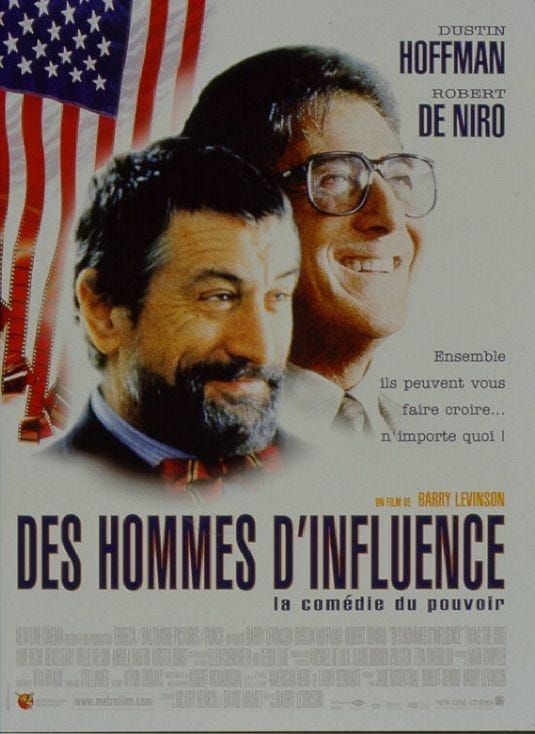
May is Classic 90s Movie month. Today’s guest post comes from Paul Graunke.
Movie Title: Wag the Dog
Year: 1997.
Writers: Hilary Henkin, David Mamet based upon the book “American Hero” by Larry Beinhart
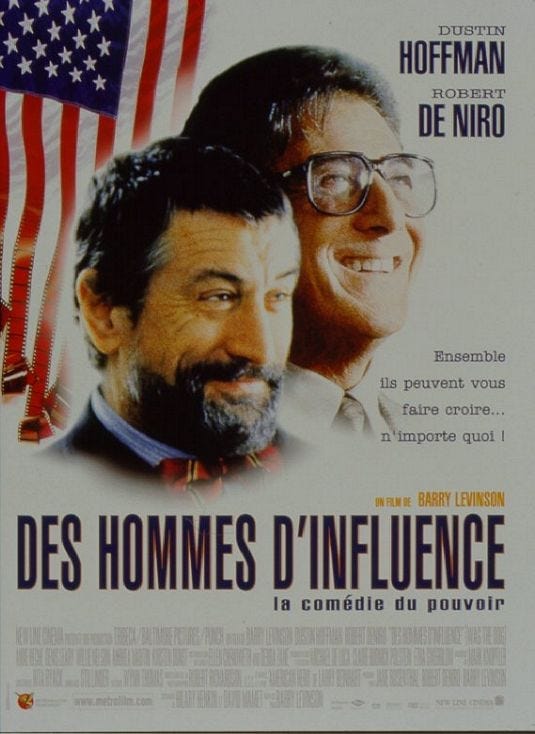
Lead Actors: Dustin Hoffman, Robert De Niro, Anne Heche.
Director: Barry Levinson.
Plot Summary: Days before a Presidential election, a Washington spin doctor enlists a Hollywood producer to produce a phony military crisis in order to distract the media and the public from a presidential sex scandal.
Why I Think This Is a Classic 90’s Movie: This is one the great satires of American politics, the tale of a clandestine and duplicitous affair between politics and show business. Timing is everything in show biz: the movie benefited by coming out just as the Monica Lewinsky scandal, then President Clinton’s affair with an intern, broke in the press. But the movie is still relevant because it shows how the modern political process in the United States has been corrupted through exploitation of electronic media. It takes to a delightfully wicked extreme the notion that political spin doctors can facilely manipulate the media and whip up patriotic frenzy on cue using the same techniques Madison Avenue uses to sell soap and Hollywood uses to sell movies.
My Favorite Moment In The Movie: The scene in the movie studio where they cut and paste a completely bogus “news report” of an “Albanian” girl (played by Kristen Dunst) fleeing while her village is under attack by terrorists. Everything in the “news story” is a fraud, an illusion. And, of course, the press and the public buy it completely.
My Favorite Dialogue In the Movie: The exchange at the end of the movie between the Hollywood producer, Stanley Motss, and the Washington spin doctor, Conrad Brean. Stanley succumbs to his fatal flaw, his hunger for recognition, the producing credit.
STANLEY: It’s tempting, but I gotta answer to a higher calling. Art. Money? You think I did this for money. I did this for credit.
CONRAD: But you knew you always couldn’t take the credit.
STANLEY: I’m not going to stand there and let two dickheads from film school take it.
CONRAD: Listen to me?
STANLEY: Are you nuts?
CONRAD: Stanley, no fooling. You’re playing with your life, now.
STANLEY: Fuck my life, I want the credit. The credit. Do you know what the New York Times said about my last picture? They called it ‘a thrill ride for the ages’ but they didn’t mention the producer. They talked about the costumes but they never talked about the producer. You know what that picture grossed? Now I’m going to stand here and let some limp-dick film-school pansy take the credit?
CONRAD: You can’t do it.
STANLEY: Don’t tell me that! Don’t you ever tell me that! I am the producer of this show! If I didn’t step up you’re nowhere. I put this together out of spit and polish! Look at that. It is a complete fucking fraud and it looks 100% real. It’s the best work I’ve ever done in my life. Because it’s so honest. (Pause) They told me I couldn’t remake Moby Dick from the point of view of the whale — $450 million domestic. I’m not even talking about the video. I made this lame turkey fly. I did it — pure Hollywood. For once in my life I will not be pissed on. Do you hear me? I want the credit. I want the credit. I’m taking it. Good bye.
And he storms away to his demise (a similar payoff, by the way, to that of another great satire on the media, “Network”.) In the final scene a Reporter (V.O.) announces that Stanley Motss died suddenly of a massive heart attack while sunbathing poolside at the age of 57 or 62 — depending on the bio.
Key Things You Should Look For When Watching This Movie: Great dialogue, of course. That’s what we expect when the likes of David Mamet has a co-credit on the script. Even so, some of the best dialogue was actually improvised — but that’s what a good script can do, present a foundation on which actors can enhance a performance.
There are no heroes in this movie. Everyone is amoral, well-practiced in the art of deceiving the public — and themselves: in their world view, winning isn’t everything, it’s the only thing. The end justifies the means.
No question, Conrad Brean, the spin doctor, is the protagonist. He’s the master mind, the prime mover in the covert effort to distract the electorate with the phony military crisis.
But who is the antagonist? Or in deference to our generous host, Scott: who is the nemesis? Who is a worthy adversary to Conrad Brean, who poses a serious threat to his scheme to get the President re-elected?
The opposition candidate in the election, Senator John Neal? We only see him in political ads and in news clips where he comes off as earnest but ineffectual. He’s trailing badly in the polls and obviously presents no serious threat to the President’s re-election. (The greatest threat to the President being re-elected is himself, not the opposition.)
A savvy, heroic reporter who threatens to expose the phony crisis and the operation behind it? Nope. In the movie, reporters are dupes.
The only serious threats to Brean’s conspiracy comes from faceless institutions of the government, from some unseen bureaucrats in the CIA and Pentagon who refuse to play along and throw some complications in Brean’s way. Which Brean deftly spins to his advantage.
It seems to me there is no worthy adversary in the movie. And that may be just the point, the problem with modern politics.
Thanks, Paul! To show our gratitude for your guest post, here’s a dash of creative juju for you. Whoosh!
We already have a set of 80s Movies. This month we cover 90s movies. So thanks to all of you for your participation in this project, creating a resource for writers, movies they should watch to help learn the craft of screenwriting!
Comment Archive