Interview [Part 4]: Geoff LaTulippe
![Interview [Part 4]: Geoff LaTulippe](https://storage.ghost.io/c/8f/29/8f29b0a7-49e5-431c-a9bb-3ade9c0a785e/content/images/size/w2000/2026/08/0_SIvEKQM8rujcN4cG.jpg)
One of the more active and colorful voices in the online screenwriting community is Geoff LaTulippe. Writer of the 2010 romantic comedy Going the Distance, starring Drew Barrymore and Justin Long, Geoff also has a blog, is co-host (along with Scott Beggs) of the popular Broken Projector podcast, and is quite active on Twitter (@DrGMLaTulippe).
Geoff and I had a wide-ranging back and forth via email about his background, the development and production of Going the Distance, and the craft of screenwriting.
Today in Part 4, Geoff talks about the distinction between a romantic comedy and a “comedy with a romance at its core,” and how the ending of the movie evolved:
Scott: Before we move more into the plot, I want to ask you: Are you a fan of romantic comedies? If so, were there any that inspired you in writing Going the Distance?
Geoff: Not at all. I find the vast majority of them contrived, trite and god-awful, with a few exceptions (WHEN HARRY MET SALLY being an obvious one). Thankfully, Judd Apatow showed up and proved they didn’t HAVE to be that way AND could actually benefit from a guy’s POV. If it weren’t for him this movie probably never happens. I really owe him a beer.
I’ve always said and I hold to this day that I didn’t write a romantic comedy — I wrote a comedy with a romance at its core. That’s a VERY important distinction for me.
Scott: The reason I ask if you’re a fan of rom coms is Going the Distance is unusual in that it’s an R-rated movie. Most rom coms are PG-13. And Going the Distance is not R-rated due to nudity or lots of sex, but primarily due to the language. And I thought that was really refreshing in that both Garrett and Erin, and several of the supporting characters, talk very frankly about everything: men, women, relationships, sex, drugs, bodily functions and so on. I get the feeling when you were writing the script, it was important to you to be as realistic as possible in terms of the dialogue, real people talking real talk about real stuff. Is that right?
Geoff: One hundred million percent. This is how I talked. It’s still how I talked. It’s how a lot of the people I hang out with talk. It’s not sanitized or restrained. It just IS. Again, authenticity was very important to me. And this is what is authentic in my life. It’s not meant to reflect how EVERYONE talks. But it IS played, I think, in a way that you can still identify with the characters, even if you’re not quite as…um, vocally unencumbered as they are.
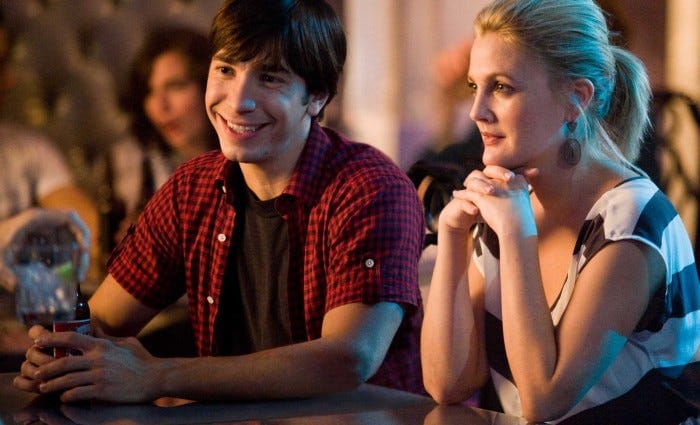
Scott: Also in that vein, although it’s an R-rated movie, there is a lot of heart to the story. How important was it to you to balance the racier elements in the script with trying to hit on genuine, authentic emotion with the characters?
Geoff: I’m a very, very, very firm believer that the funniest comedy isn’t nearly as funny unless it’s grounded by something real and dramatically centering. At the center of this movie is an all-time struggle: two people who love each other can’t be with one another. There’s so much about that experience that is genuinely heartbreaking.
So why shy away from that? Real life isn’t all laugh beats — there’s pain, there’s failure, there’s darkness. But going from the darkness into the light just makes the light that much brighter. You’re a fool if you don’t use that to your advantage. Authenticity is your friend.
Scott: Back to the plot. End of Act One, the couple — Garrett and Erin — are separated, she’s at Stanford in California, he’s in New York working at a record label, thus the central conceit of the story: a couple carrying on a long distance relationship. Once again, a tricky thing to pull off as a writer because you’ve got two parallel storylines. You use some narrative devices to have them separate, yet keep the relationship front and center. Obviously there are phone calls, Skype calls, texting and voice mail. And they get together every so often either in California or New York. But I also noticed this: Each has their own support group of friends and family, and those subplots are dominated by conversations about the couple. How much of a challenge was it for you to pull off that balance of them being separated for much of the time in Act Two, yet also keep the couple ‘together’ on screen?
Geoff: Well, I think you hit the nail on the head there: the best way of keeping them “together” was to highlight that they were going through this simultaneously and their friends and family were there for support. The trade-off you make there is that there’s really not a ton in the movie that ISN’T about them, so I can understand people wondering, “Jesus Christ, do these people ever talk about anything other than Erin and Garrett?”
So it was more of a metaphorical balancing act than anything — showing clearly that Erin and Garrett have a special place within the groups they spend their time with because of the type of relationship they’re in. If you hit that just right, they don’t need to be splitscreened on the phone every five minutes. They’re living parallel lives. I think audiences understand that.
Scott: Let’s talk about the support groups for both Garrett and Erin. Garrett has two good friends: Dan played by Charlie Day and Box played by Jason Sudeikis. Erin primarily has her sister Corinne played by Christina Applegate. First off, wonderful comedic talent there, so I’m guessing you must feel really good about writing entertaining and unique secondary characters strong enough to attract that level of talent.
Geoff: Every time they cast someone new, I felt like New Line was playing a trick on me. Like, “We got WHO?” And then I felt like I won the lottery.
I didn’t have a say in any of the casting — I just had my head down writing — but I will take credit for putting Charlie on New Line’s radar. Eventually I’m sure they would have come around to him one way or another, but I was constantly begging them to get him the script and watch ALWAYS SUNNY. Luckily, my annoying tenacity paid off.
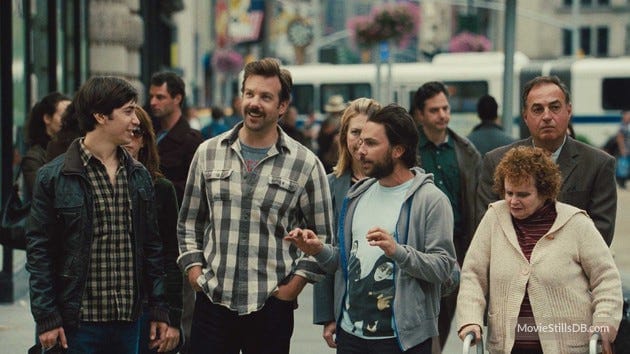
Scott: How did you go about developing Dan, Box and Corinne? And how important is it for a writer to make the story’s secondary characters, in terms of page count, as real and compelling as the primary characters?
Geoff: There are a couple things here that are important. One, you want to respect them as real characters, not devices used robotically to move the main characters in one direction or another. You have to imagine they have their own lives outside of this script, and you have to convince the audience that’s the case. So, of utmost importance: they have to have a point of view, and it has to be a point of view that an actual human would have. Caricatures don’t work in grounded movies like this.
Beyond that, you just have to make it clear that they CARE about Garrett and Erin. That way, even if their advice is problematic or they fuck things up in some way, you know they’re coming from the right place.
I wanted people to walk out of the movie thinking that these characters were properly-elevated versions of their own friends or acquaintances. Charlie and Jason and Christina and everyone just nailed it so hard. I can’t say enough about any of them.
Scott: There’s a natural evolution to the relationship between Garrett and Erin in Act Two. They start out living apart, then they decide they need to define their relationship: light but exclusive. Then they get together for the first time, followed soon thereafter with the declaration: I love you. So that’s all positive. But things start to get more difficult and increasingly do so in the second half of Act Two, some angry phones, misunderstandings, and a failed bout of phone sex, capped with a big plot development: Erin gets a job offer, only it’s with the San Francisco Chronicle. Was that dynamic — things go easy at first, then get more and more difficult — always in your mind for the overall arc of the couple’s story?
Geoff: Sure, because I think that’s how most relationships evolve, with things going great at first and then slowly regressing to enough that it just doesn’t work anymore. And with our main characters here in a situation that has them struggling from the jump, that’s amplified. Frankly, in a movie like this, that’s the only clout you have to start stacking the tension and force these people to make some decisions about their lives.
It really all comes down to mounting frustrations. It makes you wonder if things would be better if they lived in the same city, or if these two people are just hanging onto something because they don’t want to feel like they failed at it. And if it’s the latter, being long-distance has probably extended this relationship past its expiration date.
So yes — that this courtship would naturally come to a breaking point is the whole crux of the story.
Scott: Let’s talk about the ending. Garrett and Erin agree that Erin should take the job in San Francisco, and the couple essentially breaks up for a period of time. Then at the very end, Garrett shows up having moved to Los Angeles, so while the couple is not officially back together and not living precisely in the same city, the door is open for them to resume their relationship, still long distance, only now an hour away by plane. It’s not your typical storybook happy ending, but again fitting with the tone you’ve had throughout the story, it feels realistic. Did you always have that ending in mind?
Geoff: A huge part of it was that we didn’t initially want the story to have a happy ending — we wanted Garrett and Erin to break up. It seemed the most honest way to end things. Because how many of these relationships actually end up working out? Plus, I don’t think always seeing the couple stay together is necessarily satisfying.
Of course, there was no way the studio was letting this happen. So we compromised with our ending. But we intentionally set up to work as a scenario in which he couldn’t move and she couldn’t move, thus forcing one of them into action if the relationship were to be saved.
(Secretly, I hope they didn’t end up together after all but remained really close friends. It’s the only way I can sleep at night. Otherwise it feels forced to me.)
Tomorrow in Part 5, Geoff discusses what it was like when the script for Going the Distance sold, getting on the Black List and other projects he’s working on.
For Part 1, go here.
Part 2, here.
Part 3, here.
Geoff is repped by WME.
Comment Archive