Movie Analysis (Part 5): “Gravity”
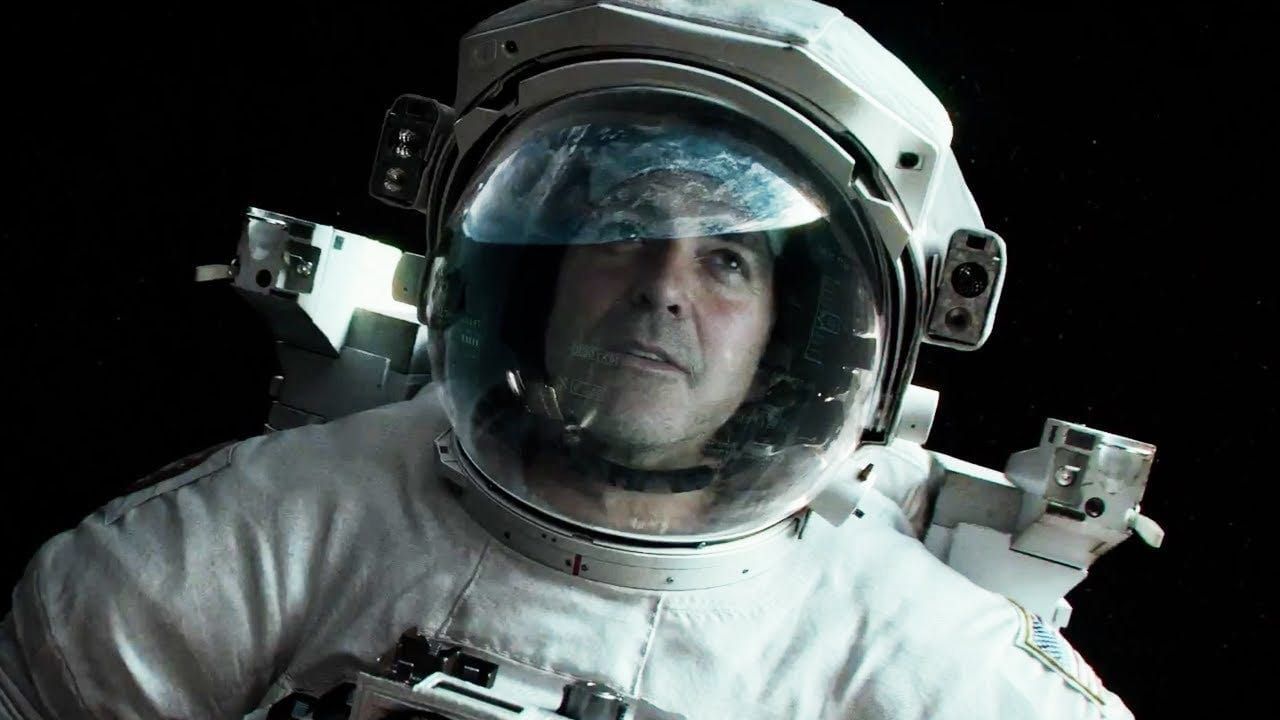
This week, I’m going through the script for the movie Gravity, excerpting every scene that touches on its primary ‘small’ story: Ryan Stone (Sandra Bullock) dealing with her grief related to the death of her young daughter. I laid out my rationale for this exercise in Part 1 of the series:
I’m not suggesting the small story in Gravity is wholly responsible for its ginormous box office success. What I am saying is this:
* At least some of the positive BWOM (By Word Of Mouth) about this movie derived from the audience’s emotional connection with a mother who has lost her child and is forced to cope with her grief under remarkable circumstances.
* If the filmmakers themselves looked at the movie as a metaphor for the Protagonist dealing with her personal issues, then it makes sense for us to think about the story that way as well.
* No spectacle movie can be considered to be great unless it has a compelling small story at work in it.
Here is what I propose: Over the next week, I’m going to go through the script for Gravity and strip out every single scene that references the movie’s small story. In that process, I am going to focus on three dynamics:
1. The overall arc of that subplot moving from Beginning to End.
2. How the metaphor of outer space services the psychological nature of this subplot.
3. Stone’s metamorphosis as she is forced to grapple with her grief.
More generally, I am hoping each of us will come away with an appreciation for the importance of the machinations of a story’s Internal World balanced against the entertainment value of all the action in its External World.
SPOILER ALERT: If you have not seen the movie and don’t wish to know what happens, do not click on More. If you do want to track the series, I’ll see you below the fold.
Plot Summary: A medical engineer and an astronaut work together to survive after a catastrophe destroys their shuttle and leaves them adrift in orbit.
Background: Dr. Ryan Stone is a biomedical engineer on her first Space Shuttle mission. She is accompanied by Matt Kowalsky (George Clooney) and Shariff (voiced by Phaldut Sharma).
Here’s where we left off yesterday per the IMDB Plot Summary:
After Ryan’s conversation with the Inuit Aningaaq ends, she slows the oxygen flow which will cause her to fall into unconsciousness from lack of oxygen before she dies.
Here are today’s excerpts from the shooting script:
The beam of a flashlight shines on her through the O.S. porthole.
She sees Matt, peering through the porthole. He starts to open
the hatch. Ryan, covering her face and reacting.RYAN: No, no, no, don’t!Matt opens the hatch, sucking out all the air and sound. He crawls
in and closes the hatch behind him. Ryan, cowering behind her hands,
but still alive. Matt sitting next to her. He leans over and turns a
dial to re-pressurize the cabin. He takes off his helmet as air and
sound are returned.MATT: (grunts) Check your watch. Thirteen hours and eleven minutes.
Call Anatoly and tell him he’s been bumped.Ryan reacts.MATT: It’s a little gloomy in here, isn’t it?Matt switches the lights back on.RYAN: How did you -- ?
MATT: Trust me, it’s a hell of a story.
RYAN: But how did -- ?Hank Williams, Jr. sings “Angels Are Hard To Find” over radio.MATT: (grunts) That’s better. I found a little extra -- a little
extra battery power. It helps that I didn’t have you around to
distract me. I have to say, I’m glad to see ya. I didn’t think you
were gonna make it. (pants) Did you find the vodka?
RYAN: (panting) You -- You never told me where -- where it was, so...
MATT: Oh, well...Matt reaches under his seat and produces a small bottle of vodka. Matt
sips from the bottle.MATT: To Anatoly. (in Russian) Na zdorovje. (sips; grunts) Huh?
RYAN: No? No.
MATT: All right. Let’s get out of here. The Chinese station’s about a
hundred miles. Just a little Sunday drive.
RYAN: We can’t.
MATT: Sure we can.Matt presses several buttons.
RYAN: There’s no fuel, I tried everything.
MATT: Well, there’s always something we can do.
RYAN: I tried everything.
MATT: Did you try the soft landing jets?
RYAN: They're for landing. So...
MATT: Well, landing is launching. It’s the same thing. Didn’t you
learn about that in training?
RYAN: I never got to land the simulator. I told you that.
MATT: But you know about it.
RYAN: And I crashed it... (emphasizing) ... every time. But this --
MATT: Listen, do you want to go back, or do you want to stay here?CAMERA SLOWLY DOLLIES AROUND IN FRONT of them as Matt switches off the
lights.MATT: I get it, it’s nice up here. You can just shut down all the
systems, turn out all the lights... and just close your eyes and tune
out everybody. There’s nobody up here that can hurt you. It’s safe. I
mean, what’s the point of going on? What’s the point of living? Your
kid died. Doesn’t get any rougher than that. But still, it’s a matter
of what you do now. If you decide to go, then you gotta just get on with
it. Sit back, enjoy the ride. You gotta plant both your feet on the
ground and start livin’ life.
RYAN: How did you get here?
MATT: I’m telling you, it’s a hell of a story. Hey, Ryan?
RYAN: What?
MATT: It’s time to go home.PULL BACK to reveal that Matt is not there. Ryan was imagining him. An
alert sounds. She leans and turns the dials to re-pressurize the cabin.
The oxygen meter starts to rise. The meter reads “O2.”Ryan presses a button, turning off the alert. She breathes deeply, then
leans and switches the lights back on, then presses more buttons on the
control panel. She reaches for a landing instructions manual, which is
marked green.
If Ryan’s interchange with Aningaaq can be looked at through the lens of theology, as we explored yesterday, the sudden appearance of Matt here transitions the scene into the psychological sphere. Since Matt does not actually appear in real life, what is he? I would argue he is the physicalization of Ryan’s inner wisdom. Matt’s character is, after all, a Mentor figure, that’s his function: He knows about space, he has a thorough understanding of the mechanics of space flight, and perhaps most importantly, he delights in every second of his existence.
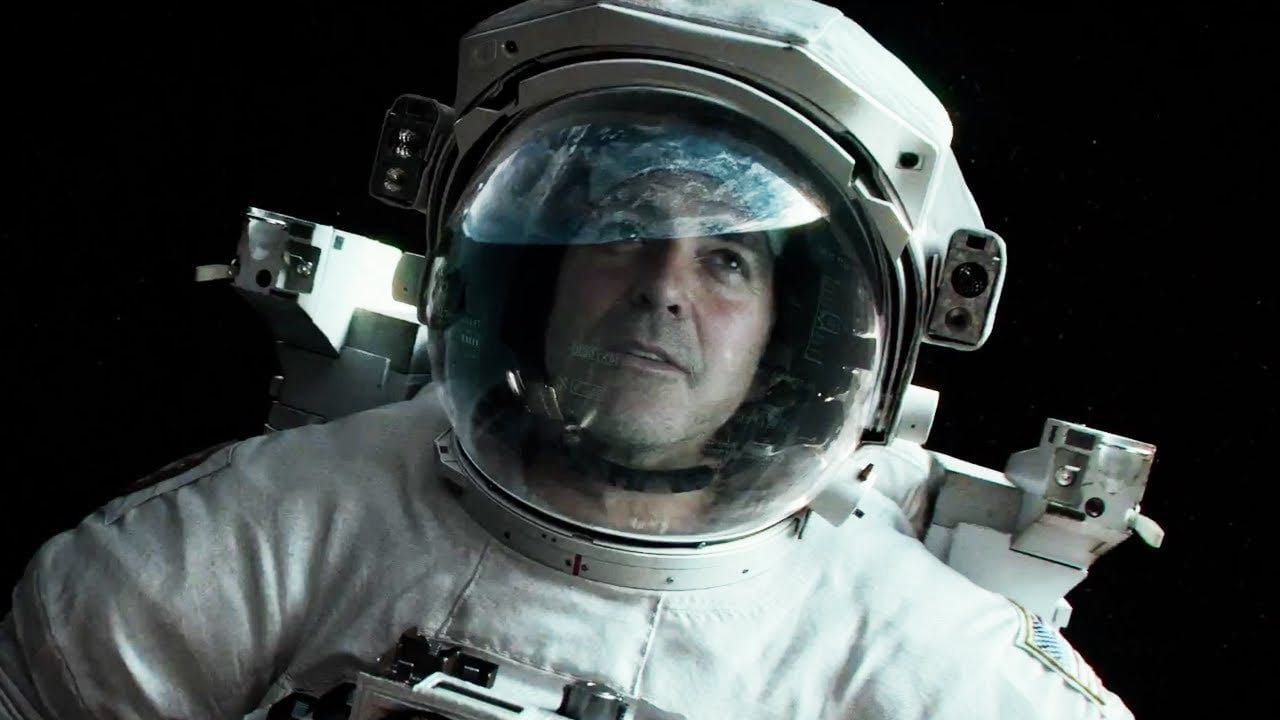
Per this last point, Matt serves as a bridge for Ryan to embrace the possibility of life. Wherein she had sought out ‘salvation’ in her ‘prayer’ with Aningaaq, and did not find it, Ryan has to go inside her psyche to its deepest truth, posed as a question:
Do you want to go back, or do you want to stay here?
This is that part of Ryan’s psyche which knows she has to move on with her life… and it’s that ultimate decision Ryan has been doing everything she can post-daugher’s death to avoid. Because if she moves on with her life, that means she will have come to some sort of peace about her daughter’s death. And to do that, she has to go through one final psychological passage: Confront her guilt.
This, I would argue, is the darkest form of her shadow. She feels guilty about her daughter’s death. On a purely pragmatic level, it is irrational. Her daughter died in an accident. Ryan had nothing to do with it. She could have done nothing to prevent it. The tragedy was a twisted quirk of fate for which Ryan could not possibly hold any culpability. Except this…
She was a parent. And the number one rule of parenting is to keep your children safe. Protect them. Keep them from harm.
Thus the essence of Ryan’s Disunity: She knows she must move forward. That knowledge lies within her psyche. Here it is physicalized and voiced by the phantasm of Matt. Yet to do that, she will have to confront the irrational, yet powerful grip of guilt she feels about her daughter’s death.
Why does this story have to happen to Ryan at this time? To compel her to confront this most existential question: Go back. Or stay here (i.e., die).
And to do that, she needs to face her guilt… which ultimately she does in a later scene.
Read this side again through the psychological lens as described above:
* I get it, it’s nice up here. You can just shut down all the systems, turn out all the lights… and just close your eyes and tune out everybody. There’s nobody up here that can hurt you. It’s safe. This refers back to Ryan’s side where she explained how she could get used to this (i.e., space) because of the “silence”. On Earth, Ryan would “just drive” to drown out the chatter of her darkest inner thoughts and avoid going home to the emptiness that was there due to the absence of her daughter. Here in the Russian space capsule, that is the ultimate ‘drive,’ potentially with the ultimate ‘silence’: Death.
* I mean, what’s the point of going on? What’s the point of living? Your kid died. Doesn’t get any rougher than that. This is one side of her psychic equation. If she had not gone on this space trip, I doubt Ryan would have ever considered suicide. Rather my guess is she would have continued to “just drive,” stuck in an emotional rut, perhaps even for the rest of her life, a sort of purgatory where she wouldn’t enjoy herself, a just price, she might figure, to pay for her guilt, and while maintaining her emotional status quo, at least keep her daughter ‘alive’ in the form of this dark shadow that looms over her.
* But still, it’s a matter of what you do now. If you decide to go, then you gotta just get on with it. Sit back, enjoy the ride. You gotta plant both your feet on the ground and start livin’ life. But the fact is, she did launch into outer space, there was a catastrophe that created the havoc she has experienced, and she is facing a life or death situation. So what was once this purgatorial haze of an existence (on Earth) has been replaced with a visceral and stark reality: There is Life. There is Death. And Ryan is telling herself, via Matt’s voice, “You cannot continue as you have. You must make a choice.”
I referenced The Shawshank Redemption previously. Clearly the sentiment of “Get busy living, or get busy dying” echoes in Matt’s words. His final words — “It’s time to go home” — is Ryan herself vocalizing through Matt the choice she has made. To get busy living.
In my view, a movie’s Protagonist almost always goes through a positive metamorphosis, one that can be described this way: Disunity — Deconstruction — Reconstruction — Unity. This scene in the Russian ship represents a turning point in Ryan’s Reconstruction, dredging through multiple layers of her psyche to get down to her Core Essence, her inner knowledge that she has to move forward — it’s time to go home.
From here, the narrative jumps back to the plot, yet there are two more moments Gravity’s ‘small story’ which we will explore in the final parts of this series.
One more thing: Matt’s line — “You gotta plant both your feet on the ground” — is a setup for the final image of the movie.
Here is the scene from the movie:
How about you? What are your interpretations of what has transpired up to this point in the story? Do you feel it’s effective? Or not? If not, how would you have approached this ‘small’ story? Or maybe you have a different ‘small’ story you think would have worked better.
A reminder: As far as I’m concerned, there is no ‘right’ or ‘wrong’ when it comes to an individual’s experience of a story, so if you liked or disliked Gravity, feel free to wade into the discussion. At the end of the day, I’m hoping this series will underscore the importance of stories having a compelling inner life.
Hope to see you in comments!
For Part 1 of this series, go here.
Part 2, here.
Part 3, here.
Part 4, here.
Tomorrow we continue with our analysis of Gravity.
Comment Archive