Great Character: Django (“Django Unchained”)
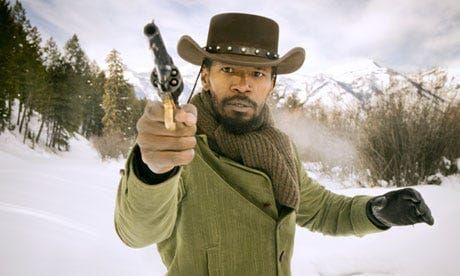
The Great Character theme for the month: Tarantino characters. Today: Jason Cuthbert looks at Django from the movie Django Unchained.
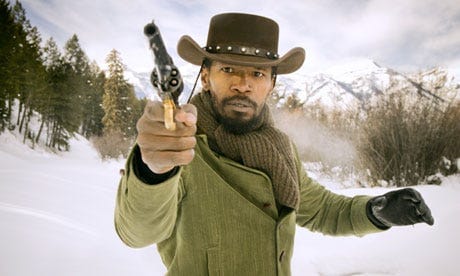
In 2009, screenwriter/director/brand name Quentin Tarantino outperformed all of his previous box office bank statements with a $321,455,689 deposit from Inglourious Basterds. But three years later in 2012, Tarantino doubled down andburst that record wide open with his very next revenge creation, Django Unchained, which took home $425,368,238 — over $100 million more. Along with two Academy Award trophies, including one for Tarantino’s personal collection: Best Writing Original Screenplay, Django Unchained provided lead actor Jamie Foxx with what at that time was his highest grossing blockbuster, playing the plantation slave turned bold bounty hunter Django.
Django Unchained IMDB:
With the help of a German bounty hunter, a freed slave sets out to rescue his wife from a brutal Mississippi plantation owner.
How does Q.T. craft an intensely violent story that makes an audience concerned about a gun-slinger that gets paid cash for making people pay with their lives? The answer is simple: by traumatizing this death collector with the weight of the inhumane system of slavery.
Django has been forced out of his family, deprived of any form of freedom, divested of any resources, savagely beaten, psychologically belittled and separated from his beautiful wife Broomhilda (Kerry Washington) before we even meet him on screen. Given the choice between shackles around his wrists or pistols in his palms — there isn’t much of a choice to make at all, especially when eliminating his previous slave masters is in his job description.
DJANGO: I like the way you die, boy.
http://www.youtube.com/watch?v=_O34Vf50sPQ
As Dr. King Schultz (Christoph Waltz), a German sickened by the uncivilized scheme of slavery, teaches Django the trade of turning wanted men into corpses, transformations begin to occur within Django. The vital glow of hope awakens Django’s pursuit of happiness. His life and time are now his own. Proper income is now an achievable possibility — so is a reunion with his wife.
The further removed that Django becomes from the subservient nature of the plantation, the closer he becomes acquainted with the acquisition of respect. Stripping off the sinful cloak of racist submission and wearing the prestigious dress code of freedom allows Django to exercise his thirst for knowledge, explore the world outside the oppressive flesh factory and polish his self-esteem in public.
DJANGO: [upon being asked his name] Django. The D is silent.
The morality of his commissioned trigger finger has Django questioning the nobility of his new profession. After already witnessing suffering with the regularity of day turning into night, Django’s plantation scars are reminders that fellow humans controlling the destiny of other humans is a soul-crushing gig. But unfortunately living in a part of the world that treats his skin color as a birth defect makes alternative employment options null and void.
As Django’s threshold for observing violence becomes tested as he and Dr. King Schultz infiltrate the Calvin Candy (Leonardo DiCaprio) plantation of horrors, Django’s desensitized tolerance becomes an asset in convincing this captor of his enslaved wife that Django is in fact on the business end of slaves fighting slaves. Even a bloody-handed bounty shooter like Dr. Schultz gets visibly squeamish when the barbaric revulsions of Africans take place live and direct. In this aggressive arena Schultz cringes at forced fights to the death and deranged butchery by canine jaws.
DJANGO: I’m just a little more used to Americans than he is.
Django’s intelligence gets an opportunity to blossom through his dignified interactions with Schultz and his mandatory quick-witted adaptation into the lifestyle of a free man in the face of cold-hearted strangers. It takes more than all of the restraint that a person can muster for Django to not prematurely pump bullets into Calvin Candy and his demonic cohorts at the sight of Broomhilda trapped naked in a filthy pit and treated like an expendable tool.
If Calvin Candy’s villainy wasn’t enough of an obstacle in Django’s urgent rescue mission, Stephen (Samuel L. Jackson), Calvin Candy’s self-hating African American footstool proves to be just as infamous. Willingly and eagerly contributing to the destruction of his culture makes Stephen a man who has long since set his self-worth on fire for an invisible position of perceived power at “Candy Land.”
Stephen’s immediate loathing of Django’s regal, unchained, demeanor is an indication that Stephen has suddenly come face-to-face with his worst nightmare — “real freedom.” No amount of antagonizing N-word spewing or Candy ass-kissing will put Stephen up on Django’s horse saddle with a pistol on his waist and a schedule of his own design. The divide and conquer psychology of slave life has permanently put Django and Stephen at odds. But Django won’t rest until those odds are even.
http://www.youtube.com/watch?v=B9tF3KgEdAI
For his unstoppable commitment to his spouse, his unwavering demand for respect and his undeniable prowess for survival — Django is one unforgettably GREAT CHARACTER.
Talk about a Protagonist who creates a strong sense of narrative drive, Django is it. Why? Because he has a clear goal and will not relent in achieving it.
Thank you, Jason, for this post. Please join us in comments to discuss Djano Unchained.
You may follow Jason on Twitter: @A2Jason.
Comment Archive