Interview [Part 4]: Brian Duffield
![Interview [Part 4]: Brian Duffield](https://storage.ghost.io/c/8f/29/8f29b0a7-49e5-431c-a9bb-3ade9c0a785e/content/images/size/w2000/2026/08/0_W2ePm7vYA7rtNE3F.jpg)
In Hollywood development circles, Brian Duffield is a popular figure. As evidence, two of his original screenplays have made the Black List: Your Bridesmaid is a Bitch and Jane Got a Gun, putting him on the 10 Screenwriters to Watch in 2013 list. In addition, he sold his spec script Monster Problems to Paramount in 2012 and has written on a big budget franchise movie: Insurgent. And if that’s not enough, Duffield is slated to make his debut as a director on his own script Vivien Hasn’t Been Herself Lately.
Brian is an active presence on Twitter (you should definitely follow him: @BrianDuffield) and we’ve gotten to know each other over the years, so I was pleased to have the chance to interview him.
In Part 4, Brian talks about working on Insurgent, the sequel to the hit movie Divergent:
Scott: I would be remiss if I didn’t talk to you about your unique approach to scene description. For example, on this whole subject of unfilmables, I’m sure you’ve heard about that.
One film description in “Your Bridesmaid Is A Bitch” is about Noah eating Taco Bell on the beach, “because he’s unemployed and, because he fucking can”. Or a scene description like, “They look like the Freewheelin’ Bob Dylan album cover, but at night, in costumes, and 40 years later, so not really.” Or, “Skylar hangs his head in shame and enters Noah’s box. (which will hopefully be the name of my next porno script).” I’m curious…
Brian: I got so much stuff into one line. There’s a weird habit of people writing reviews of your stuff and sending it to you, and sometimes, they’re really negative. Someone sent me a negative review of my spec that they wrote, which is sweet of them. That’s when I stopped reading them. But I agree that that last line is shit.
My writing has really calmed down since then. The reason why I think the script has that voice is because I wrote it in a really bizarre setting. Almost the entire movie, ugh, it’s really upsetting. I knew I was going to write this script. My sister and I were flying to Ireland to visit my family for Christmas. It was a 7 hour flight that turned into a 23 hour flight, and it was so hellish. I sat next to this drunk lunatic that was very handsy.
On the flight, this guy had a stroke, and we had to turn the plane around, and land in a blizzard in Nova Scotia. We were stuck there for like eight hours until the blizzard cleared.
I’m terrified of flying in general. I wrote probably 80 pages of that script, I knew where I was going, but I wrote it almost word for word for what it was when it went down.
You can see how anxious and loopy I am in the scene description, because I don’t know if I would have written in that way in general, if I had just been writing it in a normal setting. I was so stressed out, so miserable, and also heartbroken. I had this person grabbing my face next to me, and so I was just tapping away furiously for 20 hours straight. I feel a lot of these lines are definitely in my voice, but they also came out of a really stressful situation.
But anyway, in general, I try to write each script in the lead characters voice. It’s not first person, but the voice of the scene direction, as it were, in the script was very much in Noah’s voice, is very much in Joel’s voice. Vivien Hasn’t Been Herself Lately is probably the only exception to that rule, because writing the scene description in the character’s voice would have meant handwriting it in blood and mucus.
But the other scripts I’ve written have very much been writing in the character’s voices as much as it can be. That’s what I try to do to make it feel personal. You’re reading this person’s story, and this person is so invested that they’re bleeding out onto the scene directions. They were really passionate about it. Scene description is usually so boring to write (and read), but I’ve found if you try to write it in your lead’s voice, it becomes really enjoyable.
Scott: I definitely want to talk about Insurgent, which is a pretty unique situation. It’s a sequel to Divergent and that whole book series by Veronica Roth.
It’s interesting because it’s not only an adaptation, which has its own challenges, but also the fact that you’re writing a sequel to a movie that at the time hadn’t even come out yet.
Brian: Yeah, last year was a really a weird year. For a while, I was debating even sticking to screenwriting. I was really quite serious about either writing graphic novels or just pursuing a different career entirely because I had been in an incredibly awful film situation. It was just incredibly abusive, both to myself and other people on the project. I kind of fell out of love with screenwriting.
So I was at home, trying to figure out what I wanted to do with my life and on queue, Red Wagon had sent me Divergent. I really liked Doug and Lucy at Red Wagon as people and also when you look at what they produce, they just have this humongous body of work with some of the greatest filmmakers that have ever lived. They’re real producers, and I really wanted to work with real producers for a change.
I always thought it would be fun to be part of a pop culture thing at some point in my life. As I was reading Divergent I was trying to imagine what the second book is going to be and you kind of get to the third act of Divergent and Veronica, the author, kind of blows up the world in this really fun and unique way and so the sequel becomes this… you have no idea where the story is going to go.
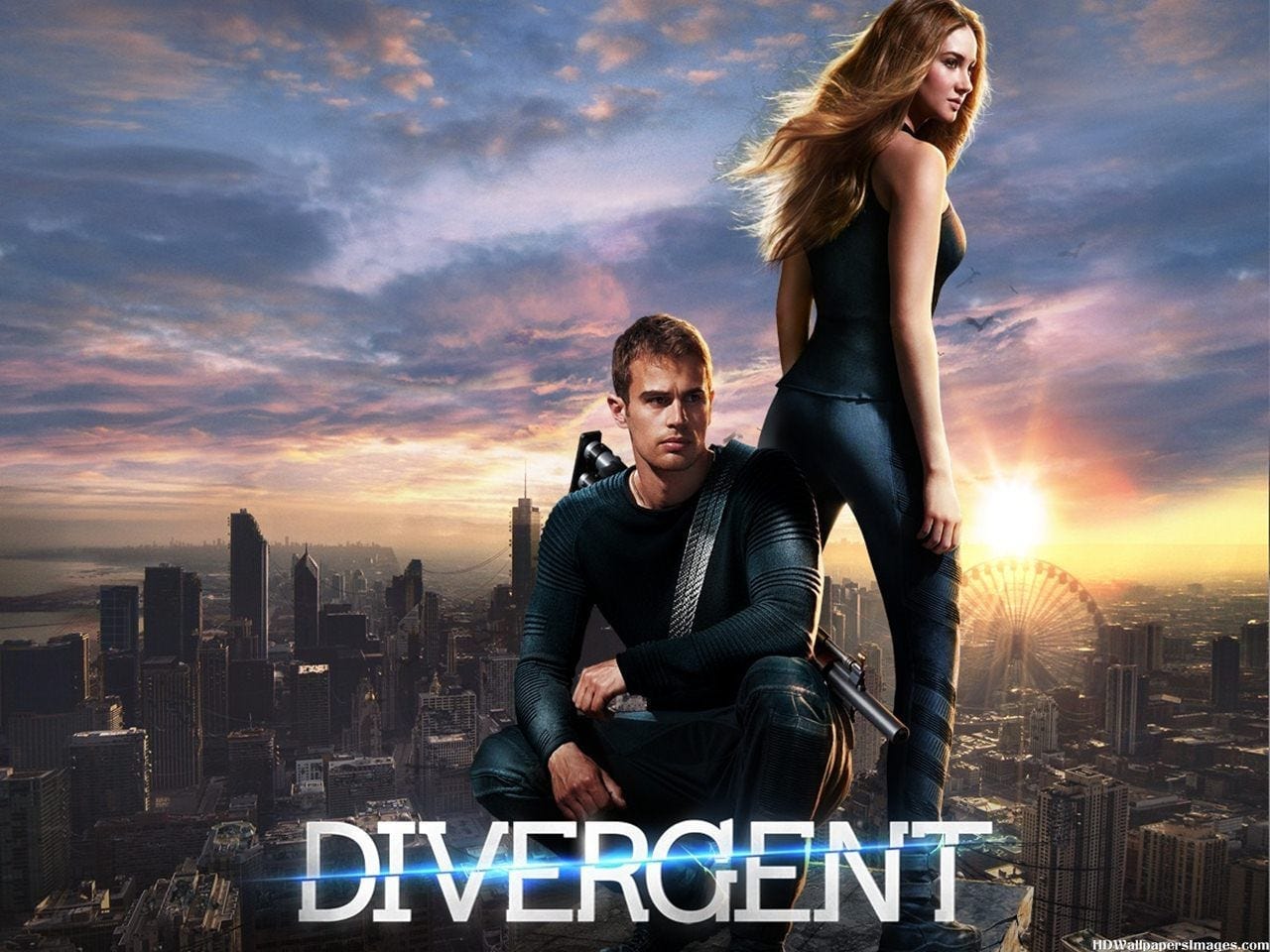
So I asked my team about it and they said, well, Neil Burger is directing the first one right now. Shailene Woodley is in it and Miles Teller is in it.
I had just seen The Spectacular Now a few months beforehand, and those two are just unbelievably talented. And then they were like, P.S., Kate Winslet’s the bad guy. And I was nowhere near arrogant enough to turn this kind of thing down because how often am I going to get asked to pitch on a “Kate Winslet is hunting Shailene Woodley” movie.
I was at a really low point in my life at the time because of the aforementioned incident, and the character of Tris, who at the end of Divergent, is in a very similar point in her life, so she’s really depressed, doesn’t know why she should go on or what she should be doing. I was like, “I can write the shit out of this. It’s exactly where I am in my life right now!” So I went in to pitch and basically, I was like, that’s how I feel right now.
Tris’ character is raised in a really conservative household, from the Abnegation faction. My parents are missionaries and I am a screenwriter known for a three page “fuck you” monologue. So I made the pitch as personal as possible, because that’s the way it was in my life at the time and it’s how I connected particularly to Tris.
It was a very surreal experience where I get to see trailers of my characters doing things before I’ve written things for them to do. I went to set and saw everyone in costume on set. It was bizarre.
Scott: You said there is something you want to be doing next as a director.
Brian: Yeah dude. I’m so excited. I wrote it over a year ago now, and I sat on it because I thought I was going to have this experience on a film set with this incredible director, so I worked with her as much as I could. Unfortunately that movie didn’t work out, but I still learned a ton from her and she was so encouraging to me to take a swing at things.
That situation really exploded, but in a way I felt ready to direct because I knew how I wanted to act on the set and how I wanted to shape a story of mine and protect the writing a little better than have it protected by other directors. I knew I wanted to have strong producers, and I knew I just wanted to surround myself with people that were kind, and good.
It’s something that I am really excited to get into. It is terrifying, but it’s really exciting at the same time. I wanted to make sure my first movie had a little bit of everything I’d ever want to do as a director, in case it’s my last movie too. I think it’s the best thing I’ve ever written on top of that. As you can tell, I’m really stoked, and excited and hope to find some actors crazy enough to go on that trip with me. We’ll see how it turns out.
Note: The project Brian is scheduled to direct from his own script is Vivien Has Not Been Herself Lately, described this way: “A young married couple struggles to survive against a supernatural entity.”
Tomorrow in Part 5, Brian shares some thoughts about key aspects of the screenwriting craft.
For Part 1 of the interview, go here.
Part 2, here.
Part 3, here.
Brian is repped by Gersh and Circle of Confusion.
Twitter: @BrianDuffield.
Instagram: http://instagram.com/briancduffield.
Comment Archive