Classic 60s Movie: Lawrence of Arabia
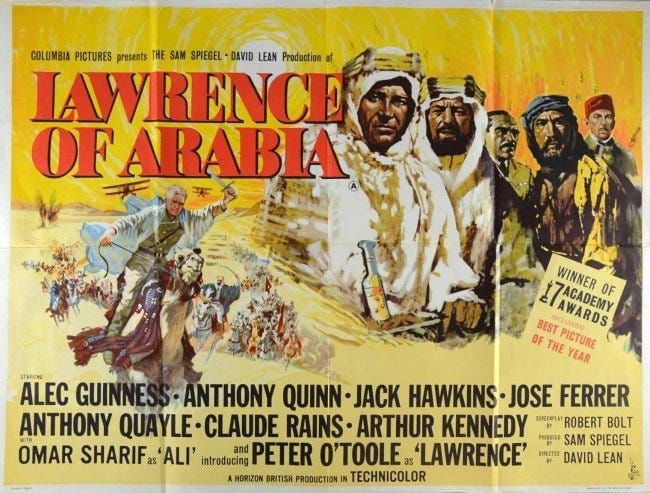
January is Classic 60s Movie month. Today’s guest post comes from Paul Graunke.
Movie Title: Lawrence of Arabia
Year: 1962
Writers: Robert Bolt, Michael Wilson, adapted from the writings of T.E. Lawrence.
Lead Actors: Peter O’Toole, Alec Guinness, Omar Sharif, Anthony Quinn, Jack Hawkins, Anthony Quayle, Claude Rains, Arthur Kennedy.
Director: David Lean
Plot Summary: The struggle of the complex and enigmatic T.E. Lawrence to liberate Arabia from the Turks during World War I — and from domination by England and France.
Why I Think This Is a Classic 60’s Movie: At 222 minutes in length in its theatrical premiere, “Lawrence of Arabia” represented the apex of the historical epic. It was also the apex of the kind of old-fashioned movie making that was supplanted in the 60’s by the New Hollywood, the post- World War II generation of filmmakers.
This movie has it all: a sweeping story, panoramic set pieces, a charismatic and controversial hero with a strong character arc, a deep cast of talented supporting characters, literate dialogue, and a rich musical score. And it dramatizes themes and issues that reverberate down to the present day state of affairs in the Middle East.
And did I mention the cinematography?
All of this is built on the foundation of a superbly crafted script. If I could only study one film on the art and craft of screenwriting, this would be my choice.
My Favorite Moment in the Movie: I don’t have one favorite moment in this film. I have too many favorite moments.
One of them is Lawrence’s encounter with Sherif Ali at the Matsurah Well, in the first act. Because: 1] It introduces the pivotal character of Sherif Ali who will be fighting — and arguing — side by side with Lawrence for the rest of the movie; 2] It introduces a major complication to Lawrence’s objective goal; 3] It initiates an ironic theme that will torment Lawrence for the rest of the story; 4] It establishes a reference point for Lawrence’s character arc.
1] Sherif Ali’s entrance is one of the greatest shots in the history of cinematography. He appears in the distance like a mirage. This shot was made decades before CGI.
2] It sets up a complication that will bedevil Lawrence for the rest of the movie: tribal feuds. Lawrence’s guide through the desert, Tafas, has violated an unwritten law of the dessert; he has drawn water from the well of a rival tribe. Knowing this, when he see Ali approaching, he goes for a pistol — and Ali kills him with one shot of his rifle from a distance.
3] The pistol was a gift from Lawrence, an attempt at friendship. And it leads to the guide’s death. This is the first instance of a pattern — a theme. Time and again, Lawrence’s good intentions backfire; his brave deeds motivated by his idealism have unintended consequences, often fatal ones for others.
4] Lawrence berates Sherif Ali for killing his guide, telling him that as long as the Arabs fight each other, they will remain “a little people, a silly people, greedy, barbarous and cruel, as you are.” This becomes the reference point for Lawrence’s character arc. He establishes himself as civilized, humane man in stark contrast to Sherif Ali.
During the course of the movie, Lawrence undergoes a negative Deconstruction-Reconstruction until he himself becomes “barbarous and cruel” himself when he orders and participates in the massacre of Turks. And compounding the tragic irony, Sherif Ali is the “civilized” character counseling restraint.
My Favorite Dialogue in the Movie: Lawrence’s exchange with Ali after being beaten (and possibly molested, although that is left off screen for viewers to imagine) at Deraa. This is the emotional low-point of the film; he has collapsed physically and psychologically. It’s also the moment of an epiphany that calls back to and pays off his earlier assertion of free will in defiance of Arab fatalism.
LAWRENCE: I’m going Ali.
ALI: Why?
LAWRENCE: Why? Heavens.
ALI: Why?
LAWRENCE: I’ve come to the end of myself, I suppose.
ALI: And the end of the Arab revolt?
LAWRENCE: I’m not the Arab revolt, Ali. I’m not even Arab.
ALI: A man can be whatever he wants. You said.
LAWRENCE: I’m sorry. I thought it was true.
ALI: You proved it.
LAWRENCE: Look, Ali. Look. (pinches flesh) That’s me. What color is it? That’s me. And there’s nothing I can do about it.
ALI: A man can do whatever he wants. You said.
LAWRENCE: He can… but he can’t want what he wants. This (pinching his flesh) is the stuff that decides what he wants.
Key Things You Should Look For When Watching This Movie:
CHARACTER DEVELOPMENT:
The major characters are given memorable introductions in scenes with argument and conflict that clearly establish their roles and characters.
The title character has a strong character arc, albeit an ambivalent one. Lawrence achieves his objective goal of leading the Arabs to liberation, and to Damascus before the British — but he loses his moral compass on the way. (This is foreshadowed when he loses his army compass in the Sinai on the way back to Cairo to announce he has done what everyone said couldn’t be done: he has captured Aqaba.)
PLOT CONSTRUCTION:
Even at a viewing length of 247 minutes (in the restored version), the story has a clear cut 3 act structure. Act 1 ends around the 52 minute mark when Feisal declares that it will require a “miracle” for the Arabs to win their freedom — and Damascus. That’s at the 21% mark — which would correspond to about page 26 in the standard 120 page length of a script. Act 2 ends when Lawrence quits his extraordinary role as a leader of the Arab revolt, seeks to become an ordinary British soldier. That occurs around minute 183, the 74% mark of the film, corresponding to page 89 of the standard 120 page length.
The midpoint of the film –and the intermission — occurs at the highpoint of Lawrence’s saga in Arabia, objectively and emotionally. He’s proved himself to be a bold and brave leader. He’s won the support of Allenby to pursue a campaign of guerilla warfare against the Turkish rail system. And he’s won the respect of the Arab warriors and his fellow British soldiers.
Yet, the intermission ends on a minor key. Allenby fears Lawrence is “riding the whirlwind”, foreshadowing what will transpire in the 2nd half of the film.
In my own study of the film, I broke it down into sequences, 15 in all, 9 before the intermission, 6 afterwards. The sequences averaged about 16 minutes in length (in the restored version).
DIALOGUE:
The dialogue is constantly informing the audience where the story is going. The story doesn’t hit the pause button so characters can explain (for the audience’s benefit) who’s who, what’s happening now and what is at stake. The dialogue advances the story even as it explains it.
USE OF PROPS:
I mentioned the compass which is lost just as Lawrence will begin to lose his moral compass. Here are three more instances that reveal character or portend adversity:
Matchstick: In the opening scene Lawrence demonstrates his indifference to suffering by holding onto a match as it burns its way down to his fingers. Later, it seems like he’s going to repeat the trick for the diplomat Dryden — but he blows it out, foreshadowing how badly he underestimates the suffering he is about to endure.
Uniform: When he returns, he resumes wearing a uniform, tries to blend. But the uniform doesn’t fit him. A metaphor for the role he would like to play, but can’t, as a regular soldier.
Grapes: As they approach Damascus, an Arab jubilantly gallops up and offers Lawrence a cluster of grapes freshly picked in Damascus. Lawrence tastes one: it’s bitter, foreshadowing the bitter disappointment that awaits him in Damascus.
MOTIF:
The story is bookended — and divided — with the visual motif of a motorcycle. The first image of the movie is the motorcycle that he rides to his death (in 1935). A motorcycle appears again some 2 hours later film when Lawrence arrives at the Suez Canal after capturing Aqaba. The motorcycle rider calls out to him, “Who are you?”, the subjective question for viewers — and for Lawrence himself. The film ends with the vehicle transporting him away from Damascus trailing in dust in the wake of another motorcycle.
Thanks, Paul! To show our gratitude for your guest post, here’s a dash of creative juju for you. Whoosh!
We already have a set of classic 70s movies, 80s Movies and 90s Movies. This month, we’re working on 60s Movies.
We have 28 volunteers. I have put in bold those who have already sent their guest post to me.
Ipsita Barik — Rosemary’s Baby
Ipsita Barik — Bonnie and Clyde
Bookman Film — The Sound of Music
Brandnewusedcar — Butch Cassidy and the Sundance Kid
Markham Cook — Jules et Jim
Steve Cook — The Blue Max
JasperLamarCrab — 2001: A Space Odyssey
N D — Lonely are the Brave
Drew Dorenfest — Easy Rider
Rick Dyke — Fail Safe
Felicity Flesher — The Music Man
PaulG — Lawrence of Arabia
D.L. Gill — Zulu
Jeff Guenther — Cool Hand Luke
Kate Hagen — Repulsion
John Henderson — Night of the Living Dead
John Henderson — The Odd Couple
John Hörnschemeyer — The Graduate
Zach Jansen — They Shoot Horses, Don’t They?
Will King — The Pink Panther
Lisaisfunny — Blow Up
Jack McDonald — Who’s Afraid of Virginia Woolf?
Daryl Powell — The Apartment
jprichard — Persona
Ally Shina — The Jungle Book
Mark Twain — The Loved One
Liz Warner — The Manchurian Candidate
Michael Waters — Dr. No
I’m looking for more guest posts to take us through January. Why not pitch in to help add to this online resource to inspire writers to learn about and — most importantly — watch great movies.
If you have a classic 60s movies on which you’d like to do a writeup, please either post in comments or email me.
And for those who have signed up, but have yet to email me your post, please do so ASAP.
Thanks in advance!
For the original post explaining the series, go here.