Interview (Part 1): Donald Margulies
Donald Margulies, one of America’s most widely-produced playwrights, won the 2000 Pulitzer Prize for Drama for Dinner with Friends (which was made into a Emmy Award-nominated film for HBO directed by Norman Jewison) and was a finalist twice before for Sight Unseen and Collected Stories. His many other plays, which include The Country House, Shipwrecked! An Entertainment, Brooklyn Boy, the Tony Award-nominated Time Stands Still and the Obie Award-winning The Model Apartment, have been produced on and off-Broadway and in theaters across the United States and around the world. Mr. Margulies has received grants from the National Endowment for the Arts, The New York Foundation for the Arts, and the John Simon Guggenheim Memorial Foundation. He was the recipient of the 2000 Sidney Kingsley Award for Outstanding Achievement in the Theatre by a playwright. In 2005 he was honored by the American Academy of Arts and Letters with an Award in Literature and by the National Foundation for Jewish Culture with its Award in Literary Arts. He was the 2014 recipient of the PEN/Laura Pels International Foundation for Theatre Award for an American Playwright in Mid-Career and the 2015 William Inge Award for Distinguished Achievement in the American Theater. He has developed numerous screenplays, teleplays and pilots for HBO, Showtime, NBC, CBS, Warner Bros., TriStar, Universal, Paramount, and MGM. He is an adjunct professor of English and Theater Studies at Yale University. The film of his screenplay, The End of the Tour (2013 Black List), directed by James Ponsoldt, premiered at the Sundance Film Festival and will be released in the fall of 2015.
Donald agreed to respond to some of my questions about writing The End of the Tour as well as his insights into the craft of writing.
Today in Part 1, Donald discusses how he became involved in the project and some key creative challenges he faced in writing the script:
Scott: The End of the Tour is an adaptation of the 2010 book by David Lipsky, Although of Course You End Up Becoming Yourself: A Road Trip with David Foster Wallace, which itself is based on recorded transcripts from five days Lipsky spent with Wallace at the end of a book tour promoting the 1996 release of the novel Infinite Jest. How and when did it come to your attention?
Donald: In March, 2011, my friend and manager, David Kanter, who has represented me in one capacity or another since 1991, and who appreciates my aesthetic sensibility better than just about anyone, sent me a book that had come his way at Anonymous Content: David Lipsky’s memoir. Kanter said, “Take a look, there may be a play in it.” Just a few pages in, I began to get very excited; I envisioned not a play but a “road picture.” I had a strong sense of what it needed to be and how I would go about achieving it. Inspiration doesn’t always work that way; sometimes, rarely, I know almost immediately how to solve a play’s or screenplay’s structure, other times I struggle for months. The script that became The End of the Tour was written relatively quickly (once the rights had been secured) and came to fruition not long after that. Between my introduction to Lipsky’s book and the movie’s premiere at Sundance was a period of less than four years.
Scott: Had you ever met David Foster Wallace?
Donald: No, I had never encountered Wallace nor, frankly, was I fanatical about his work. My appreciation of his work and interest in him really began when I read Lipsky’s book, which not only captured Wallace’s dazzling intellect but succeeded in humanizing a cultural icon. It was then that I truly understood what a huge loss his death was to our culture and was moved to read and re-read Wallace in a new light. I’m hopeful that our movie accomplishes a similar feat: of compelling audience members with limited knowledge of David Foster Wallace to seek out his books and revel in his voice.
Scott: When breaking down the book, what were some of the key themes and dynamics you knew upfront you wanted to explore in adapting the story into a screenplay?
Donald: Anyone who’s followed my plays over the years will see thematic resonances in The End of the Tour. (Collected Stories is a two-hander that tracks the complicated relationship between an older woman writer and her protégée; both Sight Unseen and Brooklyn Boy take on the struggle between artistry and fame; Dinner with Friends deals, in part, with male friendship.) In my reading of the Lipsky book, I saw a convergence of so many of the themes that have captivated my writer’s imagination. Here was a story of two incredibly smart, witty, articulate men, both of them writers, who ostensibly want the same thing: literary success and legitimacy. Lipsky, 30 years old in 1996, was the aspirant whose first novel was published to modest acclaim; Wallace, only four years older, was the newly anointed voice of their generation. The men spend five intense days together (after which, incidentally, they will never see one another again) during which their interaction fluctuates between suspicion, intimacy, competitiveness, defensiveness — sometimes from one beat to the next. I have always been fascinated by the journalist-subject dynamic (so memorably written about by Janet Malcolm in The Journalist and the Murderer about Joe McGinniss and Jeffrey MacDonald) and I saw in this material a chance to take that on, too. I had at my disposal the 300-plus-page transcript that was the heart of Lipsky’s memoir. I never listened to the actual recordings but I did spend several hours interviewing David Lipsky, who generously shared moments that weren’t included in his book, details that proved invaluable in my screenplay. My challenge was to take this treasure trove of conversation and carve out a dramatic narrative; I needed to find the conflicts, mine the subtext, create dialogue that melded with their distinctive voices. I deconstructed all that rich, dense language, shattered it, and fashioned a kind of collage out of the shards, creating new juxtapositions and contexts. The dramatic stakes were intrinsic in what became the film’s title: the event being the final days of the tour that celebrated the book that changed his life. When Lipsky leaves Wallace in Illinois and goes home to New York, Wallace is confronted with the rest of his life, which we know will end by his own hand in just twelve years. I decided from its conception to put Lipsky in the foreground of the screenplay and tell the story from his point of view (a position the script adheres to but for two brief instances at the end of the film).
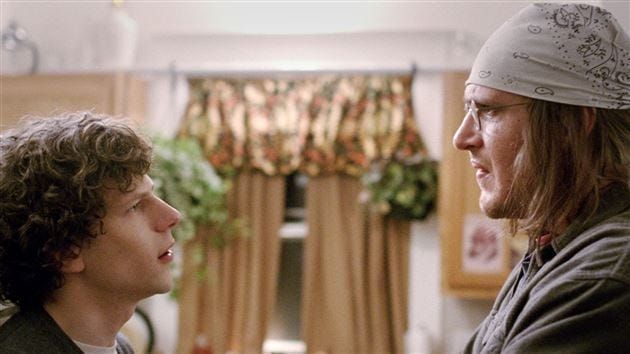
The movie’s co-stars, Jesse Eisenberg and Jason Segal
Scott: The script is a ‘road picture’. Did that influence the way you approached the characters and the structure of the story?
Donald: One of the things that excited me when I read the Lipsky book — and what convinced me that the material would be best served as a film and not as a play — was the notion of placing the great satirist of American popular culture, David Foster Wallace, on the American landscape. Not just at a book-signing or giving an NPR interview, but in cars, on highways, on airplanes, in 7-Elevens and iHops and McDonald’s, visiting the Mall of America, watching Broken Arrow in a multiplex — it was all too delicious to imagine. It needed to be a film — it would have been too constrained on the stage .
Scott: One of the most noteworthy aspects of the script is how dialogue-heavy it is. Were you at all concerned about writing a movie, known as a visual medium, in which the story is primarily comprised of two characters talking?
Donald: Yes, there are a lot of words. Chunks of speeches and dialogue scenes that run several pages, almost unheard of, I know, in conventional screenplays. I love cinematic feasts like Lawrence of Arabia but I love My Dinner with Andre, too; sometimes I have an appetite for language. Given the source material, I saw the opportunity to capture on film, through dialogue, the whirring intelligence, wit, imagery, obsessions and demons of a brilliant writer whose fiction is, arguably, largely unfilmmable. I adhered pretty closely to the itinerary Lipsky recounted in his book and was determined not to contrive Hollywood escapades for our guys on the road, certainly not in a craven effort to “open up” the story. For me it was all about the subtle shifts and calibrations in behavior between them; that’s where the drama was. Plus, I thought David and Dave made really entertaining company.
The End of the Tour generated strong buzz at its Sundance screenings. Here is an Indiewire Review.
Tomorrow in Part 2, Donald talks about the unique relationship he had with the film’s director, what it was like to have his script land on the 2013 Black List, and his experiences at the recent Sundance Film Festival.
Donald is repped by WME and Anonymous Content.