Classic 50s Movie: “Pickpocket”
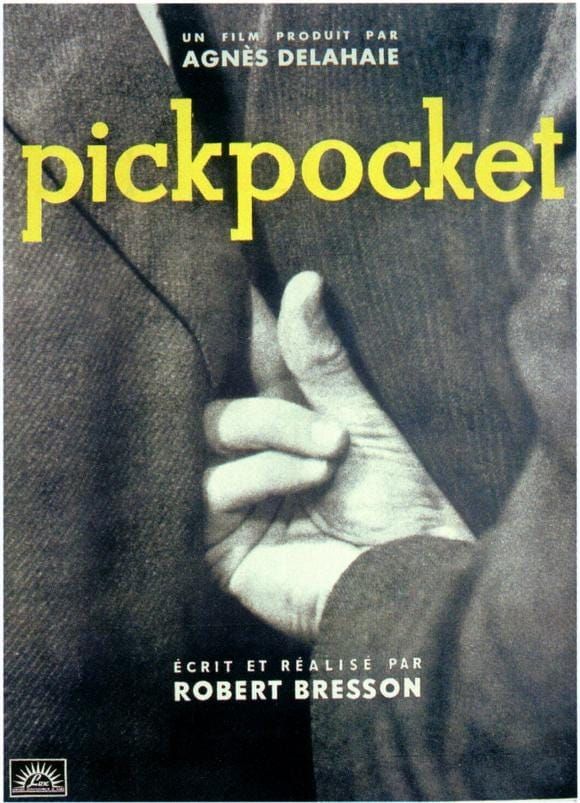
May is Classic 50s Movie month. Today’s guest post comes from Zach Jansen.
Movie Title: Pickpocket
Year: 1959
Writer: Robert Bresson
Lead Actors: Martin LaSalle, Marika Green, Kassagi (also served as technical advisor for pickpockets’ skills), Jean Pélégri, Pierre Leymarie
Director: Robert Bresson
IMDb Plot Summary: Michel is released from jail after serving a sentence for thievery. His mother dies and he resorts to pickpocketing as a means of survival.
Why I Think This Is A Classic 50s Movie: Pickpocket is a classic 50s movie (and a classic movie period) because like all of Bresson’s films, it pushes the expectations of what cinema can be. (For Bresson, there was a distinct difference between a movie — essentially filmed theatre — and film/cinema, which attempted to create new experiences with its use of moving images and sound.)
What I find most interesting about Bresson is that he was a hailed as a kind of father or forerunner of French New Wave, but none of his films fully fall into the movement. In fact, many of his early films fit in more with the Italian neorealism movement (real locations, non-actors, focus on the lower class). Granted, both movements share many commonalities, but the fact that Bresson (and Pickpocket) straddles both of these important and influential schools of filmmaking is an indication of the kind of filmmaker Bresson was. He defied categorization while still adding to various canons of film waves and movements.
And that’s also what makes Pickpocket a classic movie: It’s more or less Bresson’s masterpiece, but it’s also his most accessible film for neophytes to French New Wave and Italian neorealism and Bresson himself. It’s essentially a gateway film to styles and filmmakers some might have never discovered and enjoyed.
My Favorite Moment in The Movie: I love the tension throughout every pickpocketing scheme Michel and his accomplices perform, but Michel’s inevitable arrest (via an undercover operation he seems completely aware of) carries with it the emotional and fatalistic power of any great crime-and-redemption story.
But nothing can beat the tour de force train station sequence. There’s so much to admire, it’s probably best to just show it in its entire 4:30 instead of trying to put into words how technically sound and dramatically engaging the sequence is:
My Favorite Dialogue in the Movie: From altruism to superiority…
JACQUES: Are there many thieves?
CHIEF INSPECTOR: Many. All different kinds. An infinite variety.
JACQUES: Not all theft is so serious. Some can be excused if poverty is behind it.
CHIEF INSPECTOR: Of course.
JACQUES: Could one turn a blind eye to certain kinds of theft? (to Michel) You have a theory on that.
MICHEL: Me?
CHIEF INSPECTOR: Let’s hear it.
MICHEL: It’s nothing new.
CHIEF INSPECTOR: Let’s hear it anyway.
MICHEL: Can we not admit that certain skilled men, gifted with intelligence, talent or even genius, and thus indispensable to society, rather than stagnate, should be free to disobey the laws in certain cases?
CHIEF INSPECTOR: That could be difficult. And dangerous.
MICHEL: Society could only gain from it.
CHIEF INSPECTOR: Who will identify these supermen?
MICHEL: They themselves. Their conscience.
CHIEF INSPECTOR: You know any man who doesn’t think he’s exceptional?
MICHEL: Don’t worry. It would only be at first. Then they’d stop.
CHIEF INSPECTOR: They don’t stop, believe me. A useful thief, then? A benefactor? That’s the world upside down.
MICHEL: It’s already upside down. This could set it right.
Key Things You Should Look For When Watching This Movie: I think the most important thing you should look for when watching Pickpocket is how much Bresson expects you to be involved and an active viewer of the film.
For instances, there are few establishing or master shots in the film’s 75 minutes. Oftentimes, a scene begins with a medium shot, sometimes a close-up, and the camera never “opens up” any wider. It’s up to us, the audience, to figure out where we are with the simple yet subtle clues we’re handed. For instance, the open scene (after the shot of Michel’s diary/confession, which acts as a framing device) starts with a close-up on a purse backed up on the soundtrack with crowd noise. There’s a booth with a man taking money and giving tickets in return. It’s not until almost a minute into the narrative that we know where we are location-wise. Immediately, Bresson demands your attention and pulls into trying to figure out not only what’s going on screen, but where it’s going on (there’s another scene that looks to be at an outdoor café, but a subtle reflection in a window informs us that we’re at a carnival/amusement park).
Perhaps the most important thing to take away is how important and vital film language and grammar can be in telling the story. Film isn’t just telling a story, but it’s how you tell the story (with images and sounds). It’s not just characters speaking the plot (often right on the nose), but living and being the plot. Too often nowadays, characters are only in a movie to serve the plot or story; with Pickpocket (and much of Bresson’s oeuvre), there is no story without the characters.
Thanks, Zach! To show our gratitude for your guest post, here’s a dash of creative juju for you. Whoosh!
Twitter: @WriterZach.
We already have a set of classic 60s Movies, 70s movies, 80s Movies and 90s Movies. This month, we’re working on 50s movies. And thanks to the GITS community, we’ve got 31 movies in the works! Those who I put in bold have already sent me their posts. If you haven’t sent yours to me, please do so as soon as you can!!!
12 Angry Men — Ipsita Barik
A Place in the Sun — Zach Jansen
A Star is Born — Melinda Mahaffey
A Touch of Evil — David Joyner
All About Eve — Ricardo Bravo
American in Paris — stefani1601
Bridge on the River Kwai — Tom Peterson
Cat on a Hot Tin Roof — uncgym44
Commando Cody: Sky Marshall of the Universe — J Nilsson-Acosta
File on Thelma Jordon, The — David Joyner
Harvey — Felicity Flesher
High Noon — Jeff Messerman
Invasion of the Body Snatchers — Rick Dyke
Kiss Me Deadly — John Henderson
Marty — jetwillie69
Night of the Demon — David Hutchison
Night of the Hunter — Mark Twain
On the Beach — Liz Warner
On the Waterfront — Bilbo Poynter
Pickpocket — Zach Jansen
Pick Up on South Street — Vincent Martini
Quiet Man, The — Traci Nell Peterson
Rear Window — Roy Gordon
Rebel Without a Cause — Jack McDonald
Searchers, The — mkm28
Seven Samurai, The — Paul Graunke
Singin’ in the Rain — Maegan Kelly
Some Like It Hot — Will King
Stalag 17 — James Schramm
Sunset Blvd. — Lisa Byrd
Tokyo Story — Jeff Messerman
Vertigo — Jason Pates
Thanks to everyone!
For the original post explaining the series, go here.
For all of the 50s movies featured in the series, go here.