Classic 50s Movie: “The Seventh Seal”
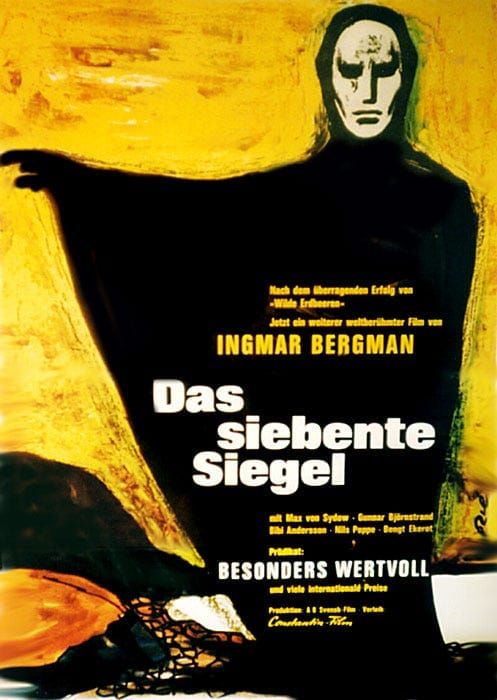
May is Classic 50s Movie month. Today’s guest post comes from Megaen Kelly.
Movie Title: The Seventh Seal
Year: 1957
Writer: Screenplay by Ingmar Bergman
Lead Actors: Max Von Sydow, Gunnar Björnstrand, Bibi Andersson, Nils Poppe and Bengt Ekerot
Director: Ingmar Bergman
Plot Summary: After 10 years away at the Crusades, a knight and his squire return home to a world unfamiliar to them. It is a world of fear and hysteria as the plague is sweeping through medieval Europe. Contrasting the squire’s strongly held secular views with the knight’s yearning for answers to metaphysical questions, Death shows up. He accepts a game of chess from the knight, with the knight’s freedom vs. his life as the stakes.
Added to this mix of life and death are a small troupe of actors, a love-sick blacksmith and his wandering wife, and others all trying to survive in a world gone mad.
Why I Think This is a Classic 50’s Movie: If Persona is Bergman’s seminal work, then surely The Seventh Seal is his most iconic and influential. Few films have had as many homages and parodies of them as The Seventh Seal has. But that just proves the adage “imitation is the sincerest form of flattery”. It is an amazing film that transcends the time in which it was made, in large part due to its ubiquitous themes of love and death.
Since the time when humans developed the brain capacity to consider philosophical issues, we have been looking for ways to cheat death. The Seventh Seal is the ultimate “trying to cheat death at his own game” film.
But it is more complex than that, although it seems to deal primarily with dualities. From the beautiful black and white cinematography by long-time Bergman cinematographer Gunnar Fischer, to the polar opposite views of knight (Von Sydow) and squire (Björnstrand), The Seventh Seal starkly lays out mankind’s soul and shows how we must all face the Grim Reaper.
The knight and squire are outsiders in their own village, as are the traveling actors. They witness first-hand the mass delirium of the villagers as they are whipped up into a religious frenzy, hoping that if they pray hard enough to God he will spare them from the Black Death. Slowly the two parties of outsiders come together and try to make their way at night through the woods to the knight’s home, where he left his bride 10 years earlier.
When we first see the wayfaring actors, they are full of life and love. It is morning in the countryside and nothing evil could possibly exist in this world. The married couple (Andersson and Poppe) has an infant son, the promise of a bright future. They even influence the faith-challenged knight, giving him hope, even for a moment. But then his game with Death continues, and his questioning of God’s silence persists.
The villagers are seen as selfish survivors, trying to cheat death and finding amusement, even of a malevolent nature, wherever they can. They terrorize Jof, the married male actor, making him perform as a dancing bear while fire licks at his feet.
In contrast to this dehumanizing atmosphere the knight and squire show great compassion. The squire saves a young woman from being raped, and both master and servant try to help another young woman accused of sleeping with the devil and bringing the plague to the village. In fact, it is the knight’s sacrifice that leads to the characters’ denouement.
The film was met with huge acclaim when it was released. It won numerous awards and has gone on to be listed in many ‘best films of all time’ lists. It has been analyzed and written about by many. It is undeniably a moving, well-made film that stands the test of time.
My Favorite Moment in the Movie: In typical film squire manner, Björnstrand’s character adds… not quite levity to the film — that’s not how Bergman works — but his earthly views and humanist attitude are lighter counterpoints to the knight’s stoicism. The garrulous squire has many high points in the film, from his banter with a church painter to his consoling friendship with the lovesick blacksmith.
Similar in film temperament to the squire is Jof, and in fact they have similar names — Jons and Jof, although the subtitles gave the squire’s ‘name’ as J. However, while the squire is a seen it all and done it all kind of guy, Jof still has a joie d’vivre attitude towards life. Scenes with either of them are wonderful.
Jof’s love of life is most profound in his relationship with his beautiful wife Mia and their lovely son. Andersson, a staple in many Bergman films, captivates the viewer with her beauty and innocence. Look for their opening scene together and their crazy musical number shortly afterwards (but no English subtitles).
My Favorite Dialogue: Understandably, many of the most enjoyable quotes are provided by the squire. I particularly love when he says “Love is the blackest of all plagues… if one could die of it, there would be some pleasure in love, but you don’t die of it.”
Contrasting this worldly topic is the knight’s struggle with his Christian faith. A typical example of his musings:
“Is it so terribly inconceivable to comprehend God with one’s senses? Why does he hide in a cloud of half-promises and unseen miracles? How can we believe in the faithful when we lack faith? What will happen to us who want to believe, but can not? What about those who neither want to nor can believe? Why can’t I kill God in me? Why does He live on in me in a humiliating way — despite my wanting to evict Him from my heart? Why is He, despite all, a mocking reality I can’t be rid of?”
However, the knight — called Antonius Block — is capable of everyday human emotion as well. Sitting with the actors, his squire and the girl he saved, Block reflects:
“I shall remember this moment: the silence, the twilight, the bowl of strawberries, the bowl of milk. Your faces in the evening light. Mikael asleep, Jof with his lyre. I shall try to remember our talk. I shall carry this memory carefully in my hands as if it were a bowl brimful of fresh milk. It will be a sign to me, and a great sufficiency.”
Of course the give and take between Death and knight shouldn’t go without an example:
Antonius Block: I want knowledge! Not faith, not assumptions, but knowledge. I want God to stretch out His hand, uncover His face and speak to me.
Death: But He remains silent.
Antonius Block: I call out to Him in the darkness. But it’s as if no one was there.
Death: Perhaps there isn’t anyone.
Antonius Block: Then life is a preposterous horror. No man can live faced with Death, knowing everything’s nothingness.
Death: Most people think neither of death nor nothingness.
Antonius Block: But one day you stand at the edge of life and face darkness.
Death: That day.
Antonius Block: I understand what you mean.
Key Things to Look for When Watching This Movie:
Of course everyone knows the short scene of von Sydow’s knight on the beach at night playing chess with Death — it is an iconographic image in the history of cinema. But that is just the beginning of their game, which is played out throughout the film.
Arguably the second most famous image from the film is the danse macabre at the end. It has also been redone in several films (again, without English subtitles):
Here is that dialogue in English: I see them! Over there against the stormy sky. They are all there. The smith and Lisa, the knight, Raval, Jöns, and Skat. And the strict master Death bids them dance. He wants them to hold hands and to tread the dance in a long line. At the head goes the strict master with the scythe and hourglass. But the Fool brings up the rear with his lute. They move away from the dawn in a solemn dance away towards the dark lands while the rain cleanses their cheeks of the salt from their bitter tears.
I can’t leave you without sharing what I believe to be the best of the homages/parodies of The Seventh Seal. Nearly 35 years after the release of this Swedish masterpiece, a sequel to a sleeper hit not only contained a scene based on one from The Seventh Seal, but one of the main characters’ look is drawn virtually identically with that in Bergman’s film, complete with fake Swedish accent:
Thanks, Megaen! To show our gratitude for your guest post, here’s a dash of creative juju for you. Whoosh!
We already have a set of classic 60s Movies, 70s movies, 80s Movies and 90s Movies. This month, we’re working on 50s movies. And thanks to the GITS community, we’ve got 31 movies in the works!
Those who I put in bold have already sent me their posts. If you haven’t sent yours to me, please do so as soon as you can!!!
12 Angry Men — Ipsita Barik
A Place in the Sun — Zach Jansen
A Star is Born — Melinda Mahaffey
A Touch of Evil — David Joyner
All About Eve — Ricardo Bravo
American in Paris — stefani1601
Bridge on the River Kwai — Tom Peterson
Cat on a Hot Tin Roof — uncgym44
Commando Cody: Sky Marshall of the Universe — John Nilsson Acosta
File on Thelma Jordon, The — David Joyner
Harvey — Felicity Flesher
High Noon — Jeff Messerman
Invasion of the Body Snatchers — Rick Dyke
Kiss Me Deadly — John Henderson
Marty — jetwillie69
Night of the Demon — David Hutchison
Night of the Hunter — Mark Twain
On the Beach — Liz Warner
On the Waterfront — Bilbo Poynter
Pickpocket — Zach Jansen
Pick Up on South Street — Vincent Martini
Quiet Man, The — Traci Nell Peterson
Rear Window — Roy Gordon
Rebel Without a Cause — Jack McDonald
Searchers, The — mkm28
Seven Samurai, The — Paul Graunke
Seventh, Seal, The — Megaen Kelly
Singin’ in the Rain — Megaen Kelly
Some Like It Hot — Will King
Stalag 17 — James Schramm
Sunset Blvd. — Lisa Byrd
Tokyo Story — Jeff Messerman
Vertigo — Jason Pates
Thanks to everyone!
For the original post explaining the series, go here.
For all of the 50s movies featured in the series, go here.