Classic 50s Movie: “Vertigo”
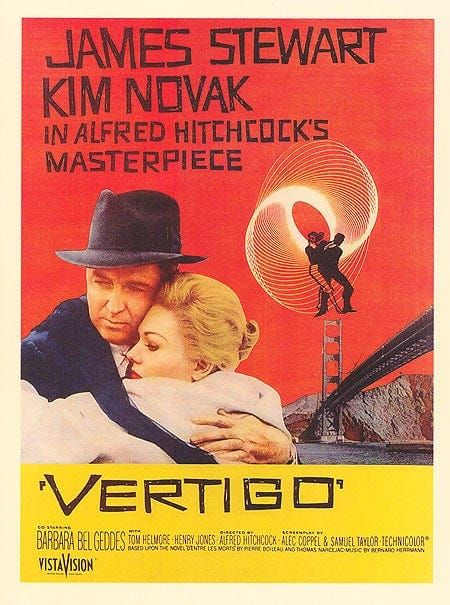
May is Classic 50s Movie month. Today’s guest post comes from Jason Pates.
Movie Title: Vertigo
Year: 1958
Writers: Screenplay by Alec Coppel and Samuel A. Taylor, based on the 1954 novel D’entre les morts by Pierre Boileau and Thomas Narcejac
Lead Actors: James Stewart, Kim Novak
Director: Alfred Hitchcock
IMDb Plot Summary: A retired San Francisco detective suffering from acrophobia investigates the strange activities of an old friend’s wife, all the while becoming dangerously obsessed with her.
Why I Think This Is A Classic: Although garnering mixed reviews upon initial release, Vertigo is now considered one of Hitchcock’s crowning achievements. It ranks ninth on AFI’s top 100 American movies, first on AFI’s top mysteries, and even replaced Citizen Kane as the greatest film of all time according to the British Film Institute’s 2012 poll. Vertigo’s influence remains very much alive today, nearly 60 years later, as evidenced from the opening in Mad Men (see 1:19 of Scottie’s dream sequence) to the Bernard Hermann’s haunting “Scène d’amour” as controversially replicated in The Artist. Some even draw parallels to Toy Story 2! By any measure, Vertigo left an indelible mark on cinema and television in a way only Hitchcock could.
My Favorite Moment In The Movie: When Scottie sits, waiting for Judy to complete her transformation into Madeleine, we watch with baited breath. Will Judy go through with it? Will Scottie lose what’s remaining of his sanity? And for a moment, as we see her in the green glow of the neon lights, we sense what it feels like to interact with an old obsession, one that we thought was gone forever, in exactly the form we remember it. Like we’ve stepped into a movie ourselves.
My Favorite Dialogue In the Movie:
Scottie: What are you thinking?
Madeleine: Of all the people who’ve been born and have died while the trees went on living.
Scottie: Their true name is sequoia sempervirens — always green, ever living.
Madeleine: I don’t like them.
Scottie: Why?
Madeleine: Knowing I have to die.
Scottie: Here’s a cross-section of one of the old trees that’s been cut down.
Madeleine: Somewhere in here I was born — and there I died. It was only a moment for you. You took no notice.
Scottie: Madeleine … Madeleine, where are you now?
Madeleine: Here with you.
Scottie: Where?
Madeleine: Tall trees.
Scottie: Have you been here before?
Madeleine: Yes.
Scottie: When? When? When were you born?
Madeleine: Long ago.
Scottie: Where? When? Tell me.
Madeleine, tell me! Madeleine: No.
Scottie: Madeleine, tell me where? Where do you go? What takes you away? When you jumped into the bay, you didn’t know where you were. You guessed but you didn’t know.
Madeleine: I didn’t jump. I didn’t jump I tell you. You told me I jumped.
Scottie: Why did you jump? Why did you jump?
Madeleine: Oh, I can’t tell you.
Scottie: Why did you jump? What was there inside that told you to jump?
Madeleine: No please. Please.
Scottie: What? What?
Madeleine: Please don’t ask me. Please don’t ask me. Get me away from here.
Scottie: Shall I take you home?
Madeleine: Somewhere in the light. Promise me something? Promise you won’t ask me again? Please promise me that.
Key Things You Should Look For When Watching This Movie:
Use of color. Watch for green symbolizing Scottie’s subconscious/falling into obsession, and red, suggesting romantic fears, or danger.
Hitchcock’s technical achievements — such as inventing what is now known as the “dolly zoom”, created by simultaneously zooming in while tracking backwards with the camera, as evidenced in the shots of Scottie looking down the staircase.
Hitchcock wasn’t happy with the letter-writing scene after seeing a final cut screening. He cut it, over the objections of the production staff. When Paramount president Barney Balaban discovered the additional edit, he ordered the scene restored. While watching Vertigo, try to imagine the film without it.
Bernard Herrmann’s eerie score, omnipresent in a film that goes nearly full sequences without dialogue.
Alternative ending
Hitchcock’s cameo
Note: I highly recommend that readers interested in immersing themselves in Vertigo’s themes and Hermann’s supernatural score (as well as in Hitchcock’s Rebecca and Psycho) take in the astounding Off Broadway production “Sleep No More”, held in the McKittrick Hotel, no less.
Thanks, Jason! To show our gratitude for your guest post, here’s a dash of creative juju for you. Whoosh!
Twitter: @JasonPates.
We already have a set of classic 60s Movies, 70s movies, 80s Movies and 90s Movies. This month, we’re working on 50s movies.
Here is an updated list of 27 fine folks who have already volunteered [those who I put in bold have already sent me their posts]:
12 Angry Men — Ipsita Barik
A Place in the Sun — Zach Jansen
A Star is Born — Melinda Mahaffey
A Touch of Evil — Vincent Martini
All About Eve — Ricardo Bravo
American in Paris — stefani1601
Cat on a Hot Tin Roof — uncgym44
File on Thelma Jordon, The — David Joyner
Harvey — Felicity Flesher
High Noon — Jeff Messerman
Invasion of the Body Snatchers — Rick Dyke
Kiss Me Deadly — John Henderson
Marty — jetwillie69
Night of the Demon — David Hutchison
Night of the Hunter — Mark Twain
On the Waterfront — Bilbo Poynter
Pickpocket — Zach Jansen
Quiet Man, The — Traci Nell Peterson
Rear Window — Roy Gordon
Searchers, The — mkm28
Seven Samurai, The — Paul Graunke
Singin’ in the Rain — Maegan Kelly
Some Like It Hot — Will King
Stalag 17 — James Schramm
Sunset Blvd. — Rick Dyke
Tokyo Story — Jeff Messerman
Vertigo — Jason Pates
I’m looking for 31 guest posts, one for each day of May. Why not pitch in to help add to this online resource to inspire writers to learn about and — most importantly — watch great movies.
If you have a classic 50s movies on which you’d like to do a writeup, please either post in comments or email me.
Thanks in advance!
For the original post explaining the series, go here.
For all of the 50s movies featured in the series, go here.