Classic 50s Movie: “The Searchers”
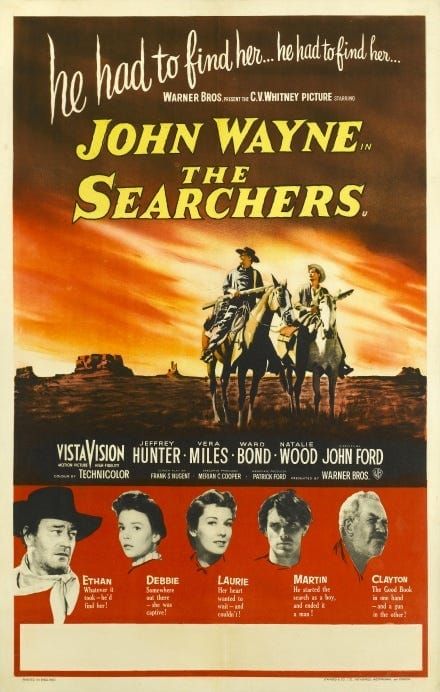
May is Classic 50s Movie month. Today’s guest post comes from Melinda Mahaffey.
Movie Title: The Searchers
Year: 1956
Writer: Frank S. Nugent from the novel by Alan LeMay
Lead Actors: John Wayne, Natalie Wood, Vera Miles, Jeffrey Hunter
Director: John Ford
Adapted IMDb Plot Summary: John Wayne stars as Civil War veteran Ethan Edwards, who embarks on a journey with his adopted nephew Martin to rescue his young niece Debbie from an Indian tribe.
Why I Think This Is A Classic 50s Movie: Cited as one of the greatest films ever made, The Searchers has legendary fans. Writing in The Hollywood Reporter, Martin Scorsese said the film was a “touchstone” for him and other directors of his generation, while Stephen Spielberg has reportedly watched the movie numerous times, including twice on the set of Close Encounters of the Third Kind.
Having said that, I don’t always find The Searchers to be the most enjoyable movie to watch — it feels unnecessarily lengthy (119 minutes) and has some unfunny comic scenes and characters. But I always come back for John Wayne’s performance. When I think of the heroes he portrayed onscreen, I think of a gruff character who treads the line between hero and villain, and I find his Ethan Edwards to be the deepest iteration of that. The Searchers is arguably John Wayne at his finest.
My Favorite Moment In The Movie: Well, let’s start off with the classic scene. Although Ethan has spent years searching for Debbie, he’d rather see her dead than living as a Comanche. Toward the end of the film, he has to make that decision:
But my favorite moment comes earlier in the movie, when he admits he’s hidden the truth about his other niece Lucy from Brad Jorgensen (her sweetie) and Martin. It’s the only scene where he shows the grief he feels; he’s usually so fixated on revenge.
My Favorite Dialogue In the Movie: Near the end of the film, Ethan and Martin return home, and Martin finds out that his sweetie, Laurie Jorgensen, is about to marry another man. (Note that this exchange is followed by one of the most polite fight scenes ever.)
Laurie: Marty, Charlie, I ain’t gonna have no fighting in my house.
Marty: Well, then, we’re just gonna fight outside, doggone it.
Key Things You Should Look For When Watching This Movie:
How the opening and closing scenes mirror each other: As the opening credits roll, the song “The Searchers” (written by Stan Jones) asks: “What makes a man to wander? What makes a man to roam? What makes a man leave bed and board and turn his back on home? Ride away, ride away, ride away.” Then the door of a homestead opens, and Martha in silhouette is framed against a Monument Valley backdrop. She comes outside to see who her visitor is — and it’s Ethan, the prodigal son. Then, at the end of the film, as Ethan arrives with Debbie, another verse of the song begins to play, ending with the same refrain of “Ride away, ride away, ride away.” This time, as the men return with Debbie, they are welcomed home by the Jorgensens. Everyone goes inside — except for Ethan. He’s framed in the dark doorway, and as he turns away, the door shuts on him.
The relationship between Ethan and Martha: There’s been a lot of speculation about the exact nature of the relationship between Ethan and Martha, his brother’s wife. Is it just fondness? Unrequited love? Is he actually Debbie’s father? The film provides no answers, but the dynamic between them is definitely weird.
Sister act: Natalie Wood plays the teenage Debbie, while her little sister, Lana Wood, plays the younger Debbie at the beginning of the film.
And a blooper: About 25 minutes into the movie, Ethan and a group of men find a Comanche Indian buried under a rock. As they lift up the heavy stone, you can very distinctly see movement as the actor breathes.
Thanks, Melinda! To show our gratitude for your guest post, here’s a dash of creative juju for you. Whoosh!
And thanks to everyone who contributed a post.
For the original post explaining the series, go here.
For all of the 50s movies featured in the series, go here.
For previous classic movie series: 60s Movies, 70s movies, 80s Movies and 90s Movies.