Interview (Part 3): Emile Gladstone
Recently I had an in-depth conversation with movie and TV producer Emile Gladstone. Previously a talent agent at ICM where he was a partner and co-head of the Motion Picture Literary department, Emile is currently in post-production on his first film Army of One, written by Rajiv Joseph and Scott Rothman, directed by Larry Charles and starring Nicolas Cage.
Today in Part 3, Emile provides background on his movie project Army of One and his take on the state of the movie business:
Scott: Let’s talk about Army of One, that stars Nicolas Cage, directed by Larry Charles. As I understand it, it was based on a magazine article about a guy who traveled to the Middle East on his own to try and capture Bin Laden. He carried a sword. Is that right?
Emile: That’s right. Jeremy Steckler is an executive that I’ve always respected. He’s now a sr executive at Conde Naste in charge of shepherding their IP into films. When I left agenting, he was kind enough to send me a bunch of articles. Of the stack there was one that was a clear movie to me. I immediately got it and had to produce it. You have to feel that way. Jump up on the table passionate.
I contacted Jeremy, and I said, “I think it’s a comedy. I think Larry Charles should direct it. This is why.”
He thought that was a great idea. We talked about different writers that had been circling the projects, and he mentioned Rajiv Joseph and Scott Rothman. I was enormous fans of theirs, off of their script, “Draft Day,” and off of Rajiv’s play, “The Bengal Tiger at the Baghdad Zoo.”
Rajiv Joseph, Kevin Costner, Scott Rothman
At the time, I didn’t know that they had any kind of comedy background but turned out to be really really funny. I knew that the comedy would come from Larry, and that if I had a strong drama writer that can bring a real level of emotional depth to the character, then it wouldn’t be a joke. We needed to care about our central character and be empathetic to his quest. Everyone reading this will agree emotion is the key to storytelling.
We reached out to those guys, and we told them that this is what we’d like to see happen. They were game, and they wrote it on spec for us. If they didn’t this movie would have never been made. They wrote a brilliant script.
We got their material to Larry Charles, who loved it and got it right away. Larry’s been at ground zero of cutting edge comedy for 30 years. Think about his career. Fridays, Sienfeld, Curb, Borat.
What happens is you, as a producer, have a notion, an idea. You read a book. You read an article, and you see it a certain way. But these ideas are alive, and constantly evolving. Then, the writer brings new stuff to it that you just didn’t see before, and you go, “Wow, that’s incredible.”
Then, the director comes in and takes it again to just a whole other level, and you’re just blown away by craft and genius that these artists bring to the table.
Larry and Rajiv and Scott continued to hone it and work on it. We got it to Nic, and Nic signed on. He was absolutely brilliant in the role and obviously has an extraordinary history in comedy that has been untapped for a very long time. The man is just a treasure, artistically, and has been looking for the right role.
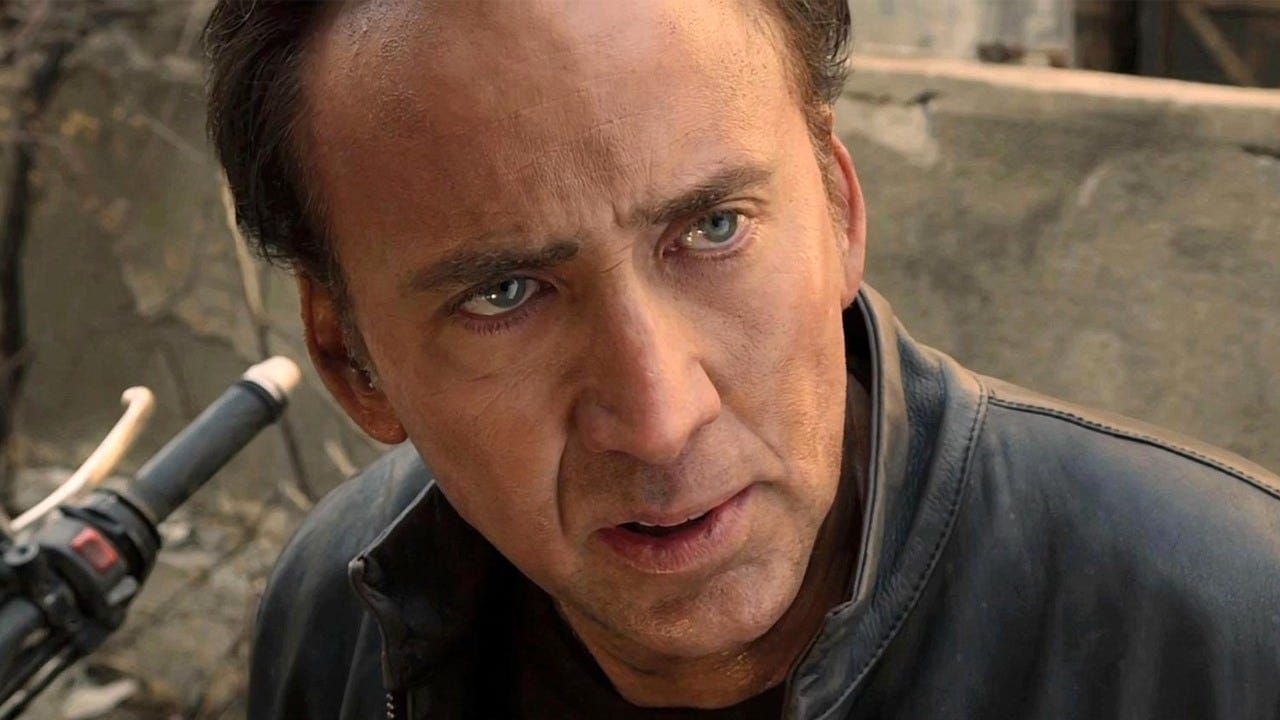
Nicolas Cage, star of Army of One
Larry felt strongly, as did Jeremy and I, that he would be terrific in it. We got him attached, and then we were able to take the package to financiers and get the movie financed. Then, we sold it to a distributor before cameras rolled, and we made the movie. But it all happened because the writers were generous enough with their time to spec it out for us.
Writers and spec scripts are central to my producing plan, since a packaged spec offers me the most leverage. Everyone is looking for a movie. Few are looking for development.
Once you lay it off at a studio or a financier as a piece in development, it’s really out of your hands. There’s so many new factors. If I have a script, I can package it. Once I have a package anything is possible. Everyone’s desperate for movies. No one’s desperate for development. If I have a movie, then I have the leverage, and I’m able to use that leverage and my skill set to navigate and get the movie made.
Scott: Let’s talk about TV. Is it Cavendish? Is that happening at ABC?
Emile: No, it was written by phenomenal writer, Chris Silber. He’s a coEP level writer. and really talented. We met, generally. He told me an idea. We developed it, and we sold it to ABC. It was in contention last season, and it didn’t move forward.
Unlike film, its really hard to pivot from the network that developed it and find another home. It happens but those are outliers.
Scott: You’ve done this for so many years and worn so many different hats, you’ve got probably a pretty unique perspective on things. There’s been a lot of changes, obviously, in the last 20 years. You mentioned financiers. The studios have this seemingly bifurcated approach. Expensive, big budget franchise movies, and then lower budget genres, but then there’s that void in the middle.
It seems like the financiers have stepped in and really…Could you maybe talk a bit about that development, and what’s your take on that?
Emile: What you just said is true and I think it’s really healthy for the business.
The studios are focused on summer and Christmas. Their tent poles and their sequels and prequels and remakes. Their algorithms and models suggest that their best returns are around movies that they spend a lot of money on. They wind up doing billions of dollars’ worth of business in box office and merchandise. Good on them. That’s terrific. Then, they also, as of recently, the last five years or four years, have said, “The margins are terrific on these low budget horror movies. Why don’t we make them, too?” Good on them. I think that’s terrific. But then, you see franchise starters, elevated genre movies, that cost between 5 and 25 million dollars fall by the wayside. Every now and then a chronicle or project x makes it through and does well, but the studios are more focused on tentpoles.
Also, dramas and, to a lesser extent, romantic comedies getting picked up by the financiers. I think that no one in this business markets or distributes better than a major studio. They’re these giant machines that can get your movie into theaters and keep it in theaters. They have incredible resources and incredible pipes. You want to take advantage of that. Some of the smartest people i know work in the studio system.
That said, If you can develop a movie outside the system, package it, and then sell it back to the system, you’re taking advantage of what they’re excellent at, while avoiding the frustration of waiting for them to focus on your smaller movie.
Our number one export in the world is film. You go to any country…I was just in Morocco. American movies were playing around the clock on every damn channel there. I was also traveling with my family in Paris, Spain, and Italy for a holiday after my shoot. Everywhere you go, on every channel it’s American film. Our export has never been stronger, and the need for our product has never been greater.
Again, the issue for the writer is going to be there’s less of a guaranteed living to make because unless you’re writing the sequels, the prequels, and the franchise movies, you’re writing more on spec than ever while desperately trying to get the next “Mission Impossible” rewrite or the next “Jurassic Park” rewrite. That’s rare air and it’s really hard to break into it.
When I was first an agent, the Disney group alone, between Hollywood Pictures, Touchstone, Walt Disney Pictures, made 30 movies a year, or something crazy like that. Now they make a fraction.
There were so many producers with studio first look deals when I first started out. Producers that need to be serviced with development. There was a lot of guaranteed business for writers in terms of writing things on assignment that paid well. Those writers would then burn out because all they were doing was producing paper. Movies often wouldn’t get made because they were making 30 movies a year, but they were developing 130.
You saw a lot of writers get burned out. You saw a lot of people get frustrated. It’s a very hard siren to avoid. Do you want to write this ride, or this whatever? It’s hard to navigate what’s going to get made and what’s not. Even when you game it to the best of your ability you can be very wrong. There’s so many extraneous circumstances.
I think it’s a great time to be a maker. That’s the way that you have to look at it now. You have to feel that you’re a maker and that you’re going to make it. Not make development. make content. Cause if you do, there is likely a buyer. And if your smart with your budget and production plan, you are going to make money.
You might make at a studio, and you might make independently, and you might make for a digital platform. There’s never been a greater time to make. It is a harder time than ever to say, “I’m going to be a professional writer that’s going to work exclusively on assignments in the studio system.” It’s still possible. People do it every day. But its really hard.
I made a great living working on filling assignments and selling specs and pitches to the studios my entire career as an agent. The majority of my clients did it, but it’s still really rare air. There was a time when you could say, “That’s what I want to do when I grow up.” I don’t think you can say that as much anymore, but you can still say, “I’m going to write movies,” and, “I’m going to write television,” and “I’m going to make.” I truly believe that more than ever you have that opportunity to do that.
Tomorrow in Part 4, I ask Emile some questions about the writing craft.
For Part 1 of the interview, go here.
Part 2, here.
Twitter: @emilegladstone.