Movie Analysis: “Inside Out” — Characters

Another in our bi-weekly series in which we analyze movies currently in release. Why? To quote the writing mantra I coined over 5 years ago: Watch movies. Read scripts. Write pages. You will note which one comes first. Here are my reflections from that post about the importance of watching movies:
To be a good screenwriter, you need to have a broad exposure to the world of film. Every movie you see is a potential reference point for your writing, everything from story concepts you generate to characters you develop to scenes you construct. Moreover people who work in the movie business constantly reference existing movies when discussing stories you write; it’s a shorthand way of getting across what they mean or envision.
But most importantly, you need to watch movies in order to ‘get’ how movie stories work. If you immerse yourself in the world of film, it’s like a Gestalt experience where you begin to grasp intuitively scene composition, story structure, character functions, dialogue and subtext, transitions and pacing, and so on.
Let me add this: It’s important to see movies as they get released so that you stay on top of the business. Decisions get made in Hollywood in large part depending upon how movies perform, so watching movies as they come out puts you in the same head space as reps, producers, execs, and buyers.
This week’s movie: Inside Out, screenplay by Meg LeFauve & Josh Cooley and Pete Docter, story by Pete Docter & Ronaldo Del Carmen, additional dialogue by Amy Poehler & Bill Hader.
Our schedule for discussion this week:
Monday: General Comments
Tuesday: Plot
Wednesday: Characters
Thursday: Themes
Friday: Takeaways
For those of you who have not seen the movie, do not click MORE as we will be trafficking in major spoilers. If you have seen Inside Out, I invite you to join me in breaking down and analyzing the movie.
There are 9 major characters in Inside Out: Riley, Mom, Dad, Joy, Sadness, Anger, Fear, Disgust, and Bing Bong. And because of the parallel journeys which take place — Riley and her parent’s relationship in the External World, and the emotions, particularly Joy and Sadness, in Riley’s Internal World — it’s possible to look at the narrative as being a kind of hybrid Co-Protagonist / Dual Protagonist construction with the two central characters being Riley and Joy.
In a Co-Protagonist story, two or more characters go on a journey together, sharing a similar metamorphosis process. We see this approach a movie like Thelma & Louise.
In a Dual Protagonist story, two or more characters intersect and may or may not spend significant time together, however each has their own distinct transformation-arc. I would argue The Shawshank Redemption falls into this category.
In Inside Out, Riley and Joy experience parallel paths, and each has her own unique spin on both what transpires in the Plotline and how their transformation occurs. However in a deft bit of storytelling, the big lesson Joy learns — that Sadness is not an emotion to be ignored or restrained, rather it is an authentic state which feelings deserved, at times, to be felt — is pretty much where Riley ends up. In other words, their dual journeys co-align at the end.
It’s actually a sophisticated bit of story construction, a nifty balancing act between Riley in the External World and her metamorphosis, and Joy (primarily) and the other emotions in the Internal World and their transformations, both individually and collectively.
It’s an even more complex approach because there is another Internal World dynamic: What goes on inside the emotions, most notably Joy.
One more point to frame the discussion: Who is the Nemesis in this story? I would suggest there isn’t one. This shouldn’t be surprising as Pixar, when they were first coming into existence as a movie production unit, had five guidelines:
- No songs
- No “I want” moments
- No happy village
- No love story
- No villain
Note that last one: No villain. Remember: An Antagonist’s function is primarily to provide opposition to the Protagonist. In Inside Out, the ‘villain’ is not a who. It’s a what. For Riley, it’s the move from the Midwest. Plus it’s the admonition from her father to be strong, essentially not to allow her true feelings of sadness to emerge. She struggles with both throughout the movie.
In terms of Joy and Sadness, the Nemesis dynamic is provided by the series of situations in which they find themselves as they attempt to get back to headquarters. There’s also this: Joy has a perception of Sadness that she is in part a problem for Riley, not as it turns out a key to the solution. That perception acts as a kind of psychological block for much of the story until Joy finally has a breakthrough and realizes how important Sadness is.
What did you think of the characters in Inside Out? Let me hear your thoughts about this surprisingly complex movie with a host of compelling characters.
This Just In: After I’d put this post to bed, this critique of Inside Out hit:
The idea that we as humans can be multiple selves, an ever-evolving product of conflicting emotions and painfully-gained insights, is readily understandable. A battle between these emotions, if personified and animated, could yield a remarkable story.
But Docter’s team didn’t explore that story. Instead they chose to explore the character arc of a personified emotion. What is a personified emotion? If you’ve never encountered one, join the club. In this case it’s apparently a dynamic animated creature who sounds like Amy Poehler. My point here is that by choosing to focus on Joy rather than Riley, the storytellers instantly diminished the universality of their work.
The article by screenwriter, playwright, and professor Paul Gulino is worth a read. Clearly he did not buy into the choices the Pixar team made in terms of the narrative’s dual storylines, as he sees the focus on Joy’s journey putting Riley into a passive role. Some comments:
* The ‘passive’ critique seems to derive from the presumed Hollywood conventional wisdom and warning against passive Protagonists. But then see It’s a Wonderful Life where George Bailey — throughout his entire life — responds to situations and never once gets to actively pursue his dreams of seeing the world and building monumental things. Yet the movie works. Why? I would argue there’s a difference between a passive Protagonist and a reactive Protagonist. George Bailey actively struggles with his life circumstances, through the choices he makes and on his emotional front. Similarly Riley in Inside Out is thrust into her psychological journey by the family’s move to San Francisco. She is not passive, I would argue, but reactive, struggling all along with her emotions, most notably how to handle her sadness.
* The fact Gulino sees Riley as being put into a “supporting role” suggests he didn’t fully buy into the concept that the five emotions are part and parcel of who Riley is, aspects of her psyche, so who they are and what they do is intimately tied to Riley herself. In fact, on an intellectual level, that’s one of the things I found so interesting in watching the movie: The interplay between Riley’s Internal and External Worlds. To this day, there is no unanimity of opinion among scientists about what consciousness really is, so the questions of why we do what we do and who we are as individuals are fundamentally mysteries. Inside Out takes a whack at those questions in the form of Riley’s particular story. Throughout the movie, what happens in her Inner World to the emotion characters is tethered to — influencing and influenced by — Riley’s External World experiences, in my view a colorful and inventive take on human consciousness.
* Yes, Joy and Sorrow go on a more ‘active’ journey than Riley, but the constraints put on Riley are overt in the form of parental pressure, and therefore innate to the story setup itself. The father is under stress due to the risky move he made in terms of his career. The mother reinforces this point in a key conversation with Riley. The basic message she receives from them: Just be a happy little girl like you’ve always been while we Big People sort out all these Big People issues. Indeed, that’s kind of the whole point of the story: She has authentic feelings of Sadness, Fear, Anger, and Disgust, all related to the move, a massive disruption in her life, but she isn’t allowed to have any place to express them as her parents’ circumstances are pushed to the forefront of the family’s life. And so she reacts: Like George Bailey who contemplates suicide, Riley actually starts to run away, and head back to the Midwest. That’s the only solution she can see.
* Another part of Gulino’s critique:
Meanwhile, Joy is treated as the de facto leader of the other emotions, without any explanation. Why is she dominant? Why do the others defer to her? They seem paralyzed when she and Sadness (Phyllis Smith) go off on their unexpected journey through Riley’s psyche. Are the storytellers suggesting that the default setting of human emotions is joy, and the rest have to compete for attention and/or defer to joy? This choice pulls us further from the basic premise.
First off, Joy would naturally be a sort of team leader due to her essential peppy, energetic, and cheerleader personality. Second, having read several interviews with co-writer/director Pete Docter, a primary inspiration for Inside Out was inspired by what happened in his own family, how he saw his daughter go through major emotional changes as she move toward and into adolescence. He wondered what had happened to his happy little girl? Through the series of images of Riley growing up, we see that a dominant mood in her childhood is one of joy. The movie attempts to explore that shift from a fundamentally joyful personality to one riven by sadness in a compressed time frame. Finally, I doubt Pixar is suggesting “the default setting of human emotions is joy,” rather they are saying it is the nature of this specific story: Riley’s journey.
* Re Joy’s character, Gulino adds this:
Further, how can we explain the notion that Joy has a parent’s point of view? The idea that an 11-year-old girl has, within herself, a parental perspective, is rather unusual to say the least, and certainly not borne out in my own parental experience. And yet there is Joy, an integral part of Riley’s psyche, conducting her business like Riley’s mother.
That’s an interesting take — Joy functioning as Riley’s “mother” — but I didn’t see that at all. Rather Joy’s efforts at returning Riley to her joyful pre-move emotional state is more like an obsession. Joy is attached to the way Riley was, unwilling at first to acknowledge the upheaval the events in the External World would evoke in the Internal World. Like I said previously, both Joy and Riley need to learn there is room for all sorts of emotions, that in particular Sadness has its place. Joy’s resistance to this until she finally has an epiphany re Sadness doesn’t strike me as parental, but rather infantile. Joy sees the world of emotions as simplistic and she clings to that childish perception. By the end, she and the other emotions, and by extension Riley, see them as more complex in nature, and that fact is visualized when the colored memory orbs shift from single colors (in the beginning) to mutlicolored (at the end). The message: As we grow up, we learn life is a more nuanced experience, that moments can have all sorts of layers of emotional meaning, an endless combination of feelings.
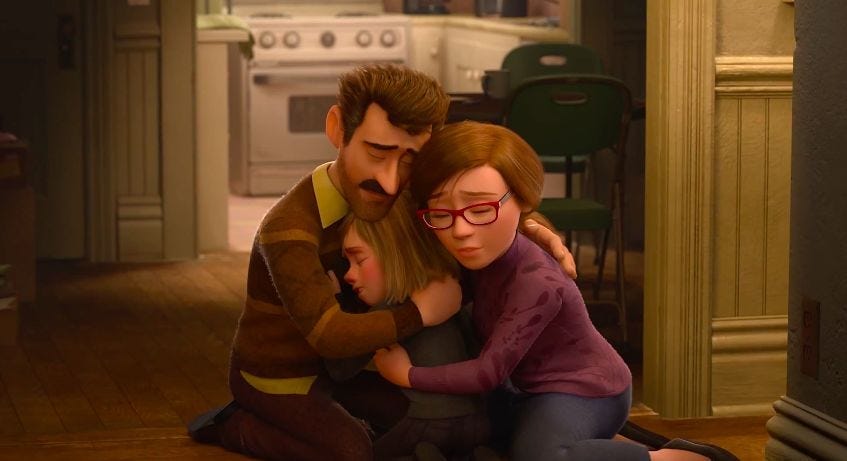
So when Joy embraces the importance of Sadness… and Riley physicalizes this embrace by expressing her sadness to her parents… and the family embraces Riley in that moment, realizing that amidst the current upheaval in their lives, this young girl needs to have room for her feelings… that moment brings all the storylines together in a wonderful piece of synergy.
At least that’s how I experienced it. But as I say, there’s no right or wrong in interpreting a story. Each of us brings an entire lifetime of experiences, memories, feelings, knowledge, and everything else to a story when we watch, read, or hear it.
I look forward to any thoughts you may have about Inside Out.
Comment Archive