Movie Analysis: “Jurassic World” — Themes
Another in our bi-weekly series in which we analyze movies currently in release. Why? To quote the writing mantra I coined over 5 years ago: Watch movies. Read scripts. Write pages. You will note which one comes first. Here are my reflections from that post about the importance of watching movies:
To be a good screenwriter, you need to have a broad exposure to the world of film. Every movie you see is a potential reference point for your writing, everything from story concepts you generate to characters you develop to scenes you construct. Moreover people who work in the movie business constantly reference existing movies when discussing stories you write; it’s a shorthand way of getting across what they mean or envision.
But most importantly, you need to watch movies in order to ‘get’ how movie stories work. If you immerse yourself in the world of film, it’s like a Gestalt experience where you begin to grasp intuitively scene composition, story structure, character functions, dialogue and subtext, transitions and pacing, and so on.
Let me add this: It’s important to see movies as they get released so that you stay on top of the business. Decisions get made in Hollywood in large part depending upon how movies perform, so watching movies as they come out puts you in the same head space as reps, producers, execs, and buyers.
This week’s movie: Jurassic World, screenplay by Rick Jaffa & Amanda Silver and Colin Trevorrow & Derek Connolly, story by Rick Jaffa & Amanda Silver, characters by Michael Crichton.
Our schedule for discussion this week:
Monday: General Comments
Tuesday: Plot
Wednesday: Characters
Thursday: Themes
Friday: Takeaways
For those of you who have not seen the movie, do not click MORE as we will be trafficking in major spoilers. If you have seen Jurassic World, I invite you to join me in breaking down and analyzing the movie.
In Jurassic Park, there were two central and interrelated themes, both voiced by Dr. Ian Malcolm:
“Life will find a way.”
“Your scientists were so preoccupied with whether or not they could… that they didn’t stop to think if they should.”
Both of these are rooted in chaos theory which Malcolm so succinctly and seductively explains:
These themes play throughout the story and virtually at every level, helping to stitch together the narrative so that it’s not only a grand spectacle, there is meaning to the events that unfold. Everything the T-Rex does, all the damage and chaos it creates is an example of chaos theory at work, of life finding a way, and reinforcing the point that recreating dinosaurs may be something scientists can do… but probably ought to avoid.
Of course, if that logic were to prevail… there would be no moneymaking sequels!
Jurassic World echoes this theme in its own way when two characters talk about the same concept: Control.
Masrani, the owner of Jurassic World, says to Claire: “The key to a happy life is to accept you are never actually in control.” Of course, Claire is all about control, that’s her job and she probably obtained the position because she’s good at being in control. I suspect one reason why she’s single and apparently has no interest in having children is they represent aspects of a life which would tend to be out of control, but that’s just speculation.
But, of course, control is critical when overseeing a park where live dinosaurs roam. Indeed, they have facilities called ‘containment centers’. When Owen presses Claire for details about Indominus Rex, he immediately knows this is a dumb idea. I don’t remember the exact line, but he says something to the effect that people can’t control dinosaurs, it’s folly to think otherwise. In this respect, he functions as a second cousin to Dr. Ian Malcolm, Owen’s way of saying dinosaurs are wild beasts, the very embodiment of chaos. Even as he works at training them, Owen knows at any given moment, he could be dead meat. The movie physicalizes this possibility early on when the new attendant feeding the raptors gets flung into the cage causing Owen to have to go in and save the day.
The theme continues to play out in the story:
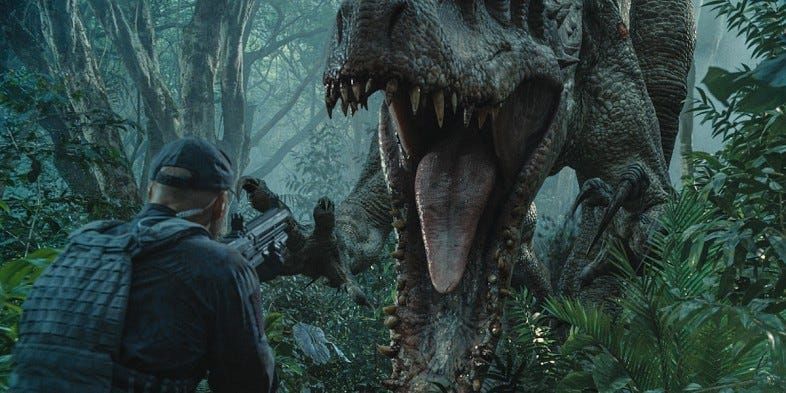
* Owen proved right as Indominus breaks loose, creating massive chaos and damage, hunting for “sport”.
* Claire is thrust into a new experience of being totally out of control, but as part of her arc, she learns to live with it, rolling with the punches, and eventually making what amounts to an irrational decision, certainly against the intentions of the corporation for which she works: To free T-Rex to fight Indominus.
* And most notably with the Hoskins character who is convinced through Owen’s abilities as a trainer, humans can control raptors which would make them the greatest weaponized warriors ever.
So control in JW is the flip side of chaos in JP. It may not be handled as elegantly as the themes in JP, but at least there is a conscious effort to work the theme into the story throughout the narrative.
Were you struck by the theme of control in the movie? Did you think it was handled well? Are there other themes at work in Jurassic World?
I look forward to your comments.
Comment Archive