Classic 40s Movie: “Brief Encounter”
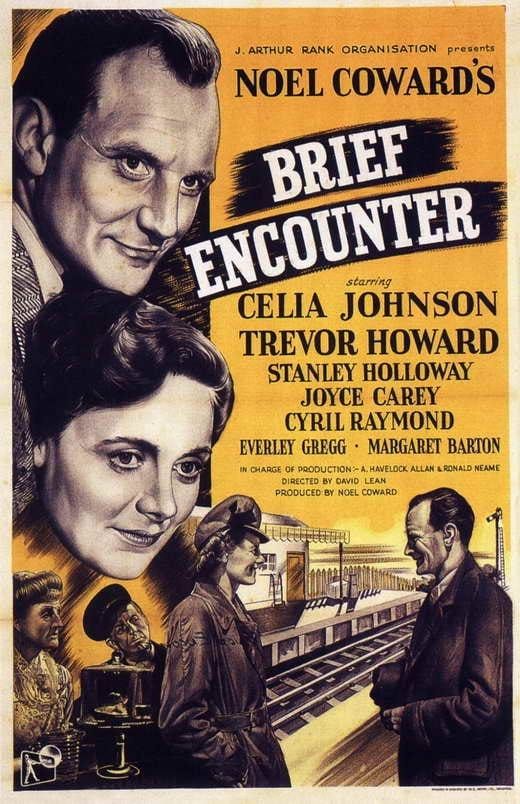
September is Classic 40s Movie month. Today’s guest post comes from Emily Bonkoski.
Movie Title: Brief Encounter
Year: 1945
Writers: David Lean, Ronald Neame, Anthony Havelock-Allan, based on a play by Noel Coward
Actors: Celia Johnson, Trevor Howard
Director: David Lean
IMDb Plot Summary: Meeting a stranger in a railway station, a woman is tempted to cheat on her husband.
Why I Think This Is A Classic 40s Movie
Brief Encounter begins with us meeting Laura and Alec, having a private conversation that’s rudely interrupted by her friend Dolly. Clearly uncomfortable and caught off-guard, Alec rushes off when his train arrives. Dolly has a one sided conversation with Laura, who clearly has other things on her mind based of her generic, automatic responses. Arriving home, she sits in her living room with her husband, remembering what all brought her to this despondent evening in.
This film is a fantastic representation of the writer, the director, and the actors being perfectly in-sync. As a credit to the writing, Brief Encounter is based on the one-act play, Still Life by Noel Coward. The dialogue is frank, revealing, and unashamed. The characters are unapologetic in regards to their relationship yet at the same time do feel forms of guilt. To have such vulnerability revealed in a film written 70 years ago and still be completely relatable is an excellent feat.
As for the acting, they brilliantly portrayed realistic, honest people that are not fancied up by costume or haughty language. They are everyday, ordinary people. Celia Johnson didn’t do many films, she was much more renowned on the stage. Being selective about her film roles, in reading this script she knew she just had to do it. It was too one-of-a-kind to pass up. She perfectly portrays the subtleties of Laura. She selectively reveals herself and lives a rich inner world that she hardly reveals outwardly. Trevor Howard plays her counterpart, a curious energetic doctor who is eager to become closer with Laura. When they’re first together, they almost act like young lovers: almost giddy when around each other.
Brief Encounter was under intelligent, meticulous direction by David Lean. Perhaps a credit to his life before direction, being an editor, Lean had a keen eye for pulling subtleties out of his cast and knowing just what shot would emphasis the importance of the scene, pushing the film forward. His use of angles (in particular the Dutch angle) and focused lighting pull us into the relationship of the two characters, unwilling to let go right until the end. Justifiably, Brief Encounter received three Oscar nominations– Best Writing, Adapted, Best Actress in a Leading Role, and Best Director. Sadly, it won none.
This picture shows black and white film at it’s finest. The use of light and dark focuses our attention, but much happens in the darkness. The light and dark also captures the bleakness of life at the time. The numerous tones of gray support the listlessness and uncertainty of Laura, which in turn represents the overall sentiment of the world at the time due to the end of the Second World War. Interestingly, this was filmed in the farthest part of England from the blitzes to avoid the bombings as much as possible. Naturally, that fact would impact and heighten the mood of the film.
It’s vital to point out that this film was obviously created during the tyranny of the Hay’s Code, yet it still portrayed an extramarital affair as legitimate, honest love. It doesn’t feel like a fling, it’s a love story, which again was a rarity for the time. To make this film even more of a standout than it already is, it’s told solely from the perspective of the woman. That was difficult to find then in film and it’s still difficult to find to this day. She faces and confronts different truths. She lives with a couple of parallels. For one, she’s pulled between two lives: the life she’s leading and the life she envisions herself to have with Alec. The second being the conversations she has on the surface and the undercurrent of her sincerest thoughts.
My Favorite Moment In The Movie
It’s a small moment but makes Laura an even more sympathetic character. Dolly yammers on about some inane topic and while Laura pretends to be listening to her, we’re clued in on what she’s thinking about. With the low bumbling of Dolly’s voice in the background, Laura says, “I wish you’d stop talking. I wish you’d stop prying and trying to find things out. I wish you were dead — no I don’t mean that. That was silly and unkind. But I wish you’d stop talking.” It’s incredibly human because we’ve all had those quick thoughts when we’re talking to someone we don’t care for; it’s slightly humorous, but understandable and relatable.
My Favorite Dialogue In The Movie
It’s two dialogues co-occurring — it’s our first introduction to Laura’s balance between her surface life and her inner world:
Dolly: Well this is a bit of luck! This train is terribly packed! I really am very worried about you, dear, you look terribly peeked.
Laura: I’m alright, really I am. I just felt faint for a minute, that’s all. That happens to me: I did it once in the middle of Bobby’s school concert, I don’t think he’s ever forgiven me!
Dolly: Well he certainly was very good looking!
Laura: Who?
Dolly: Your friend, Dr. Whatever-His-Name-Was.
Laura: Yes, he’s a nice creature.
Dolly: you known him long?
Laura: No, not very long. I hardly know him at all really.
Dolly: Well my dear, I’ve always had a passion for doctors, I can well understand — [voice fades low]
Laura: [to herself] I wish I could trust you. I wish you were a wise, kind friend, instead of a gossiping acquaintance I’ve known carefully over years and never particularly cared for. I wish, I wish…
Dolly: [voice abruptly cuts back in] …he’s going all the way to Africa — is he married?
Laura: Oh, yes.
Dolly: Any children?
Laura: Yes, two boys, he’s very proud of them.
Dolly: Is he taking them with him, his wife and children I mean?
Laura: Yes, yes he is.
Dolly: Oh I suppose it’s sensible in a way, rushing off to Africa to start life anew in the wide open spaces and that sort of thing but wild horses wouldn’t drag me away from England and home and all the things I’m used to — I mean, one has one’s roots.
Laura: Oh yes, one has one’s roots.
Key Things You Should Look For When Watching This Movie
Pay attention to the framing of the whole story. The opening scene plays out from an outsider’s perspective and we start to learn about Laura at a deeper level. We then jump back in memory, eventually meeting up again with the opening scene again but from a new perspective. It’s a wonderful structure of various times. By the end we understand the full weight of the opening scene, so it’s interesting to then go back and review the start of the film.
Watch for Celia Johnson’s subtleties. When she has the thought voiceovers, she’s never dramatic about it how so many actors do. So often when thoughts are played out in films, we see a physical manifestation demonstrated via expressions. Johnson expresses her thoughts how people actually do — hardly any expression at all. Laura’s evolution is fantastic to watch because she goes from an ordinary woman, to a more adventurous person, to a sobering woman aware of her life, to a type of private self-destruction. She so expertly unfolds her stoic misery as well as her reasoning and justifications she tosses back and forth with herself.
The opening shot of the train going by while the credits running overtop provides a sort of ominous foreshadowing. It’s a lower angle, putting us in a more vulnerable spot from the start. Watch for changing camera perspectives of Laura as well as our relation to her. As stated above, Brief Encounter uses the full advantage of black and white film with how much it utilizes light and dark. There’s one particular scene where they kiss in the train station in the darkness before the shadows of approaching people catch up with them. Additionally, the completely brilliant use of the Dutch angle to show a claustrophobic, overwhelming psychological state and the de-escalation of that pressure is probably one of the best uses of that technique ever filmed.
Thanks, Emily! To show our gratitude for your guest post, here’s a dash of creative juju for you. Whoosh!
We already have a set of classic 5os movies, 60s Movies, 70s movies, 80s Movies and 90s Movies. This month, we’re working on 40s movies. And thanks to the GITS community, we’ve got 30 movies in the works, one for each day of the month!
Those who I put in bold have already sent me their posts. If you haven’t sent yours to me, please do so as soon as you can!!!
Act of Violence — Eric Rodriguez
Arsenic and Old Lace — Katha
Bicycle Thieves — Megaen Kelly
Brief Encounter — Emily Bonkoski
Casablanca — Paul Graunke
Double Indemnity — Susan Winchell
Five Graves to Cairo — Jeff Gibson
Foreign Correspondent — Doc Kane
His Girl Friday — John Henderson
It’s a Wonderful Life — David Laudenslager
Key Largo — Will King
Laura — Melinda Mahaffey Icden
Les enfants du paradis — Brendan Howley
Mrs. Miniver — Traci Nell Peterson
Notorious — Christine Henton
Now Voyager — Melissa Privette
Out of the Past — Brantley Aufill
Rope — Lance Morgan
The Bank Dick — Bob Saenz
The Best Years of Their Lives — Shaun Parker
The Big Sleep — Ipsita Barik
The Ghost and Mrs. Muir — Annie Wood
The Long Voyage Home — Vincent Martini
The Lost Weekend — Liz Warner
The Maltese Falcon — Roy Gordon
The Ox-Bow Incident — Clay Mitchell
The Philadelphia Story — Kristen Demaline
The Sin of Harold Diddlebock — David Joyner
The Third Man — Harry Cooke
To Have and Have Not — Felicity Flesher
Thanks to everyone who steps up for this ongoing project!
For the original post explaining the series, go here.
For all of the 40s movies featured in the series, go here.
Click REPLY and see you in comments about today’s classic 40s movie!