Classic 40s Movie: “Double Indemnity”
September is Classic 40s Movie month. Today’s guest post comes from Susan Winchell.
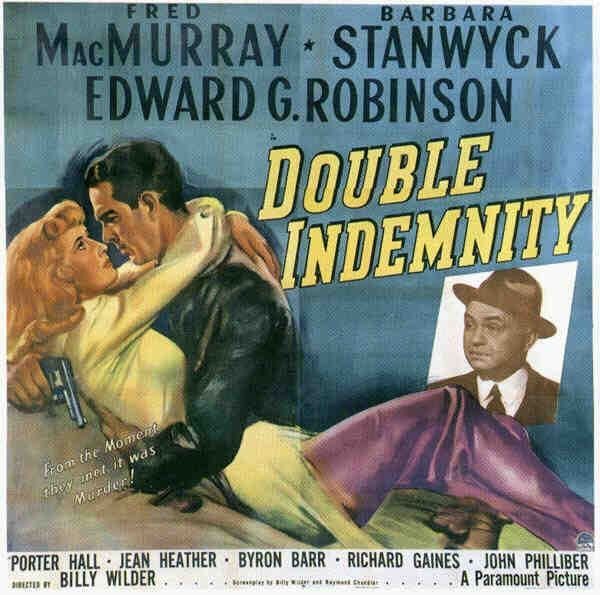
Movie Title: Double Indemnity
Year: 1944
Writers: Billy Wilder and Raymond Chandler, based on a novella by James M. Cain
Lead Actors: Fred MacMurray, Barbara Stanwyck, and Edward G. Robinson
Director: Billy Wilder
IMDb Plot Summary: An insurance representative lets himself be talked into a murder/insurance fraud scheme that arouses an insurance investigator’s suspicions.
Why I Think This Is A Classic 40s Movie
Woody Allen has said that Double Indemnity is “the greatest movie ever made.” Movie love is, of course, in the eye of the beholder. But in my view he is not far off — this is as masterful a story of murder, love, and suspense as you are ever going to see.
Double Indemnity is not just a classic of the 40’s, it is a classic for all times. It heralded a new kind of American movie — giving moviegoers a first taste of a new style of story and filmmaking. Double Indemnity came to be regarded by many as the first, and possibly the greatest, example of Film Noir.
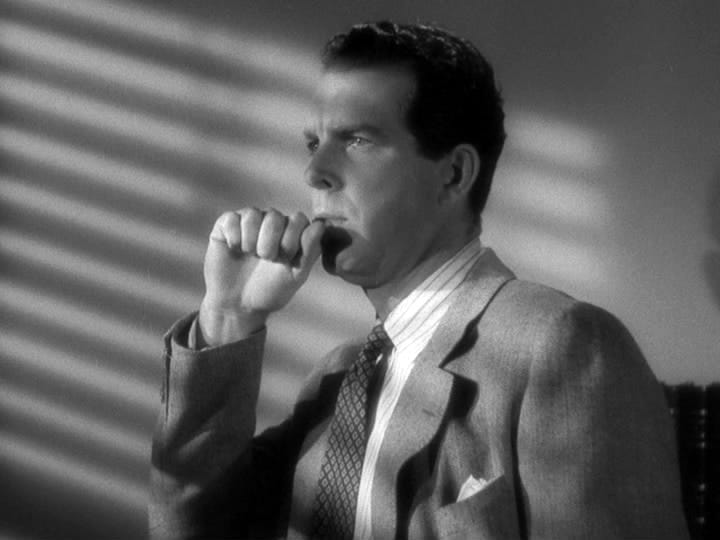
Wilder chose to make the film in black and white, using a newsreel style of shooting. Some have suggested that the film borrows from the look of German expressionism, but Wilder said no, he was going specifically for newsreel’s realism. His DP, John Seitz, stretched the boundaries of darkness, shadow, and light to make the look of the film reflect the grimness of the story.
The grim nature of the story is also new in film at this time, arising from the hard-boiled detective fiction of the 30s, and reflecting a new hunger among American moviegoers for more realistic film stories in the wake of World War II and a changing world.
As the story goes, Barbara Stanwyck was eager to play the femme fatale, but Wilder had great difficulty casting the male lead — apparently everyone turned it down because of how playing a murderer might affect his career. Fred MacMurray was a contract player at Paramount and he agreed, reluctantly, to take the role. This is Edward G. Robinson’s first great character role.
My Favorite Moment In The Movie
It’s a bit of a cliché, but true, that it is hard to pick just one. My personal favorite moment in the film is when Keyes (Robinson) dresses down his boss for concluding that Mr. Dietrichson’s death was a suicide.
But a close second, and perhaps the most important psychological turning point in the story, is when Neff (MacMurray), after accomplishing what seems like the perfect murder, walks down an empty street in the dead of night and begins to experience an overwhelming sense of dread, observing “I couldn’t hear my own footsteps. It was the walk of a dead man.” Chilling.
My Favorite Dialogue In the Movie
I absolutely love the sexually charged dialogue between Neff and Mrs. Dietrichson (Stanwyck). It is filled with double entendre and subtext. Here is one of my favorite examples:
Phyllis: Mr. Neff, why don’t you drop by tomorrow evening around 8:30? He’ll be in then.
Walter: Who?
Phyllis: My husband. You were anxious to talk to him, weren’t you?
Walter: Yeah, I was. But I’m sort of getting over the idea, if you know what I mean.
Phyllis: There’s a speed limit in this state, Mr. Neff. Forty-five miles an hour.
Walter: How fast was I going, officer?
Phyllis: I’d say around ninety.
Walter: Suppose you get down off your motorcycle and give me a ticket.
Phyllis: Suppose I let you off with a warning this time.
Walter: Suppose it doesn’t take.
Phyllis: Suppose I have to whack you over the knuckles.
Walter: Suppose I bust out crying and put my head on your shoulder.
Phyllis: Suppose you try putting it on my husband’s shoulder.
Walter: That tears it. 8:30 tomorrow evening, then.
Phyllis: That’s what I suggested.
Walter: You’ll be here too?
Phyllis: I guess so. I usually am.
Walter: Same chair, same perfume, same anklet?
Phyllis: I wonder if I know what you mean.
Walter: I wonder if you wonder.
Key Things You Should Look For When Watching This Movie
The rat-a-tat-tat of the dialogue made me realize that Mamet and Sorkin did not invent this spare, quick fire, smart, and funny, style of writing and delivering dialogue. Apparently this was one of Raymond Chandler’s most important contributions to the film.
The structure is sublime. The whole story is told in flashback, with a masterful use of voice over to tell the tale from Neff’s point of view. Note that the audience knows “who-done-it” from the beginning. The suspense is in the switchbacks, turns, and juxtaposition of the characters. Examples include when Mrs. Dietrichson is behind Neff’s apartment door, hidden from Keyes as Keyes explains to Neff how she committed the murder with an as yet unknown accomplice; when Keyes brings in the only witness that might be able to identify Neff as the imposter and invites Neff to the meeting; when the car won’t start after the deed is done. Also, Mrs. Dietrichson’s backstory, suggesting murderous calculation, slowly unfolds, adding to the sense that Neff is being backed into a corner.
The characters are full blooded and complex. While Neff and Mrs. Dietrichson are cold-blooded murderers, they are also it turns out, capable of love. Mrs. Dietrichson realizes this late, right before Neff kills her. And in the end, when all is lost for Neff, and he is literally wounded, he steers Zachetti back to Lola, both saving Zachetti and attempting to put things right between young lovers. The audience roots for the murderer. Finally, pay particular attention to the relationship between Neff and Keyes, who have a close and touching friendship — the intimate pay off in the last scene is set up beautifully throughout the film.
Thanks, Susan! To show our gratitude for your guest post, here’s a dash of creative juju for you. Whoosh!
We already have a set of classic 5os movies, 60s Movies, 70s movies, 80s Movies and 90s Movies. This month, we’re working on 40s movies. And thanks to the GITS community, we’ve got 27 movies in the works!
Those who I put in bold have already sent me their posts. If you haven’t sent yours to me, please do so as soon as you can!!!
Act of Violence — Eric Rodriguez
Arsenic and Old Lace — Katha
Bicycle Thieves — Megaen Kelly
Brief Encounter — Emily Bonkoski
Casablanca — Paul Graunke
Double Indemnity — Susan Winchell
Five Graves to Cairo — Jeff Gibson
Foreign Correspondent — Doc Kane
His Girl Friday — John Henderson
It’s a Wonderful Life — David Laudenslager
Key Largo — Will King
Laura — Melinda Mahaffey Icden
Les enfants du paradis — Brendan Howley
Mrs. Miniver — Traci Nell Peterson
Notorious — Christine Henton
Now Voyager — Melissa Privette
Out of the Past — Brantley Aufill
Rope — Lance Morgan
The Bank Dick — Bob Saenz
The Best Years of Their Lives — Shaun Parker
The Big Sleep — Ipsita Barik
The Ghost and Mrs. Muir — Annie Wood
The Long Voyage Home — Vincent Martini
The Lost Weekend — Liz Warner
The Maltese Falcon — Roy Gordon
The Ox-Bow Incident — Clay Mitchell
The Philadelphia Story — Kristen Demaline
The Third Man — Harry Cooke
Thanks to everyone who steps up for this ongoing project! Still need 2 more volunteers. If you’re interested, please email me with the classic 40s movie of your choice.
For the original post explaining the series, go here.
For all of the 40s movies featured in the series, go here.
Click REPLY and see you in comments about today’s classic 40s movie!
Comment Archive