Movie Analysis: “Back to the Future” — Characters
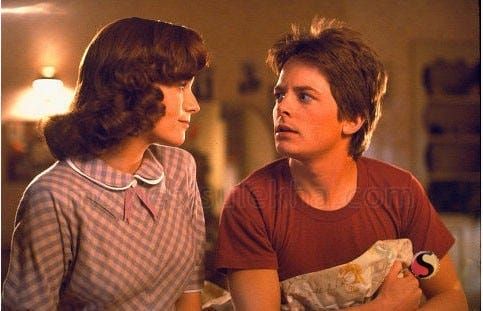
Another in our bi-weekly series in which we analyze movies currently in release. Why? To quote the writing mantra I coined over 5 years ago: Watch movies. Read scripts. Write pages. You will note which one comes first. Here are my reflections from that post about the importance of watching movies:
To be a good screenwriter, you need to have a broad exposure to the world of film. Every movie you see is a potential reference point for your writing, everything from story concepts you generate to characters you develop to scenes you construct. Moreover people who work in the movie business constantly reference existing movies when discussing stories you write; it’s a shorthand way of getting across what they mean or envision.
But most importantly, you need to watch movies in order to ‘get’ how movie stories work. If you immerse yourself in the world of film, it’s like a Gestalt experience where you begin to grasp intuitively scene composition, story structure, character functions, dialogue and subtext, transitions and pacing, and so on.
Let me add this: It’s important to see movies as they get released so that you stay on top of the business. Decisions get made in Hollywood in large part depending upon how movies perform, so watching movies as they come out puts you in the same head space as reps, producers, execs, and buyers.
This week’s movie: Back to the Future, written by Robert Zemeckis and Bob Gale.
IMDb plot summary: A young man is accidentally sent 30 years into the past in a time-traveling DeLorean invented by his friend, Dr. Emmett Brown, and must make sure his high-school-age parents unite in order to save his own existence.
Our schedule for discussion this week:
Monday: General Comments
Tuesday: Plot
Wednesday: Characters
Thursday: Themes
Friday: Takeaways
For those of you who have not seen the movie, do not click MORE as we will be trafficking in major spoilers. If you have seen BTTF, I invite you to join me in breaking down and analyzing the movie.
Those of you who have followed GITS for some time or taken some of my Screenwriting Master Class courses likely know I have developed a theory how many movies feature a specific set of five character archetypes: Protagonist, Nemesis, Attractor, Mentor, Trickster. They derive from these seven questions:
* Who is the story’s Protagonist?
The first, most basic question of any story.
* What does the Protagonist want?
This is the Protagonist’s conscious goal and is tied to the Plotline’s end point.
* What does the Protagonist need?
This is the Protagonist’s unconscious goal and is tied to their Transformation end point.
* Who is trying to keep the Protagonist from their goal?
This is the story’s Nemesis who functions in opposition to the Protagonist.
* Who is connected to the Protagonist’s emotional growth?
This is the story’s Attractor who is most connected to the Protagonist’s emotional development.
* Who is connected to the Protagonist’s intellectual growth?
This is the story’s Mentor who who is most connected to the Protagonist’s intellectual development.
* Who tests the Protagonist to prepare them for the Final Struggle?
This is the story’s Trickster, sometimes ally, sometimes enemy, a way testing the Protagonist.
These five are the Primary Character Archetypes and they function as integral parts, both in relation to the plot and with regard to the Protagonist’s psychological metamorphosis.
Here is the roster of key characters in Back to the Future:
Marty McFly
Dr. Emmett Brown
Lorraine Baines
George McFly
Biff Tannen
Jennifer Parker
What’s interesting is the multiple ways you can assess the character interrelationships insofar as plot is concerned. Obviously Marty is the story’s Protagonist, however his fate is intimately intertwined with that of his father Young George McFly. So as a thought experiment, why don’t we switch Protagonists and look at the story through George’s eyes.
Protagonist — George
Nemesis — Biff
Attractor — Lorraine
Mentor — Marty
Trickster — ???
What is George’s goal? To be with Lorraine. Who’s keeping him from that goal? Biff is the external force, but even before Biff shows an interest in Lorraine, something prevents George from stating his intentions to Lorraine, a combination of his inner state of being involving fear of rejection, low self-esteem, general lack of courage. Lorraine as Attractor: Obvious.
And Marty’s relationship with Young George can best be seen as a Mentor figure. Marty knows all about George due to Marty having come from the future. He knows events which will unfold in the present because they happened in the oral tradition of Marty’s past. He provides advice to George and encourages him to act upon his want (express his feelings for Lorraine).
Is there a Trickster character in relation to this switched perspective looking at George as the story’s Protagonist? I suppose we could say that Doc Brown is in an indirect way, but that’s a stretch. I’m going to go for George’s will. There are times when his will to be with Lorraine causes him to act, such as climbing a tree to spy on Lorraine through her bedroom window. There his will serves as an ally. But there are many other times when his will flounders and fails, time and again not standing up to Biff. There his will is an enemy.
And really George’s Final Struggle is a test of wills: Can he tap into his inner ‘warrior’ and stop Biff from accosting Lorraine, thereby winning her affection… or not? Of course, he does, and that rounds out George’s transformation.
Of course per the real Protagonist’s story, this is a penultimate event. Marty still needs to get back to 1985 which he eventually does. However it is helpful to look at the story through George’s eyes as a Protagonist because it drives him an important point: The difference between Lorraine connecting with George when he got hit by a car, which is what happened in the Original Past, but prevented by Marty in the New Past, and George punching out Biff in the New Past is what explains the difference between Old George and Old Lorraine, and their tawdry, mundane life from which Marty wishes to escape, and New George and New Lorraine, their upscale, cool life which Marty discovers when he returns from the past.
In other words, when Marty intersects with George in the past and helps George go from a passive character to a proactive one, finding his will and giving expression to it when he slugs Biff, that sets off a chain of life and lifestyle events which leads to New George, New Lorraine, and a whole New Reality in the McFly universe.
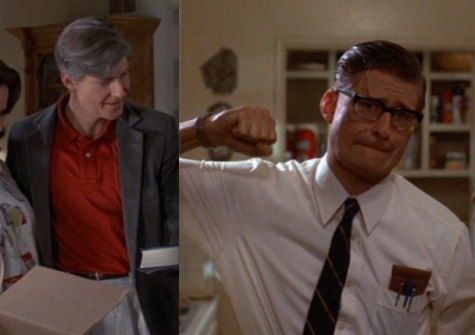
Marty is the story’s Protagonist. But in relation to George, Marty functions as a Mentor.
How about you? What thoughts do you have about the characters in Back to the Future?
Comment Archive