Interview (Written): Lawrence Kasdan
When my spec script K-9 was floating around Hollywood, before it eventually sold to Universal, there were a number of agencies interested in signing my writing partner and me. The most aggressive was Bauer / Benedek, later to merge as part of UTA. They showed me their client list. As soon as I saw one name, I was sold. That name: Lawrence Kasdan.
I was a huge fan as he’d written some of my very favorite movies: Star Wars: Episode V — The Empire Strikes Back, Raiders of the Lost Ark, Body Heat, The Big Chill.
In 1988, I got a chance to hear him speak to a group of young writers, agents, producers, and execs. He was so articulate and knowledgeable, and had such an obvious passion for movies.
With that as background, you are in for a treat. This Wired interview with Kasdan hit online yesterday and it is excellent. I could, if I had time, break it down for a week-long series there is so much ‘meat’ in it.
I’ll save all of the cool background on his work with Star Wars, both old and new, Raiders, and the rest, and focus on some observations Kasdan had about the psychological nature of storytelling, ideas I resonate with and often preach here on the blog:
Force Awakens, New Hope, Empire- — these are movies about fulfilling what is inside you. That’s a story that everybody can relate to. Even when you get to be my age, you’re still trying to figure that out. It’s amazing but it’s true. What am I, what am I about, have a fulfilled my potential, and, if not, is there still time? That’s what the Star Wars saga is about.
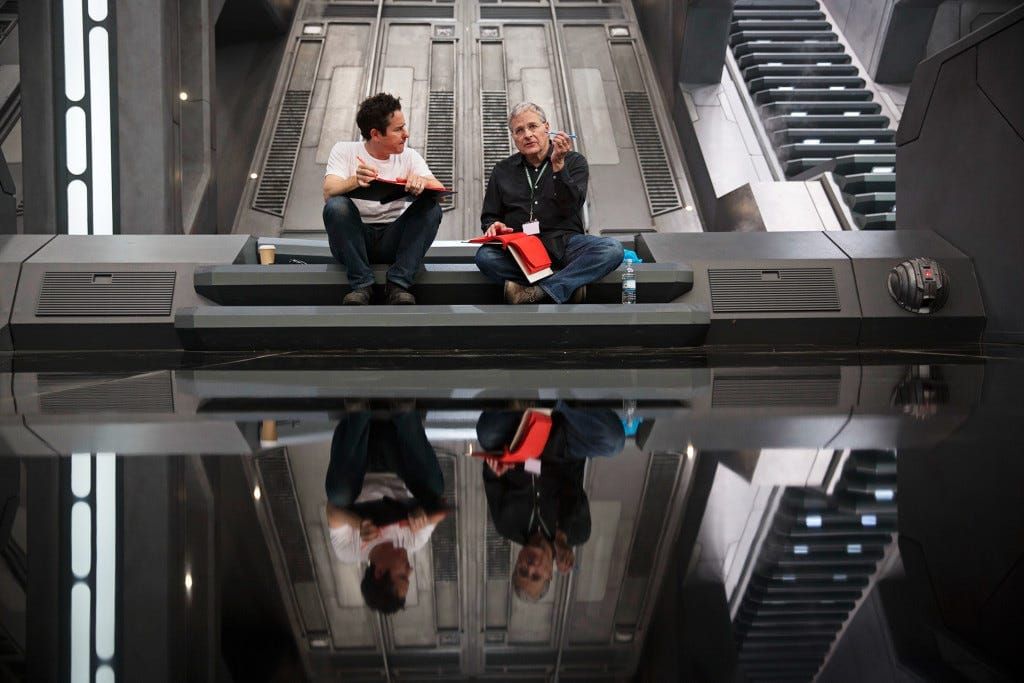
J.J. Abrams, Lawrence Kasdan
I’m always drawn to the same kind of stories. You make a movie like The Big Chill and you’re dealing with the same issue you deal with in Empire, which is how you’re going to live your life. The attraction of Westerns is, it was a brand new land with no rules, so people had to decide how they were going to be in that landscape, and some people decided one way and some decided the other, and people like Wyatt Earp were caught in the middle. They’re questions of identity and morality, you know. What kind of person am I going to be?
To the extent that you can influence what your kids are like — and there’s a limit, I can tell you — you want to be some sort of example, like, this is how we behave. When there’s no one looking, how do we behave? When we have no reason to be nice to someone, are we nice anyway? Do we do the honorable thing in the shadows, when no one can see us? Those are the issues in Empire, in Body Heat. Something about genre, like all fairy tales, makes things very clear. There are archetypes that mean certain things in our collective consciousness. To me the most amazing thing about A New Hope is that — and this has a lot to with both George and [concept designer] Ralph McQuarrie — the second Darth Vader comes out of the smoke, there’s no question in anybody’s mind. including my five-year-old grandson’s, that this is the bad guy. And it has everything to do with the way he looks. He doesn’t have to say a word. It’s so fundamental, so Jungian. This is the image of danger and evil that has persisted since people started telling stories
— —
My favorite line that I ever wrote is in Raiders. Sallah says to Indy, “how are you going to get the box back?” And Indy says: “I don’t know. I’m making this up as I go.”
That is the story of everybody’s life. It happens to be very dramatic for Indiana Jones. Get on the truck, get on the horse. But for you and me, we’re making it up, too. Here’s how I’m going to behave. Here’s what I’m willing to do to make a living; here’s what I’m not willing to do. How we make up our lives as we go. That’s such a powerful idea, because it’s very exciting. It’s the biggest adventure you can have, making up your own life, and it’s true for everybody. It’s infinite possibility. It’s like, I don’t know what I’m going to do in the next five minutes, but I feel I can get through it. It’s an assertion of a life force.
This totally aligns with the way I look at storytelling. At their foundation, stories ask two questions of characters, most especially Protagonists:
Who am I?
How am I?
The first is the big existential one: Is the Protagonist the individual we meet at the beginning who is living a life of Disunity or will they transform through their adventures into someone who embraces their Authentic Nature?
The second is a behavioral question: Forced to reject and move beyond their Old Ways of being once they move into the New World, what will the Protagonist learn to stitch together New Ways of behaving?
That first arena is very often the primary domain of the Protagonist / Nemesis relationship.
That second arena is more often where the Attractor, who provides emotional wisdom, and the Mentor, who provides intellectual wisdom, have most of their influence.
These psychological and philosophical questions transform the events of a plot into a story which has emotional resonance because, as Kasdan points out, what the characters are dealing with are the very questions we deal with. Moreover the self-understanding characters discover along the way gives the story meaning.
This question Kasdan raises — How do we make up our lives as we go along — roots the story-crafting process in our characters which is, I would argue, where it should be.
For the rest of the interview — again a great read — go here.