Interview (Part 6): Anthony Grieco (2015 Nicholl Winner)
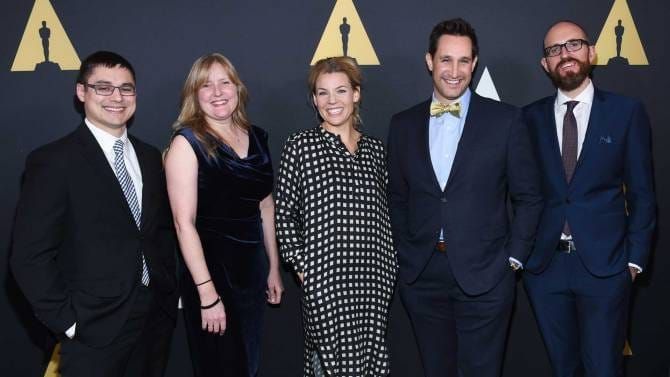
Anthony Grieco wrote the original screenplay “Best Sellers” which won a 2015 Nicholl Fellowship in Screenwriting. Recently Anthony and I had an excellent phone conversation in which we covered a lot of territory, his background and how he got into writing, a deep analysis of “Best Sellers”, and a discussion about the writing craft.
Today in Part 6, Anthony offers some advice to aspiring screenwriters:
Scott: You’re one of those people who rewrites as you go along, you’re not one of those vomit draft types?
Anthony: I’m trying really hard to be a vomit draft guy, and I still think I am. But my primary draft is a lot of scaffolding. Getting the foundation down and putting the walls and the roof on. The detailing comes later. I will make notes to myself along the way. “Give them some business here,” or I will ask a question, “What’s the axe in the room?”
That’s the object in the scene that is an extension of how the character feels about what’s happening. Does someone incessantly click a pen, chop onions, make their bed, etc… Basically behavioral subtext. That often says more than dialogue.
Scott: How about dialogue? How do you go about writing dialogue in your characters?
Anthony: I have some simple rules to start…if it’s wider than your index finger and your middle finger put together horizontally, it’s probably a mouthful. On a more complex level, all the dialogue that passes my character’s lips in the first half of the script usually comes through the filter of my hero’s armor.
In the first half of a movie, your lead character lies a lot. That’s her filter. Her attitude. This is where structure also informs me a lot. When I think about moving into act two, the first thing a character does to solve her problem is take the path of least resistance. The dialogue often reflects that attitude.
Scott: Lucy does that in the script.
Anthony: Here’s the thing. I’m freestyling here when I’m answering this question but if you get me talking, I come to what I probably should have said in the first place. Dialogue is a character’s attitude. How does she feel about the world?
For the first half of the script, her attitude is her defense mechanism. That’s what we hear. When she opens her mouth, she’s always lying, but she doesn’t know she’s lying. Only the writer knows that.
She’s trying to make sure you don’t reveal her greatest fears.
Scott: Right. Robert Towne has that thing. It’s like, “The best question you can ask is ‘what do they fear the most?’”
Anthony: Yes. Again, this plays to irony. For instance, if you’re going to write a movie about a germophobe who is forced to live in a garbage dump, you already know you’re going to set yourself up for some interesting dynamics.
Dialogue is reflective of attitude. Attitude is reflective of the character’s greatest fear.
Scott: To me, I resonate with that so much. Everything you’ve said in the setup is about character. You’ve established the character stuff, as opposed to, not necessarily what the screenwriter gurus are preaching but the way that it gets articulated it seems like in the online screenwriting world, is going outside in, plug these things into certain things, happen at certain pages.
Anthony: Well, I definitely believe in structure informing you, but more as an emotional roadmap. You want people to experience a story, not plot. There’s a big difference between the two. You won’t notice structure and page counts when you’re lost in good storytelling.
The plot is a canvas. The story is rooted in emotions, the internal.
For instance, I recently watched Brooklyn. I was so engrossed. But because I connected to her internal journey. Sure, on the surface it’s a love story, but it’s really about her love affair with the future, and that future was America. As someone who moved from Toronto to pursue my dreams her in L.A., I identified with that. I identified with her internal need to chase her future. And for their own reasons, it’s apparent that a lot of other people identified with that as well.
Scott: Yep. That’s really the blanket it’s wrapped in.
Anthony: As writers, it’s not easy to execute. It’s hard to do. I feel like sometimes I sound preachy, but I really believe in that fundamental principle of “make me care.” That’s all anybody can do. Make me care.
Someone can come in and give you notes on this and that, but if you’ve made the story about something, that usually survives those changes. I equate screenplays to the blueprint for a house. That house happens to be a movie. Once a director comes in and says, “I love your house, but to hell with the granite countertops. I hate granite countertops.” You can rip them out and it’s not going to change the principal foundation that house was built on. “I hate this wall.” “OK. Knock it out.”
The roof’s not going to cave in because you’ve created a story that’s about something. No one can change the fact that it’s about something.
Movies never go as you imagined them. The casting will be different. The director’s vision will be different. But a certain incarnation, however executed, will still play to that sentiment you were trying to get across.
I’m sure my script, if it finds its way, it’s going to morph into something I didn’t imagine, but I’m sure it’s still going to circle the idea about being a fraud.
Scott: One last question for you: What advice do you have for aspiring writers?
Anthony: Do not write to the market. Write the script that expresses something about your attitude toward the world. I was always confused when people would say, “Wow. That writer. What a voice.” I’d be like, “What does that mean? Are they writing fragmented sentences that are really cool? Are they using double dashes? What’s going on there? What’s voice?” Then I realized your voice is your attitude about the world.
It’s best to sit down and write a story that captures your attitude toward the world. That story’s got to have personal elements to it. It’s got to be a story you love to write.
Your screenplay is your calling card. If it doesn’t get made it still gets you meetings. It can still get you jobs. Write what you love. What does that mean? It means write what you think best expresses you and your attitude toward the world.
The only screenplays that have ever rewarded me in my time here in L.A., came from that place. Best Sellers came from that place.
For Part 1 of the interview, go here.
Part 2, here.
Part 3, here.
Part 4, here.
Par 5, here.
Anthony is repped by Paradigm and Aperture Entertainment.
Twitter: @SwimCharlieSwim.
Comment Archive