Interview (Part 2): Andrew Friedhof (2015 Nicholl Winner)
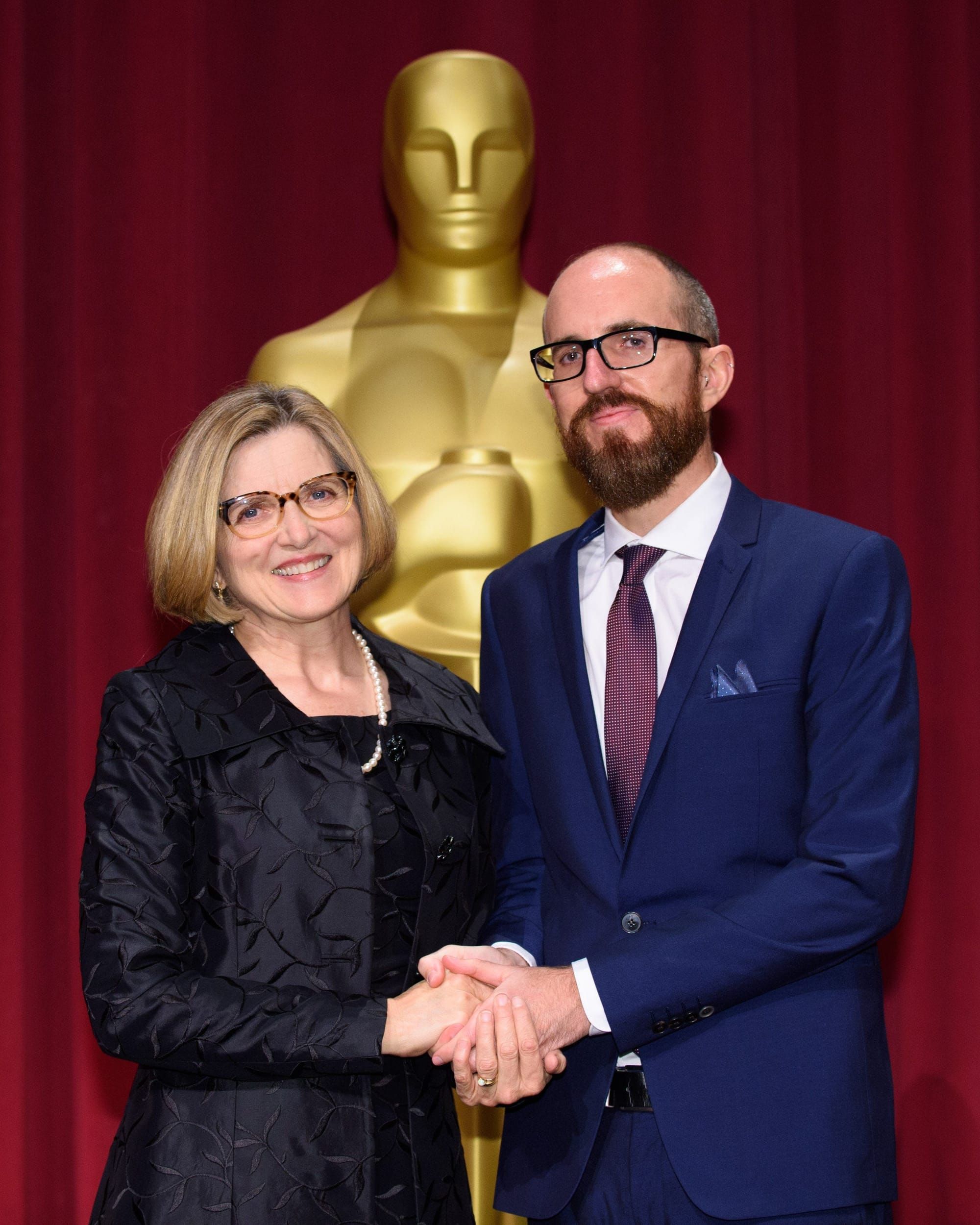
Andy Friedhof wrote the original screenplay “Great Falls” which won a 2015 Nicholl Fellowship in Screenwriting. Recently I had the opportunity to chat with Andy about his background as a writer and his award-winning screenplay.
Today in Part 2, Andy talks about what inspired him to write “Great Falls”:
Scott: That’s right. I remember interviewing David Guggenheim [2010 Black List]. He used that word. The most democratic way of getting into the business is by writing a spec script because it’s your work.
Speaking of spec scripts, I’ve been doing research. You mentioned you’d written several. I found some of them floating around the Internet. I’m just going to toss a few titles out there and get some comments on them. There was a script called, “Made in China,” that made the Austin Film Festival, did pretty well there.
Andy: That was a very early script. One of the things I’ve learned, and I probably should have listened to other people’s advice on this, is your first four or five scripts, it’s probably worthwhile putting them in the bottom drawer.
I think some of my early scripts probably had a little bit of merit to them, but were mostly pretty flawed. I think that script is one of them. I can give you the logline. It’s quite a bizarre story. As I mentioned, started being a comedy more than a drama. I was particularly influenced by Charlie Kaufman. The script involves a loner who finds a novel programmed into his microwave. [laughs] He transcribes the novel from the microwave, sends it out to publishers, and gets a book deal.
He ends up taking credit for the novel, becomes rich and famous, but ends up feeling guilty about it and travels to China to try to find the real author who works in the microwave factory. Quite a bizarre story.
Scott: That’s a fun idea.
Andy: It was interesting listening to Anthony [Grieco], who’s another Nicholl Fellow, because he’s his story is set in the book publishing world. There’s a few beats in that script that I thought to myself, “Oh, that’s kind of similar to Made in China.”
In my script he sends it to a female publisher. She takes him under her wing and introduces him to the book publishing world, accompanies him on a book tour, and that sort of thing. It’s interesting to see the coincidental parallels between the story I wrote and his. Obviously, my script was nowhere near as good as Anthony’s.
Scott: I know The Bitter Script Reader. At one point he did a post on a script you wrote called, “Three Percent of Nothing.”
Andy: As I mentioned, the past three or four years I’ve been working full‑time on screenwriting. There’s been encouraging milestones along the way. Two years ago I got a script into the quarter finals of the Nicholl, which was called “Stat.” That script is currently optioned by Smart Entertainment.
Then “Three Percent of Nothing” got into the semifinals last year. That landed me my current agent. That story, again, this is a bit bizarre, because it’s set in the world of NBA, which Sam [Regnier]’s script was also set in. I don’t know if those guys have been plagiarizing from me, or what. [laughs] It’s about a US agent who is a Jerry Maguire type, Jerry Maguire plus 10 years. His agency is on the brink of failure and he’s losing clients to a former partner.
His top client calls him one night and says, “Someone’s been killed at my mansion. We need to cover this up,” because he’s got a morality clause in his contract and they’re in the middle of negotiations. Basically, they hide the body, using a former client that’s fallen on hard times to help them. It all unravels from there.
It’s a character piece with thriller elements. It’s much more similar to “Great Falls” than “Made in China” I think, which I think is a result of me developing my voice. As I said, that landed me my agent a couple years ago.
Scott: You speak to the value of writing a spec script. Obviously, you’re improving with a writer with each one, but, also, you get something optioned by Smart Entertainment. You get an agent off one. You’re getting more and more notoriety.
Was this the master plan? This contest, that competition, this venue, were you hitting things as you went along and found out about them?
Andy: I think the prevailing mindset when you start out as an aspiring screenwriter is, “If I can just reach this milestone, I’ll have finally made it.” You start off and you tell yourself, “If I can just get an agent, then I’ll finally be able to call myself a screenwriter.”
Then you get an agent, and you think, “Oh, I also need a manger. I need a manager as well.” There’s this series of goals you’re constantly aiming for with the expectation that you’ll eventually reach some plateau called “working screenwriter”. Even now, with the Nicholl Fellowship, I’m thinking, “Okay, this is great but the next step is to sell a script or land an assignment,” and that sort of thing.
I hope that doesn’t come across as unappreciative of what I’ve achieved but I feel like having that hunger and realizing that you’re not going to reach some place where you’re finally comfortable and can put your feet up and say, “I’m officially a screenwriter, and I will be until my dying day.” [laughs] That day is never going to come. You’ve always got to keep working.
For me there was no master plan. There were encouraging moments along way, and those definitely convinced me to keep going. If I hadn’t gotten the quarterfinals of the Nicholl two years ago, then the semis last year, and then this year…
To be honest with you, in July last year, shortly before the announcement of the Nicholl quarterfinalists, I had set up a job alert on my email with the intention of possibly returning back to my previous career as an engineer. The Nicholl Fellowship came just in time, because obviously you can’t be unemployed forever.
There were positive steps along the way, but it’s still been a difficult journey. I’m under no illusion that there’s still a lot of difficulty to come. You’ve just got to keep working hard and worry about the thing that you can control, which is the quality of the writing.
Scott: That’s a nice segue to your 2015 Nicholl winning screenplay, “Great Falls”. Here’s a plot summary provided by the academy:
“After negligently killing a hunter with her patrol car, a sheriff’s deputy and her superior must decide what to do with the only witness to their crime, a death row inmate only days from execution.”
Let’s start at the very, very beginning. What was the inspiration for this story?
Andy: Back in 2014, my then girlfriend, now wife, and I were traveling around the United States and Canada for about four months. We did a fairly extensive trip around North America, had a fantastic time, and met some incredible people.
While we were in New York I read an article in the Times about a botched execution of a man called Clayton Lockett. The execution is actually pretty similar to what is depicted in the script itself. It was apparently quite a harrowing experience for the people that were present. They tried to insert the needle into his arms, neck, legs and feet at least a dozen times, from memory.
Scott: I remember that. In Oklahoma, right?
Andy: It was, yes. He was a former drug addict, so his veins had collapsed, so they had to inject him, actually, in a vein in his groin. To preserve his dignity, what remained of it, they covered him with a cloth.
Because of that they weren’t able to see that the injection site had failed when they started injecting him with the cocktail of drugs they use to execute prisoners. He ended up dying of a heart attack I think nearly an hour after the procedure had begun, and during that time he tried to sit up on the execution table and speak. It was pretty horrifying to read the series of events that had occurred in that room.
The whole story was just such a stark contrast to the incredibly decent and friendly people we’d met on our trip. It was such a disconnect for me, that this thing had been carried out in these people’s names, when I compared that to my recent experiences.
It got the wheels turning. Obviously, I don’t exclude myself in that by the way. There are plenty of things that the Australian government does that I completely disagree with. They have particularly heinous refugee policies, for example.
It got me thinking about how we’re so often disconnected from the violent or immoral acts that are carried in our names. There’s plenty of examples of that phenomena in terms of policing, foreign wars, factory farming, that sort of thing. We’re kept at a distance from the violence done on our behalf, whether we agree with it or not. That got me thinking about what would happen if that barrier was torn down, what sort of circumstances would bring that about. That was the genesis of the idea.
If it’s moral and legal for someone to fatally inject a prisoner in a temporary single-wide trailer in Deer Lodge which is what the execution chamber at Montana State Prison has consisted of for decades, does it make that much difference if it’s someone who’s doing it in a cabin thirty miles down the road I was interested in exploring that idea and testing people’s belief in the death penalty.
Scott: Interesting, what I hear you saying is that basic “what if.” I think those are the two best words for coming up with a story idea.
Andy: [laughs] That’s right.
Robin Swicord and Andy Friedhof
Tomorrow in Part 3, Andy talks about researching “Great Falls” and three major characters in the story
For Part 1 of my interview with Andy, go here.
Andy is repped by ESA and Circle of Confusion.
Twitter: @andrewfriedhof.