Interview (Part 2): Isaac Adamson
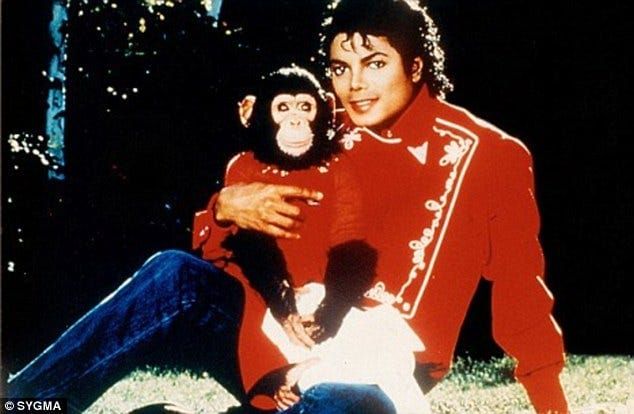
The top rated screenplay on the 2015 Black List is “Bubbles” and it was written by Isaac Adamson. It’s a terrific story, one of the most, if not the most unique ways to approach writing a biopic I have ever seen: The story is a snapshot of Michael Jackson’s life told from the perspective of his pet chimpanzee Bubbles. I would have been interested in interviewing Isaac simply based on the creative inspiration of that idea — I mean, who thinks like that — but when it hit #1 on the Black List charts last year, it was a no-brainer. I reached out to Isaac’s manager Lee Stobby and we finally arranged a time in Isaac’s busy schedule to spend an hour together over the phone, talking with Isaac from his home in Portland, Oregon.
Today in Part 2, Isaac answers the inevitable question: How did he come up with the idea to write “Bubbles”:
Scott: Reading “Bubbles,” first of all it’s wildly entertaining and it’s obviously professional quality writing, so you stand as a testament to being able to do that… learn the craft just from involvement with the primary sources — movies and scripts.
Isaac: Yeah, I think that’s where you learn it. Particularly, reading scripts because it is a much different way of writing than when you’re doing novels. You just have to be so much more succinct and so much more disciplined and really make solid choices about what’s the one thing you want the reader to get out of this scene or this character description? Whatever it may be. You can write an 800‑page novel, whereas with screenplays it’s pretty much 90 to 120 pages. It really forces you to be a lot more economical.
Scott: Let’s talk about your screenplay, “Bubbles,” which as I mentioned, topped the 2015 Black List. Here’s a plot summary:
“A baby chimp is adopted by pop star Michael Jackson. Narrating his own story, Bubbles the chimp details his life within the King of Pop’s inner circle through the scandals that later rocked Jackson’s life and eventually led to Bubbles’ release.”
I’m sure you get asked this every time someone asks you the premise of the story. What was your inspiration for it?
Isaac: It’s kind of a three‑pronged thing. When Michael Jackson died, along with all the other articles that came out I remember there was something in “People” or “US Weekly” or one of those kind of magazines you pick up at the dentist’s. They said, “Where’s Bubbles now? What happened to Bubbles?” It talked about how he was living in this ape sanctuary in Florida. I filed that away and thought, “Oh, that’s kind of interesting.”
Then there is a book that was shortlisted for the Man‑Booker prize in the UK called “Me Cheetah,” which was basically the story of Tarzan, but told through Cheetah’s perspective. I never read the book but I thought, “That’s a cool idea.”
I’ve actually since heard that [laughs] that’s not really what the book is. It’s more about the chimpanzee that played Cheetah and his life in Hollywood. I still have to check it out someday.
Those are the two primary things that got me thinking about it. At that point I was thinking of it as a novel but I just didn’t think I could sustain the voice of a chimpanzee for the hundreds of pages that it would take. The other concern was just music being such a visceral thing. I think it’s really hard to write about music well. That kept me from doing it.
The thing that put everything into place was seeing Dawn of the Planet of the Apes and the Shakespearean relationship between some of the characters. It got me thinking about chimp hierarchies but also what if Bubbles had this pseudo‑Shakespearean way of talking. Once I had that, I knew I had the voice. It was just a matter of figuring out where in Michael Jackson’s life Bubbles actually fits in to try to make it reasonably historically accurate.
Scott: Well, that answers the question because I was going to ask you, the voiceover narration is really quite entertaining. First of all he’s quite smart, very intelligent. But he does have a rather sophisticated worldview that comes through in his voice.
You’re suggesting that having watched The Planet of the Apes and perhaps that sort of Shakespearean feel, that’s what led to the voice for Bubbles?
Isaac: Yeah. I think that was definitely an influence on it. Plus it’s just inherently funny to have a chimpanzee, who are normally looked at as goofy, clownish animals, to have this really elevated way of speaking.
Scott: You mentioned funny, but it’s actually poignant, too. The tone, the balance between those two, did you know that right up front as you started the project, or is that something that evolved in the writing?
Isaac: Both in a way. I think it evolved, but it also close to was what I was initially aiming for. I didn’t want to write something that was just a total farce. Whether it was some kind of celebrity take down about Michael Jackson or something like that.
I really wanted it to be more about Bubbles than it was about Michael Jackson because it is a sad story. It’s about this animal whose in this lab and then he goes on this great adventure. Eventually, he winds up in a cage. I didn’t think pumping up the laughs would really serve that story well.
Michael Jackson and Bubbles
Scott: Just right there you mentioned three acts, right? He’s in a lab, on a great adventure then ends up in a cage.
Isaac: Yeah. It had that structure built in.
Scott: How much research did you do on Michael Jackson?
Isaac: I did a lot but it was all second source variety. I read some biographies. I read all kinds of magazine articles, watched the ton of stuff on YouTube. It was like drinking from a fire hose because there’s so much information out there about Michael Jackson.
What helped me to be able to accomplish it in the time I did was just that I knew that I wanted to narrow my focus mostly to the years surrounding when he was making and touring the “Bad” album.
Scott: How about researching chimpanzees?
Isaac: I didn’t do a great deal of research into chimpanzees. I had some primate anthropology classes in college that I remembered. I did do a fair amount of research about actual Wauchula Ape Sanctuary in Florida, where Bubbles lives and the other animals that are there with him. It’s kind of funny because so many of them were showbiz animals.
Scott: One thing that I was really struck by is much of the humor in the story derives from Bubbles’ interpretation of Michael’s behavior. For example, on Page 13, the draft I read, he is watching Michael Jackson practicing his dance moves and he says, “As he loose his war cry, I understood these sessions were not simply a matter of exercise. He was building strength and stamina before venturing forth to the battlefield. He would don war paint and turned his face spectral fantastic shade meant to strike fear into the heart of the enemy.”
To write that, I imagine you really had to inhabit Bubbles’ worldview.
Isaac: Yeah. I did. I wanted to force myself to really try to keep everything through his perspective and know that his perspective would be colored by this hierarchical way of thinking for one, but also a fundamental misunderstanding of what all these humans around him were up to.
Tomorrow in Part 3, Isaac talks about some of the remarkable anecdotes in the script which are based in truth and some other stories he omitted which are equally bizarre.
For Part 1 of the interview, go here.
Isaac is repped by CAA and Lee Stobby.
Twitter: @isaacadamson.