Classic 30s Movie: “Gunga Din”
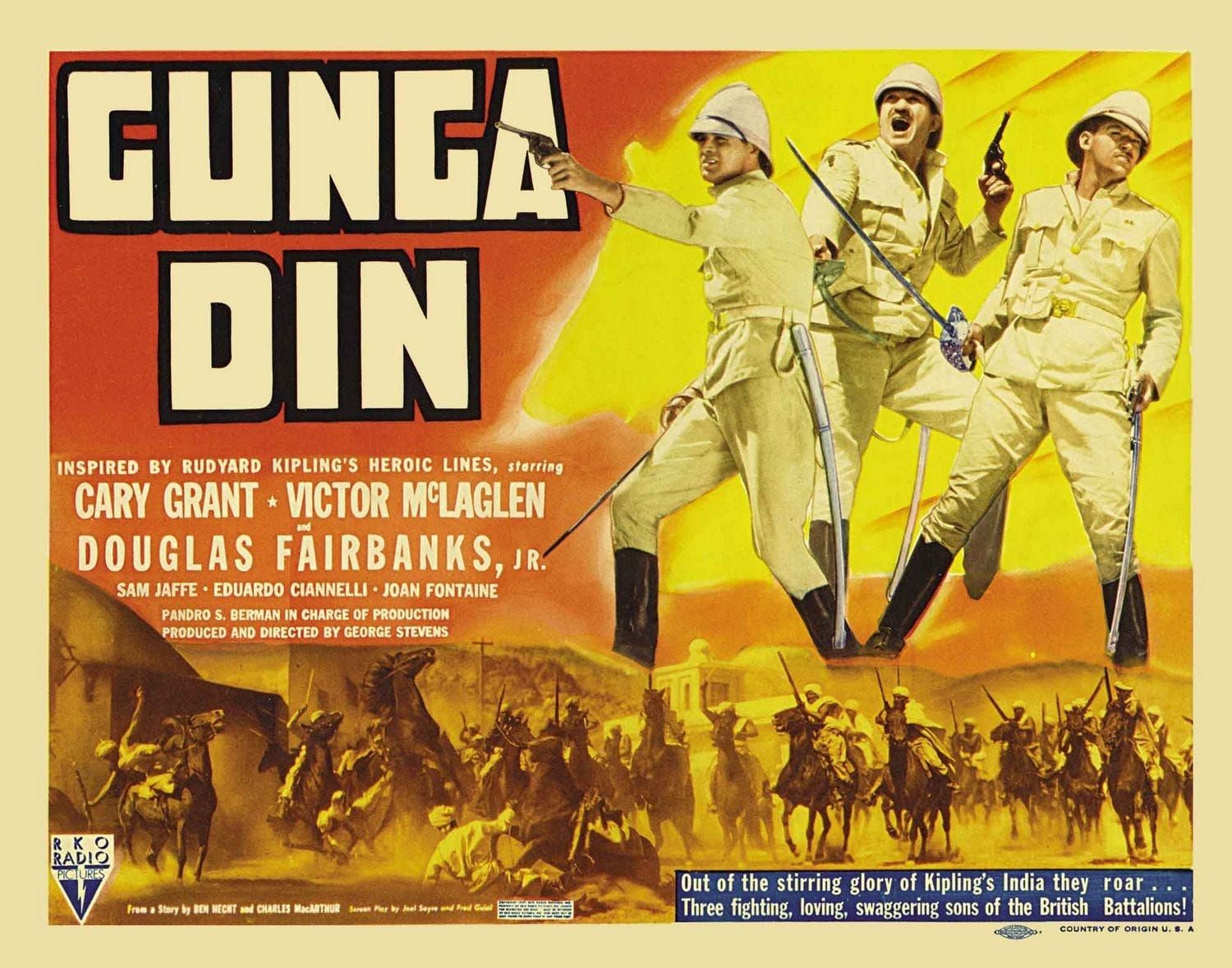
May is classic 30s movie month. Today’s guest post comes from Steve Huerta.
Title: Gunga Din
Year: 1939
Writers: Joel Sayre, Fred Guiol, Ben Hecht, Charles McArthur, William Faulkner, Lester Cohen, John Colton, Vincent Lawrence, Dudley Nichols, Anthony Veiller, from the poem by Rudyard Kipling.
Actors: Cary Grant, Douglas Fairbanks Jr., Victor McGlaglen, Sam Jaffe, and Joan Fontaine.
Director: George Stevens
Plot Summary: A trio of buddies, sergeants all in the British Army, carouse & brawl their way across Imperial India. Intensely loyal to each other, they meet their greatest & most deadly challenge when they encounter the resurgence of a hideous cult & its demented, implacable guru. Now they must rely on the lowliest servant of the regiment, the water carrier GUNGA DIN, to save scores of the Queen’s soldiers from certain massacre.
Why I Think This Is A Classic 30s Movie
1939 was an historical year for American film, in that there were so many iconic films produced. The Wizard of Oz, Gone with the Wind, The Hunchback of Notre Dame, and Gunga Din all opened that year. Gunga Din was the second highest grossing film of that year behind GWTW. It also was the great-grand-daddy of modern action-adventure films. Think Raiders of the Lost Ark, with the humor and relentless action interspersed with exotic locations and heroic protagonists playing it for fun. Millions of adolescent boys cut their teeth on this film even after it was shown on TV decades later. Director Stevens infused the production with a certain style which is still hinted at and paid homage to by more recent directors. Star Wars can also be counted in this mix. Kurosawa showed signs of influence by Stevens cinematography in the Fifties with remarkable tracking shots on horseback at apparent high speeds to deliver the feel of sheer kinetic motion and action. But beyond all this there is a heart-felt affection for the character Gunga Din. The lowly native water bearer wants only one thing: to be a noble soldier.
The film opens with a routine patrol being murdered in their sleep by the Thuggees, a murder cult who worship the goddess Kali. The commander of the British outpost calls for three sergeants, Cutter(Grant), Ballantine(Fairbanks), and Machesney(McLaglen) to investigate a 48 hour lull in communication with an outpost which has been overrun by more Thuggees. There they find a village apparently deserted except for a small group of men who begin chanting to Kali and refuse to follow the British. The three sergeants and the small detachment are attacked by more Thuggees and after a brief battle, they escape to report the news to the commanding officer.
During the march back to the outpost, Ballantine reveals he is leaving the Army in six days to marry and go into the tea business. The other two are shocked but are already scheming to derail the marriage. When they report to the commander, he knows this is the Cult of Kali. Fifty years before they had been ten thousand and they killed thirty thousand people a year. The commander sets the regiment on full alert and patrols the countryside for the Thuggees. Gunga Din is with the three sergeants through all of this as a regimental bhisti, a water bearer who dispenses relief from the wretched heat of the region.
While back at the outpost, Cutter observes Din mimicking the training going on at the training field. He puts Din through his paces and tells him, “Very regimental Din” to which his face shines with pride. He also sees Din has procured a bugle and when Cutter chastises Din, he tells Cutter “ This is only pleasure for poor bhisti”, and Cutter relents and lets him keep it.
Machesney worries over his pet elephant, Annie setting up a major comic dilemma when Cutter steals Annie and with Din as his guide, searches for a Temple of Gold( as a bit of trivia, William Goldman used this title for his debut novel). This search for treasure and gold is Cutter’s obsession and ultimately it leads to Cutter’s capture by the Thuggees who hold them hostage in order to lure the whole regiment into a trap. Cutter gives Din an order: go and tell the others where he is and bring the troops. The Guru leader of the cult had been educated in England and his intelligence at the head of such a force is chilling. There seems to be no way out. When Ballantine and Machesney show up alone and are themselves captured, Cutter is livid. But the three together are a formidable opposition and they isolate the Guru from the other Thuggees and hold him hostage in the tower of the Temple. I won’t spoil the ending because it’s as smooth as clean glass.
Dismissed by many as being Politically Incorrect because of the patronizing premise of the occupying British powers rescuing the native subjects from the Thuggee terrorism (which was historically accurate), to focus on this today is to miss a film which has a great script, inter-character chemistry, epic sweep, humor, charm, and is just fun to watch.
My Favorite Moments In The Movie
My personal favorite moments in the film are many, but watching the way each of the three sergeants interact with each other is fascinating. The way Cutter is the only one who treats Din even remotely as a fellow human being instead of like a servant and how their relationship develops is poignant. The way Ballantine is wrought with guilt about leaving the army and how at times even the gruff Machesney notices that Din is a different kind of man then he first thought. All these things meld into a tight portrait with depth and feeling, and humanity.
My Favorite Dialogue In the Movie
Ballantine: You displease me greatly, and I ignore the both of you.
Cutter: (to Din) Eight feet away from where I’m sitting, right here, there’s enough gold to make me sole owner and proprietor of a pub as big as the Crystal Palace. Best pub in Hampshire.
Sgt. Archibald Cutter: Now get me some tools. Something to rip these blinking bars out.
Gunga Din: Already bring all tools could find. [holds up a fork] Is this satisfactory, sahib?
Sgt. Archibald Cutter: Look… What do you think I want to break out of — a bloomin’ pudding? Now go on, get something big.
Din returns with an elephant.
Sgt. Archibald Cutter: What are you doing, Din?
Gunga Din: The large tool you asked for, sahib.
Sgt. Cutter confronts the Thugs in their stronghold.
Sgt. Archibald Cutter: Well, if it ain’t young toadface. Fancy meeting you here.
Guru: Vile dog! For that insolence you shall grovel before my son. You shall grovel, I say!
Sgt. Archibald Cutter: Look here! I’m a soldier of her Majesty, the Queen. I don’t grovel before any ‘eathen.
Guru: Tabul, take him to the tower and teach him the error of false pride. Take him away!
Sgt. Archibald Cutter: You’re mad!
Guru: Mad? Mad. Hannibal was mad, Caesar was mad, and Napoleon surely was the maddest of the lot. Ever since time began, they’ve called mad all the great soldiers in this world. Mad? We shall see what wisdom lies within my madness. For this is but the spring that precedes the flood. From here we roll on. From village to town. From town to mighty city. Ever mounting, ever widening, until at last my wave engulfs all India!
Key Things You Should Look For When Watching This Movie
I think first you should try to suspend any modern political notions about British Colonialism of the 19th Century and just lose yourself in the film! It’s pretty easy really. Notice the techniques the cinematographer Joseph H. August uses to enhance the story. He also was Director of Photography on The Hunchback of Notre Dame that same year and was also DP on John Ford’s The Informers four years before that. He has a way with light amid overwhelming darkness in many of his shots. Also notice the subtle scenes where Stevens SHOWS US Din’s nature with small gestures, not dialogue. I first saw this film on television when I was a boy and I was always thrilled, laughing, and at the end always had a tear at how sad it is when good people are lost and gone forever. Yet watching Din’s sacrifice over and over again always makes me proud to know the rare people like him do exist.
Thanks, Steve!
To show our gratitude for your guest post, here’s a dash of creative juju for you. Whoosh!
We already have a set of classic 40s movies, 5os movies, 60s Movies, 70s movies, 80s Movies and 90s Movies. This month, we’re working on 30s movies. And thanks to the GITS community, we’ve got at least 22 movies in the works and hopefully!
Those who I put in bold have already sent me their posts. If you haven’t sent yours to me, please do so as soon as you can!!!
All Quiet on the Western Front — Michael Waters
Bride of Frankenstein — Marija Nielsen
Bringing Up Baby — Melinda Mahaffey
Captain Blood — John Arends
City Girl — Adam Westbrook
Dracula — Sheila Seaclearr
Duck Soup — David Joyner
Gone With The Wind — W. H. Morris
Gunga Din — Steve Huerta
It Happened One Night — Joni Brainerd
Make Way for Tomorrow — Susan Winchell
Mr. Smith Goes to Washington — Amber Watt
Rebecca — Katha
Snow White and the Seven Dwarves — Will King
Sabotage — Jeff Xilon
Stagecoach — Thenewlight
The 39 Steps — Felicity Flesher
The Adventures of Robin Hood — Clay Mitchell
The Petrified Forest — Rachel Sheridan
The Women — Liz Clarke
Topper — Wayne Kline
Trouble in Paradise — Vincenzo
Vampyr — Megaen Kelly
I am still looking for volunteers. If there’s a 30s movie you’d like to write about, please post your suggestion in comments or contact me via email.