Classic 30s Movie: “Vampyr”
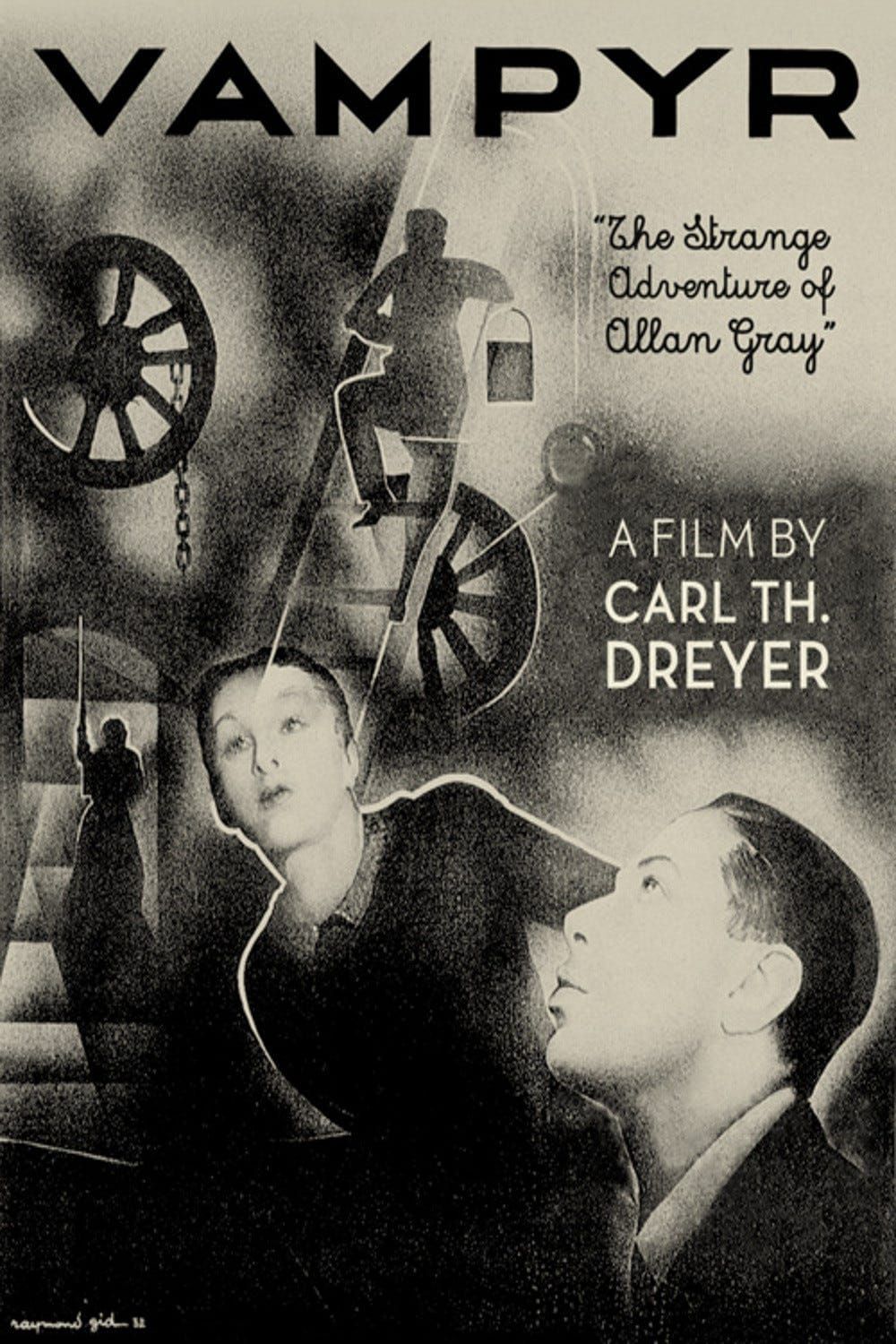
May is Classic 30s Movie month. Today’s guest post comes from Megaen Kelly.
Title: Vampyr
Year: 1932
Writers: Screenplay by Christen Jul and Carl Theodor Dreyer, based on a story by Joseph Sheridan Le Fanu
Lead Actors: Julian West, Jan Hieronimko, Rena Mandel and Sybille Schmitz
Director: Carl Theodor Dreyer
Plot Summary: Wanderer Allan Gray finds himself in the quaint French village of Courtempierre at night fall. Renting a room for the night at an inn, this young man who is predisposed to pursuing supernatural activities finds more than he bargained for. In the span of one night he sees shadows with no people, barking dogs with no dogs, a girl suffering under a mysterious ailment, and much much more creepiness.
It turns out that the village is under the curse of a vampire and Gray, along with a steadfast servant of a murdered man, must work to lift the curse or else more murders will occur.
Why I Think This Is A Classic 30s Movie
Five years after the first sound picture was released, Danish master Carl Theodor Dreyer wrote and directed his first sound film, Vampyr. Unlike many vampire films, both before Dreyer’s (e.g., 1922’s Nosferatu) and since, which are based on the brilliant Bram Stoker novel Dracula, Vampyr is based on Irish writer Joseph Sheridan Le Fanu’s short story “Carmilla”, which in the film credits is listed as In a Glass Darkly, published in 1872. In a Glass Darkly is actually comprised of five short stories of a gothic nature; in fact, Le Fanu is considered by many as the leading ghost story writer of the 19th Century. The short story “Carmilla” has been the springboard for several vampire films since Dreyer’s.
Vampyr is more a psychological thriller than a horror film, although it does range from creepy to terrifying. But compared to today’s horror movies which try to outdo each other in gallons of blood splashed across the screen and myriad ways of killing people, Vampyr makes the audience work to figure out what is going on and indeed, what will happen.
Because the film straddles both silent and sound films, it incorporates elements from both. There is extensive use of not only inter-titles but long inter-titles, which act more like a narrator than a bridge between actions. These inter-titles often take the form of pages from a book on vampires that Gray and the male servant read to figure out what is going on and what they have to do to rectify the situation.
There is minimal dialog in the film; in fact, there are no quotes worth mentioning from the film as it relies so much on its amazing visuals to tell its story. This is where it shares elements from ‘horror’ films that came before, particularly the stunning German expressionistic films The Cabinet of Dr. Caligari (1920) and the aforementioned Nosferatu.
While American studios were rushing to change up their equipment and theatres were upgrading their premises to accommodate the new ‘sound pictures’ at the end of the ’20s, European filmmakers and producers were more hesitant to enter headlong into sound production. Many thought sound would detract from the visual aesthetics of the movies produced in Europe at the time.
Despite the challenges of the new technique, Dreyer got around these by continuing to pursue his own unique visual style. And this is the strength of the film. Not the performances, not the sound, but the arresting images on the screen. At the end of the day the film is all about Dreyer and this is why he and the film have stood the test of time and indeed, have influenced future filmmakers and the genres of gothic, horror, and psychological thrillers.
My Favorite Moments in the Movie
In a word (actually two) Vampyr is a freak show! There is a sinister Mark Twain doppelganger doctor, shadows that not only have no person attached to them but can kill a human being, deformed people, and on and on.
An early moment in the film that is mesmerising is when Gray (Julian West) is walking around the village and wondering at all the shadows. The film takes place at night but is filmed in the day time. We only know it is night because everyone is carrying either candles or lanterns. But this gives Dreyer the opportunity to utilise light to play up shadow, which of course is a metaphor for good vs. evil. Here is the sequence on YouTube:
Probably, and quite rightly, the most amazing sequence in the film is when Gray comes across a coffin and when he looks in he sees his lifeless body. He watches in horror as the casket maker places the lid on the coffin, but it has a window over the impassive face of the dead Gray. Then the action moves from third person to first person as we see through the eyes of the ‘dead’ Gray as the coffin is carried through the village. Is this a dream?
Key Things You Should Look For When Watching This Movie
The threat of the vampire is more implied than revealed. It’s refreshing.
What part does the nefarious Doctor have in the scheme of the curse on the village? Is he the vampire? A minion of the vampire? His final scene is quite amazing and is also a metaphor for what is written on the lid of Gray’s coffin.
Here is the entire 1932 movie:
Thanks, Megaen!
To show our gratitude for your guest post, here’s a dash of creative juju for you. Whoosh!
We already have a set of classic 40s movies, 5os movies, 60s Movies, 70s movies, 80s Movies and 90s Movies. This month, we’re working on 30s movies. And thanks to the GITS community, we’ve got at least 22 movies in the works and hopefully!
Those who I put in bold have already sent me their posts. If you haven’t sent yours to me, please do so as soon as you can!!!
All Quiet on the Western Front — Michael Waters
Bride of Frankenstein — Marija Nielsen
Bringing Up Baby — Melinda Mahaffey
Captain Blood — John Arends
City Girl — Adam Westbrook
Dracula — Sheila Seaclearr
Duck Soup — David Joyner
Gone With The Wind — W. H. Morris
Gunga Din — Steve Huerta
It Happened One Night — Joni Brainerd
Make Way for Tomorrow — Susan Winchell
Mr. Smith Goes to Washington — Amber Watt
Rebecca — Katha
Snow White and the Seven Dwarves — Will King
Sabotage — Jeff Xilon
Stagecoach — Thenewlight
The 39 Steps — Felicity Flesher
The Adventures of Robin Hood — Clay Mitchell
The Petrified Forest — Rachel Sheridan
The Women — Liz Clarke
Topper — Wayne Kline
Trouble in Paradise — Vincenzo
Vampyr — Megaen Kelly
I am still looking for volunteers. If there’s a 30s movie you’d like to write about, please post your suggestion in comments or contact me via email.
Thanks to everyone who steps up for this ongoing project!
For the original post explaining the series, go here.
For all of the 30s movies featured in the series, go here.
Click REPLY and see you in comments about today’s classic 30s movie!