Interview (Written): Michael Haneke
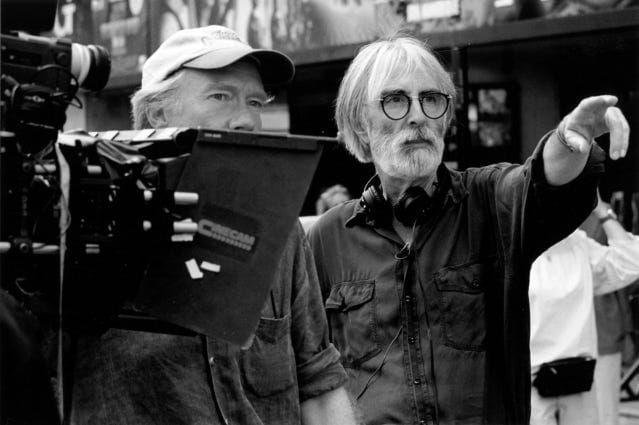
A 2014 Paris Review “The Art of Screenwriting” interview with Oscar winning writer-director Michael Haneke (The Piano Teacher, Amour).
INTERVIEWER: When you sit down to write a new script and jot down the first scene, do you already know what the last scene is going to be?
HANEKE: I know much, much more than that! I only sit down to write when I’ve laid out the entire film. Before that, I work according to the classic method. I spend time collecting all my ideas, and once I feel that I have enough, I start dividing up all these individual thoughts on small Post-it notes, assigning a specific color to each character. Then I start arranging those notes on a large board in order to figure out the arc of the story. I end up scrapping roughly three-quarters of my notes. But it’s only natural that you throw out even good ideas — there is simply no way you can put everything into a story. Only when my story is complete, in the sense that I know all the major plot lines regarding the major characters, do I sit down to write. And that’s just so much fun! It’s really a pleasant process. Once you’re on the right track, you can indulge yourself. Before that, you can’t see the forest for the trees. When I have a thousand options, I actually have none at all. Film requires you to plan each detail meticulously, and this is exactly why it’s so different from writing a novel.
Writer-director Michael Haneke
INTERVIEWER: Your biggest concern then, if I’m not mistaken, is with your characters’ individual psychologies?
HANEKE: Absolutely, and that’s really the only thing I know anything about. I would never set out to make a political film. I hope that my films provoke reflection and have an illuminating quality — that, of course, may have a political effect.
Still, I despise films that have a political agenda. Their intent is always to manipulate, to convince the viewer of their respective ideologies. Ideologies, however, are artistically uninteresting. I always say that if something can be reduced to one clear concept, it is artistically dead. If a single concept captures something, then everything has already been resolved — or so it appears, at least. Maybe that’s why I find it so hard to write synopses. I just cannot do it. If I were able to summarize a film in three sentences, I wouldn’t need to make it. Then I’d be a journalist, I’d get to the heart of the matter in those three sentences, and my readers would know what it’s all about, and that would be that. But that is not what I find interesting.
Look, life itself is the object of art. You aim to construct a parallel world in your novel or your play. The truly captivating thing is the story that unfolds between your protagonists. Of course, for somebody with political convictions — and we all have those — there is no way they aren’t going to seep into your artwork. Céline, for example, was a right-wing extremist. And that was visible in his work, but he still wasn’t completely inept as a writer. There are thousands of examples, from both the left and the right. At the academy, I always lecture on propagandistic films of various origins so as to sensitize my students to their particular way of functioning. In my films, however, politics happen only subcutaneously, and it is never my intention to say, Look, this is what I’m trying to tell you, now swallow it. My objective is a humanistic one — to enter into a dialogue with my viewers and to make them think. There isn’t much more you will be able to achieve in the dramatic arts. And frankly, I don’t know what else you should be able to achieve.
For the rest of the interview, go here.