Interview (Part 2): Matt Manfredi and Phil Hay (“The Invitation”)
I’m a big fan of producer Mynette Louie and what she and her cohorts are doing at Gamechanger Films, a film fund for women directors, so when I saw their newest movie The Invitation was coming out in April this year, I made it a point to watch it on VOD the week it went into distribution. I loved it! So I got in touch with Mynette who connected me with the movie’s screenwriters Matt Manfredi and Phil Hay, and we ended up having a great conversation about their careers, the craft of writing and their thriller movie The Invitation.
Today in Part 2, Phil and Matt talk about writing the comedies Ride Along and Ride Along 2, why they write so many different types of movies, the inspiration for The Invitation, and how it is Karyn Kusama ended up directing the movie:
Scott: Let’s talk about Ride Along which was so successful it had a sequel. That’s a comedy. You talk about exploring different genres, how did Ride Along come about?
Matt: Our first couple spec scripts were comedies. It’s always where we thought we were going to start at, but, you know, Crazy / Beautiful, Aeon Flux… so we were doing R.I.P.D. at Universal. At the time, it was going very well. The studio was very happy with the script and liked the work we had done on it and we had and still have a very tight relationship with them.
They had just gotten Ride Along from New Line. The executives thought we would be a good fit with Tim Story, and we’d be good to get the script into shape, because they needed…at that point, they had brought on Cube and Kevin.
There was a window that they needed to hit in terms of production, basically just had one shot at it, and so they came to us, and said, “Can you do this? Can you get this into shape in about six weeks?” We did. We got along with everyone really well. It’s the kind of movie we like to write. It’s a character‑based, action comedy, which we love.
Phil: I think of it sometimes in this way: if you’re a screenwriter, it’s what you’re training for years to make yourself to be ready to do. We had to be able to…You have to be ready when that kind of thing happens. It just doesn’t happen that you’re prepared to jump into something with such high stakes and that much pressure.
So we were able to leap in very aggressively, and able to promise them that within a pretty intense time frame, we could get them a movie. Of course, we ended up working on it for a whole lot longer than that.
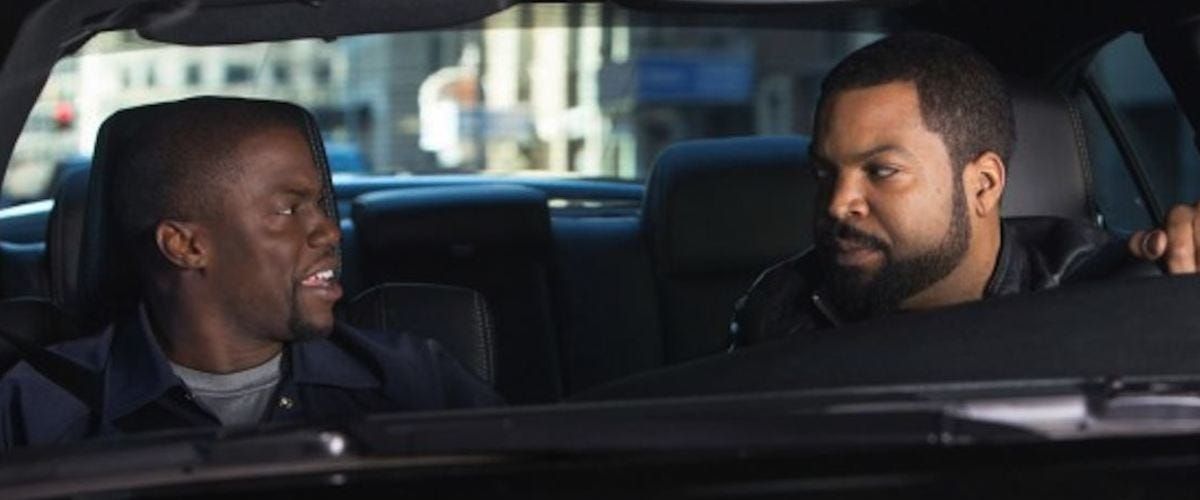
Kevin Hart and Ice Cube in Ride Along
Once we got to work with Tim, Will, Cube, and Kevin, all of them are really great amazing collaborators. We all melded very quickly. We all were very directed towards the same movie. That was a very invigorating and fun experience, because it was so intense and so impacted. Then we got to make a sequel and continue that experience…
Matt: Also on a movie like that, it’s a different experience in terms of at a $20 million budget, you just get to go. It was exciting from the moment the script was finished. It wasn’t an over‑long development process, or a lot of second guessing, we just went, and it was exciting and fun.
Scott: Just looking at the variety of movies you’ve done, have your agents at UTA ever said, “Hey guys, you’d make our job a lot easier if you’d just do one genre? Put you on one list, and we just brand you for six or seven years.”
Has that ever come up, have you ever thought about doing it, or are you happy to be doing a variety of different stories?
Matt: It hasn’t really come up. No one’s ever really said that to us. We’re grateful for that. In terms of material that comes to us, you do see a trend. I think people do try to categorize you. When we were working on Ride Along, and R.I.P.D., and all that stuff, we were getting a lot of comedies sent our way.
With The Invitation, we’re seeing a different kind of material coming to us, which is fun and exciting. It keeps you invigorated.
Phil: It has been great that our agents have never really… as Matt said, they’ve never really try to herd us one way. I think if there’s something that served us well, it’s that we generally really do follow our gut and our heart. We never ever try to talk ourselves into doing something because it would be “a good idea to do it.” That’s how you get in trouble.
We never take something because we feel we should for external reasons, and we never turn down something good because maybe the circumstance is less than ideal or it looks like it’s going to be a battle if we truly believe in that movie, and the people working on it, and that story. I think there are a lot of screenwriters like us out there. Nobody’s just one thing. We love all different kinds of movies.
We also really crave to be able to explore different genres, and different relationships, and different movie experiences. In many ways, you can’t get things that are more different from each other than something like The Invitation and something like Ride Along, but we deeply care about all of them.
They all reflect some part of us that we are trying to figure out or express.
Scott: The standard advice to aspiring writers is, “Pick one genre, and write the hell out of that so that you’re more likely to get representation, and milk that brand.” There are, obviously, writers with a lot of different interests. It’s great that you been able to carve out a career like that.
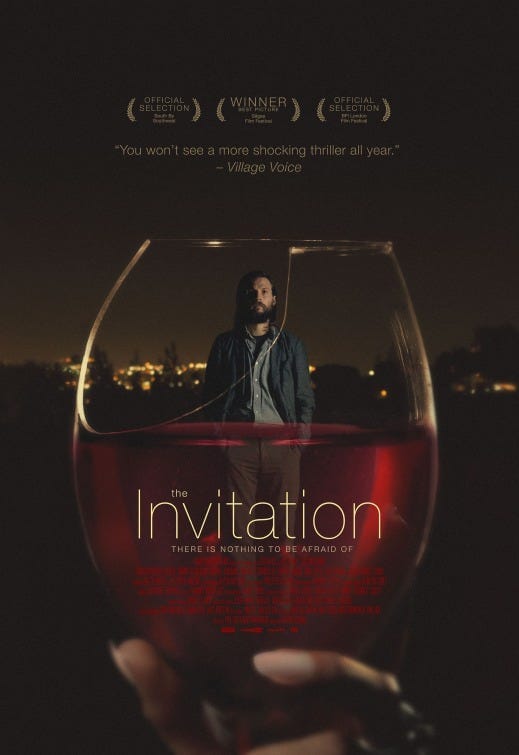
Let’s jump to one that you mentioned which we want to focus on, The Invitation. Here’s a plot summary: “While attending a dinner party at his former home, a man thinks his ex‑wife and her new husband have sinister intentions for their guests.”
I read where you said the ending was what came to you first. What was the inspiration for The Invitation?
Matt: In terms of the plot, the ending is what came to us first. It really came out of discussions we were having around theme, about grief, and about the isolating nature of it, and how you can all of a sudden not know someone who you thought you knew, and how suppression of big emotions can be harmful, about denial.
We were talking in and around those things, and talking about Southern California and its uniqueness, how this is a place where there are a lot different approaches to spirituality and coping with things.
Phil: There’s a very deep bed of mythology too, a very dark underpinning of these ideologies and ideas in Los Angeles and in California. Obviously, there are some references within the movie to that. As Matt said, this one came to us a lot through the world of feelings, and ideas, and things we wanted to explore.
Also, we’re interested in the idea of, how do you know someone? It would be emotional horror to feel that you knew someone very well, have them disappear, and when they came back, they were a completely different person. That was like something, as a “what if,” that we kept coming back to.
Matt: Once we knew what we were writing about, we knew it was going to be a dinner party, we knew it should be in the hills. The ending presented itself to us very early, because in a strange way, that is the premise of the movie.
Phil: Once we knew that, that was an organizing principle that we needed.
Matt: That we were working towards.
Phil: It took us many years to write this script, for a couple reasons. It’s a script and a movie that really demands a lot of fine‑tuned turns and a very rigorous, very exacting approach to structure.
That was always there, as something we were always working on, but honestly, it also for myself at least, something that took many years to see into, to let the ideas seep in, and let what it’s about creep up on us. That was the process that also took a long time, and took a lot of emotional energy.
I think one other thing I’d say is, one of the reasons we were drawn to tell the story in the framework of a thriller, or a psychological thriller, or something that eventually becomes a horror movie, is because those genres have produced some of the most, to me, moving and poignant movies that I’ve seen recently.
A lot of the most personal, and the most political, films take place in those genres for me.
Scott: You’ve been doing primarily studio movies. You have this idea, obviously, of a contained environment. That’s a great way to do a lower budget thing. Was this always in mind to do a lower budget film, and have Karyn direct it?
Matt: It was always in mind to do a lower budget film, but we originally thought of directing ourselves, and we weren’t sure at what level it would be done, whether we’d be doing it at some kind of mini major, or independent production company, or whether the traditional foreign financing kind of thing.
As we explored directing it ourselves, we realized that there was a better director that we knew, who is very close. It just seemed like a fantastic fit. Obviously, we love working with her. When she was open to that idea, we just ran with it.
Phil: Once we knew we were going to make it independently, there were then many iterations with different budget levels. We made it for a million dollars ultimately, and what that allowed us to do was to make it without any casting contingencies, and without any sense of having to make a foreign pre‑sale decision about who we were going to cast.
For us, that was really critical, because it allowed us to cast the actors who were the perfect people to play the part, period. When you make a movie for a million dollars, we’ve seen, now having the movie in release, and with a distributor who we absolutely love in Drafthouse Films — who got the movie immediately, and very profoundly — that was the right size for this movie and provided a path to success.
That was the responsible level to make the movie, and we were counting on Karyn’s craft, our craft, all of our collaborators, including the composer and editor, both of whom are our longtime friends, all of whom are doing us favors by working on this movie, because no one is getting paid a lot to do it.
That’s where we realized that we could pour all the resources we had, that we developed over the course of a 16 year career, into this one movie, and make it as big as it can be, for as little initial investment as we can do it. That was helpful. Even though it created a lot of logistical challenges, it was creatively free.
Karyn will tell you over and over again, it’s deceptively hard to shoot one location, and to shoot 12 people in a room. That’s, in fact, in some ways more difficult than shooting a car crash. But keeping it contained did allow us to go as low budget as we did.
Tomorrow in Part 3, Matt and Phil talk about three of the key characters in The Invitation and how those characters emerged in the duo’s writing process.
For Part 1 of the interview, go here.
Matt and Phil are repped by UTA.
Twitter: @phillycarly, @MattRManfredi.
Here is a trailer for The Invitation:
The Invitation website.
Rent or purchase The Invitation here.