100 Screenwriters on Screenwriting
Professional screenwriters reflect on the craft.
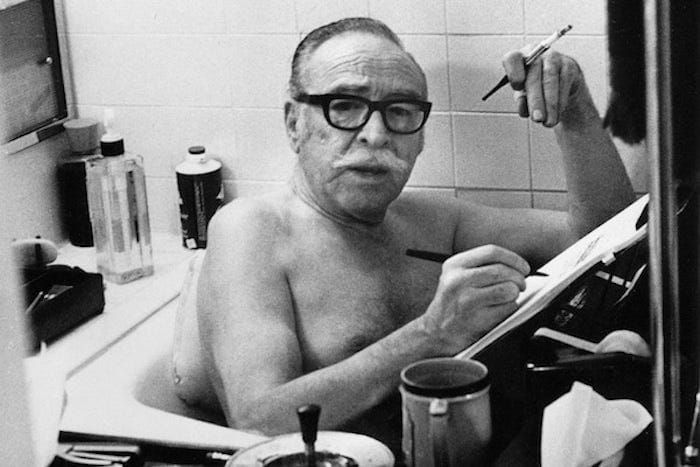
Professional screenwriters reflect on the craft.
“My one note of screenwriting advice is: Make sure you can *see* the movie before you start writing the actual script.”
— Arash Amel
“Sometimes you’re swinging your way through a first draft like a blind miner with a pick-axe. That’s OK. Just get it done.”
— Justin Marks
“It’s really important to start off well. If you grab people early in a script, they’re going to keep reading.”
— Carter Blanchard
“No matter what the concept is, nobody cares if there’s not an empathetic way into the story.”
— Daniel Kunka
“The challenge of screenwriting is to say much in little and still preserve an effect of leisure and natural movement.”
— Raymond Chandler
“Outlining is necessary work, but you have to have something left to discover during the writing or you won’t be inspired.”
— Liz W. Garcia
“I think it’s always easier to revise a script, even a truly awful one, than face the tyranny of the blank page.”
— Stan Chervin
“You have to empathize with, even love the villains you write. Otherwise it just becomes caricature.”
— Lisa Joy
“A screenwriter’s currency is a finished script. Not an outline, a take, a beat sheet, a rough draft. A finished script.”
— F. Scott Frazier
“My best writing has been on the scripts I wrote as suicide notes to the industry — sort of, ‘Fuck you, guys, I’m outta here.’”
— Marc Norman
“I have learned the first rule of screenwriting is having no rules. Everyone has to find their own way of doing things.”
— Guillermo Arriaga
“Eighty percent of a motion picture is writing, the other twenty percent is the execution.”
— Billy Wilder
“If you’re not prepared to be rejected, don’t try to write films.”
— Peter Hyams
“The single most important question one must ask oneself about a character is what are they really afraid of.”
— Robert Towne
“Each scene must be a drama in itself. The whole picture must be made up of a series of small dramas.”
— Jeanie Macpherson
“Plot does not drive characters. Characters drive plot. Characters want, need, feel, act, react. This creates plot.”
— Chuck Wendig
“Screenplays don’t have to read like an instruction manual for a refrigerator. You can write them as a pleasurable read.”
— William Goldman
“If you’re inviting people into a story, invite them into all parts of it. Inhabit each character as fully as possible.”
— Nikole Beckwith
“Every five to ten pages, I want a big fist to come out of the screenplay and punch the reader in the gut.”
— Allan Durand
“If I have anything to say to young writers, it’s stop thinking of writing as art. Think of it as work.”
— Paddy Chayefsky
“Interesting things happening to interesting people is basically the only rule of screenwriting.”
— Brian Duffield
“That’s something I always ask myself: ‘Is this a movie that I would go to see?’”
— Charlie Kaufman
“Each writer starts differently, but the only valid way is start with character. Character IS plot. Character IS story.”
— Eleanor Perry
“A writer can always write. That’s one of the great luxuries we have: Words are cheap.”
— John August
“When you make a movie, always try to discover what the theme of the movie is in one or two words.”
— Francis Ford Coppola
“I start thinking about key scenes. I write those scenes first, out of order. I call it ‘the scent of blood.’”
— Jim Uhls
“If you trust the moment as you write, it will always bring you what you need.”
— Bruce Joel Rubin
“I’m not romantic at all about the creative process. I feel like a plow horse — just one foot in front of the other.”
— Caroline Thompson
“At the top of my computer in big, bold letters, it says, ‘What is the simple emotional journey?’ I look at that all the time.”
— Billy Ray
“Forget every rule Syd Field, Robert McKee or any other screenwriting guru ever taught you. Except one: Never be boring.”
— David Mamet
“I force myself to sit down, write and hope it doesn’t turn out shitty. If it turns out shitty, I change it.”
— Will Beall
“It’s not until you really throw your character into the story that you can genuinely understand who they are.”
— Elijah Bynum
“Never attack a scene head on, do it obliquely. It makes the audience more curious if you approach your points sideways.”
— Catherine Turney
“For me, a screenplay starts with something I can tell other people in five minutes.”
— Harold Ramis
“I endlessly chart and re-chart a movie. Before I write, I have all the scenes listed, what happens in each scene.”
— Paul Schrader
“Good dialogue comes from character development. The better you know your character, the more specific the dialogue will feel.”
— Chris McCoy
“The job of the screenwriter is to run the film in the reader’s imagination. And nothing should get in the way of that.”
— Colin Higgins
“If I could say anything, it’s keep going. Don’t go back and fix that scene, that dialogue. Just write the next word.”
— Anna Hamilton Phelan
“A movie is about an emotional struggle. The physical struggle is a manifestation of that.”
— John Gary
“It’s the words, it always gets back to the words…”
— Julius Epstein
“Character is destiny. Change, growing from within and forced from without, is the mainspring of character development.”
— Rita Mae Brown
“The first draft is the one thing they can’t take away from you, so revel in it.”
— Daniel Waters
“Character exists in emotions and sensations. Without it, they no more represent a living person than a fleshless skeleton.”
— Francis Marion
“A bad script written is still better than an amazing one that isn’t.”
— Jon Boyer
“Write what you want to see. If you don’t, you won’t have any true passion in it, and it won’t be done with any true artistry.”
— John Milius
“That’s our job, to spark curiosity and emotion from an audience, for them to discover what’s going on in their own heads.”
— Seth Lochhead
“Screenwriting is all about what happens next, what happens next. It’s speed chess, not chess.”
— Richard Price
“One day, you will sell your screenplay, and then your problems will begin.”
— Audrey Wells
“I realized screenwriting was a real art form. I had to prostrate myself before it and study it if I wanted to be good.”
— Stephen Gaghan
“Writing is the best gig in the whole business, as far as I’m concerned. You just sit down and make shit up.”
— Robert Mark Kamen
“To make something really great and different and interesting means taking risks and following these ideas in your head.”
— Brad Bird
“Reprogram your brain so THE END isn’t a giant finish line. You got pages done today. You’ll do more tomorrow.”
— Eric Heisserer
“It’s really important to know not to panic, it’s all going to come together; you’ve just got to keep pushing forward.”
— Lisa Cholodenko
“Emotion, by definition, is invisible. So cinema is, by definition, dealing with the invisible.”
— Jim Sheridan
“The blank page is the greatest moment of writing a script… be happy that you have the privilege of facing it.”
— Lorenzo Semple Jr.
“Write it. Shoot it. Publish it. Crochet it, sauté it, whatever. MAKE.”
— Joss Whedon
“I think one of the reasons that people resent writers is because when we are writing, we are God.”
— Phil Alden Robinson
“The people I believe in the most create work about people who are real. When people see truth in art, it resonates.”
— Jill Soloway
“Sometimes you’re swinging your way through a first draft like a blind miner with a pick-axe. That’s OK. Just get it done.”
— Justin Marks
“What does this character want and more importantly why do they want it? Those are what I look at as I’m writing dialogue.”
— Brad Ingelsby
“The more you adhere to some kind of screenwriting formula, the more likely you are to end up with a formulaic screenplay.”
— Gary Whitta
“Quality prep work makes writing the script much easier. I know what I need out of each scene going forward.”
— Jeff Morris
“If you’re doing it to tell stories that need to be told, you can get yourself through the bad moments.”
— Naomi Foner
“Audiences go to movies to feel. When the movie becomes too mechanical instead of organic, audiences detach from the film.”
— Simon Kinberg
“Slack is one fault and slick is another. Both are bad faults in story.”
— James M. Cain
“Make sure your first 20 pages kick serious ass. Hook that first reader, get them INTERESTED, then it’s off to the races.”
— Scott Neustadter
“Emotional authenticity is more important than historical. We can’t recreate a world, but we can recreate the emotions of it.”
— James DiLapo
“I’m always looking for stories, that next diamond in the rough, something that’s been looked over or can be reinvented.”
— Lindsay Devlin
“The best writing is also subconscious where you don’t know that you’re doing it, and you don’t realize you’ve done it.”
— Scott Frank
“A great script creates an irresistible narrative flow that propels a reader to an inevitable dramatic conclusion.”
— Javier Grillo-Marxuach
“Every movie ever made is an attempt to remake The Wizard of Oz.”
— Joel Coen
“Characters should never enter. They should storm in, they should skulk in, they should tremble in. Create visual pictures.”
— Larry Ferguson
“I find their voices by writing down every thought that would be in their head and then cutting off the fat.”
— Julia Hart
“I fell in love with screenwriting. It’s like story poetry, the most disciplined form of modern writing.”
— Shawn Lawrence Otto
“I don’t have a formal rewrite process; I just compulsively groom and regroom scenes like a cat with OCD.”
— Diablo Cody
“I want to know my whole story works before I start writing.”
— Tom Schulman
“No matter how big or high concept your story is, it only works if there’s a small, personal story at its core.”
— Chris Sparling
“When I write a screenplay, I create an emotional map, where the characters are, where they’re going and where they’ve been.”
— Ava DuVernay
“People always say, write what you know, and I think it’s write what you know emotionally.”
— Spenser Cohen
“You can dress it up, but it comes down to the fact that a movie is only as good as its script.”
— Curtis Hanson
“I try my very best in every film I’m working on to make you fall in love with those characters.”
— Mark Bomback
“The first draft, the first structure is really important… Do it fast, don’t get stuck.”
— Oliver Stone
“Don’t worry about getting an agent. When you have enough quality work under your belt, they will come calling.”
— Stephany Folsom
“The secret to screenwriting is short sentences, small words, and BIG pictures.”
— William Kelley
“One of the few things I’ve discovered about writing is to form a habit that becomes an addiction.”
— Frank Pierson
“Everything is a more perfect in your head. Once you make concrete choices — one word over another — everything gets worse.”
— Damien Chazelle
“Remember, not every idea is a movie. You don’t want to run out of plot before you run out of pages.”
— Mike Sweeney
“It’s like building a wall. You’re changing the details, but you’re still trying to keep the overall shape of the story.”
— Leigh Brackett
“I rewrite and rewrite and rewrite. I know in advance that my so-called first draft will be my tenth draft.”
— Carol Foreman
“Hollywood lives or dies on something that seems new and original, but is very much like something that made money before.”
— Michael January
“There’s a magic to being present when you’re writing a character. Just spit it out, then go back and edit it later.”
— Reid Carolin
“It’s the words, it always gets back to the words…”
— Julius Epstein
“Roger Corman taught me you could make a movie about anything as long as it had a hook to hang the advertising on.”
— Amy Holden Jones
“I don’t think writing is as much an act as a way of being. It’s the living and thinking that makes the writing.”
— Sean Hartofilis
“Don’t write what they want, they don’t know what they want, just make it GOOD.”
— Nora Ephron
“To make a great film, you need three things — the script, the script and the script.”
— Alfred Hitchcock
“If you’ve got craft, you got game. If you got game, you can write your way in and out of anything.”
— Robert Mark Kamen
“A lot of writers try to get approval and love way too early. Get the script right first.”
— Allison Burnett
“The question to ask about a new story idea: Can you really see it opening at a theater next weekend?”
— John Swetnam
“The writing period is the same: 5 pages a day, 7 days a week. Nothing magical. You just sit there and keep typing.”
— Stirling Silliphant
10 Screenwriters on Screenwriting: Vol. 1
10 Screenwriters on Screenwriting: Vol. 2
10 Screenwriters on Screenwriting: Vol. 3
10 Screenwriters on Screenwriting: Vol. 4
10 Screenwriters on Screenwriting: Vol. 5
10 Screenwriters on Screenwriting: Vol. 6
10 Screenwriters on Screenwriting: Vol. 7
10 Screenwriters on Screenwriting: Vol. 8
10 Screenwriters on Screenwriting: Vol. 9
10 Screenwriters on Screenwriting: Vol. 10
To read 50 Things About Screenwriting, go here.