2016 Dialogue-Writing Challenge: Day 5
Last year at this time, we did a month-long Dialogue-Writing Challenge. It was a big success with dozens of writers participating. We all learned quite a bit about this important aspect of the craft plus we had some fun in the process. So I’ve decided to bring it back!
Every Monday-Friday at noon Eastern / 9AM Pacific in February, I will upload a post with a prompt for writing dialogue. Each day, write a scene per those guidelines. If you really want to get in the spirit of things, upload your scene here in the comments section of the original post. That way you can critique others’ pages and receive feedback on your dialogue as well.
To provide extra motivation for this series — to get people to WRITE PAGES — I am giving away some of my Craft classes to Dialogue-Writing Challenge participants. That’s right: For free!
The Craft classes highlight key principles and practices tied to the nitty gritty of writing a script. Here is the Craft lineup, the only time I will teach each of these courses in 2016:
January 25: Craft: Pixar and the Craft of Storytelling
February 8: Craft: Story Summaries
February 22: Craft: Handling Exposition
March 7: Craft: Scene Description Spotlight
April 4: Craft: Character Development Keys
May 2: Craft: Create a Compelling Protagonist
May 16: Craft: Write a Worthy Nemesis
May 30: Craft: The Coen Brothers and the Craft of Storytelling
Each is a 1-week online class featuring 7 lectures written by me, lots of screenwriting insider tips, logline workshops, optional writing exercises, 24/7 message board conversations, teleconferences with course participants and myself to discuss anything related to the craft of scriptwriting.
A popular option is the Craft Package which gives you access to the content in all eight Craft classes which you can go through on your own time and at your own pace, plus automatic enrollment in each 1-week online course. All for nearly 50% the price of each individual class. And special bonus content: 7 lectures on How to Introduce Characters so a script reader will immediately get a clear sense of who each character is… and be entertained in the process.
To qualify to take one of my Craft classes for free, write and submit ten [10] Dialogue-Writing Challenge posts, then provide feedback on ten [10] posts from other writers. The former to get you writing, the latter to work your critical-analytical skills.
A chance to take any of my eight Craft classes, interface with me online along with the usual stellar group of writers who take Screenwriting Master Class courses, while using writing exercises and feedback to upgrade your skill at writing and analyzing dialogue.
ISN’T THAT AN AWESOME IDEA?!!!
A couple of logistical notes:
* Limit your post to 2 pages. Out of fairness to everyone participating in the public dialogue-writing workshop, let’s not abuse anyone’s patience or time with really long scenes.
* Give your scenes a beginning, middle and end. You may enter late and exit early, but provide an arc to each of your posts. Even monologues or telephone conversations, both of which we will be doing this month.
* Don’t be concerned about proper script format when you copy/paste your pages, rather the content and execution are the important thing. So as a default mode, do this: (1) Don’t worry about right-hand margins on scene description or dialogue, just keep typing until it manually shifts each line. (2) Don’t worry about character name position, rather do this:
SCARLETT: Rhett, Rhett... Rhett, if you go, where shall I go? What shall I do?RHETT: Frankly, my dear, I don't give a damn.
Today’s prompt: Use voice-over narration with a flashback.
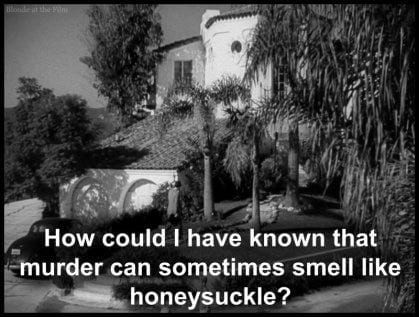
That’s right, we are going against two supposed screenwriting ‘rules’: Don’t use either because they represent ‘weak writing’. Tell that to Eric Roth who wrote Forrest Gump or Billy Wilder and Raymond Chandler who wrote Double Indemnity. Here is your chance to beat down this narrow-minded thinking.
Apart from selecting an entertaining scene, here’s one big key to help make this work: Don’t use the V.O. to describe what we can see happening. Rather use the voice-over to go deeper into the emotional experience and meaning of the moment. The flashback itself should convey the event through visuals. Use the V.O. to tell us something we can’t know from the actions on screen.
Focus on the dialogue, not the action to drive the scene. In most movies, it’s the other way around because movies are primarily a visual medium, however sometimes the script requires a dialogue-driven scene and we need to hone our chops at being able to do that effectively.
Write a 1–2 page dialogue-centric scene, then copy/paste in comments.
If you are interested in qualifying for 1 free Craft class with me, please note in each post you submit the number of scenes you have written. If today is your first effort, note that it is Scene 1. The next one, Scene 2. And so forth.
Also when you provide feedback on someone’s scene, please note in each reply the number of comments you have uploaded. So if today is your first response, Feedback 1. The next one, Feedback 2.
You are on an honor system, as I don’t have time to check every post, so do the right thing!
Remember: In order to qualify for one of my free Craft classes, you need to submit ten [10] Dialogue-Writing Challenge posts, then provide feedback on ten [10] posts from other writers.
FEEDBACK TIP: Sometimes a change in the mood of the character using voice-over narration can elevate the scene. Frantic. Calm. Sarcastic. Hopeless. Excited. Provide a version of one side of their dialogue with an alternate emotion-state on the part of the speaker.
Want to join in? Here are the previous challenge prompts:
Day 1 challenge: A young child asks an adult, “Where do babies come from?”
Day 2 challenge: Write a monologue in which a character expresses regret for something in their past.
Day 3 challenge: A scene built around the line “Give me the God damn key.”
Day 4 challenge: A stoner conversation.
It’s the 2016 Dialogue-Writing Challenge! Give a jolt to your creative and writing muscles… and win 1 free online class with yours truly.
NOTE: My Craft: Handling Exposition class starts Monday, February 22. If you have done all 10 exercises and provided 10 feedback posts by February 19, you are eligible to take that class for free. It’s an important class that dovetails directly into writing dialogue, so you can use that as some motivation!
Finally if you have a suggestion for a dialogue-writing prompt, please post in comments or email me.
To see all of the 2015 Dialogue Writing Exercise prompts, go here.