A Story Idea Each Day for a Month — Day 14
This is the fifth year in a row I’ve run this series in April. Last week I provided a daily explanation about why you should make it a habit to be generating story ideas. This week, I’ll give you some tips on how to come up with stories.
Tip: Go random.
This is going to sound really stupid. Well, it is really stupid. But all it takes is one time to pay off, then it becomes clever because as we know, there’s a fine line between clever and stupid.
Anyway the very first screenwriting class I taught 10 years ago was at UCLA. One night, I took two caps and some 3x5 inch index cards. I handed out 10 cards to each student, then instructed them on 5 cards to write a job [e.g., plumber, lawyer, dog catcher] and on the other 5 cards to write a location [e.g., shopping mall, swimming pool, church]. I collected the cards, jobs in one hat, locations in the other.
Then we went around the room, each student pulling a card from each hat, an exercise in generating totally random story conceits.
So someone pulls out “Doctor” and “Cruise Ship.” Nothing much there.
Then another person pulls out “Jockey” and “Restaurant.” Again nothing.
Then someone pulls outs “Cop” and “Kindergarten.”
I. Kid. You. Not. “Kindergarten Cop,” totally random, right there in that Westwood classroom. Okay, so the moment of inspiration was 12 years after the movie, but still it proved — sorta — that sometimes totally random, stupid ideas have the potential to generate story concepts… and even be a little clever.
Today’s story: F. Scott Fitzgerald’s Lost Years.
Authors, Ernest Hemingway once mused, were best advised to meet Hollywood studios at the state line: “You throw them your book, they throw you the money, then you jump into your car and drive like hell back the way you came.” But his fellow Lost Generation icon F. Scott Fitzgerald spent years in the 1930s writing for studios, where the Great Gatsby author was paid handsomely to write one ill-fated script after another. Visiting Metro Goldwyn Mayer’s offices in 1985, Rutgers grad student Wheeler Winston Dixon found their basement contained desks still stuffed with Fitzgerald’s notes — “they had the actual legal pads there, intact,” Dixon recalls in amazement. Among their boxes of castoffs, he discovered Fitzgerald’s six-page outline for the ending of his famously unfinished script to Infidelity, a 1938 Joan Crawford vehicle that got scrapped for portraying, well, infidelity.
These days the notes are safely archived at the University of South Carolina, far from MGM’s basement — and Dixon is now a Professor of Film Studies at University of Nebraska. Fitzgerald’s screenplay and concluding notes remain something of an undiscovered treasure, Professor Dixon insists: “I still think to this day, if you gave it to a really good screenwriter, it’d be a brilliant script.”
There are three other stories in the link above, but I wanted a go at this one. Fitzgerald’s term in Hollywood was a tempestuous one. Out of all the scripted projects he wrote, the famed author managed to garner one screenwriting credit, a shared credit at that for the 1938 drama Three Comrades. This sad letter Fitzgerald penned to producer Joe Mankiewicz over a disagreement about a screenplay provides a pretty good indication of what the movie business did to the writer:
“My only hope is that you will have a moment of clear thinking. That you’ll ask some intelligent and disinterested person to look at the two scripts. Some honest thinking would be much more valuable to the enterprise right now than an effort to convince people you’ve improved it. I am utterly miserable at seeing months of work and thought negated in one hasty week. I hope you’re big enough to take this letter as it’s meant — a desperate plea to restore the dialogue to its former quality…all those touches that were both natural and new. Oh, Joe, can’t producers ever be wrong? I’m a good writer–honest. I thought you were going to play fair.”
So what if an aspiring writer discovered a heretofore screenplay penned by Fitzgerald, not one of his studio assignments, but an original story? What if the script is amazing. And what if… the third act is missing?
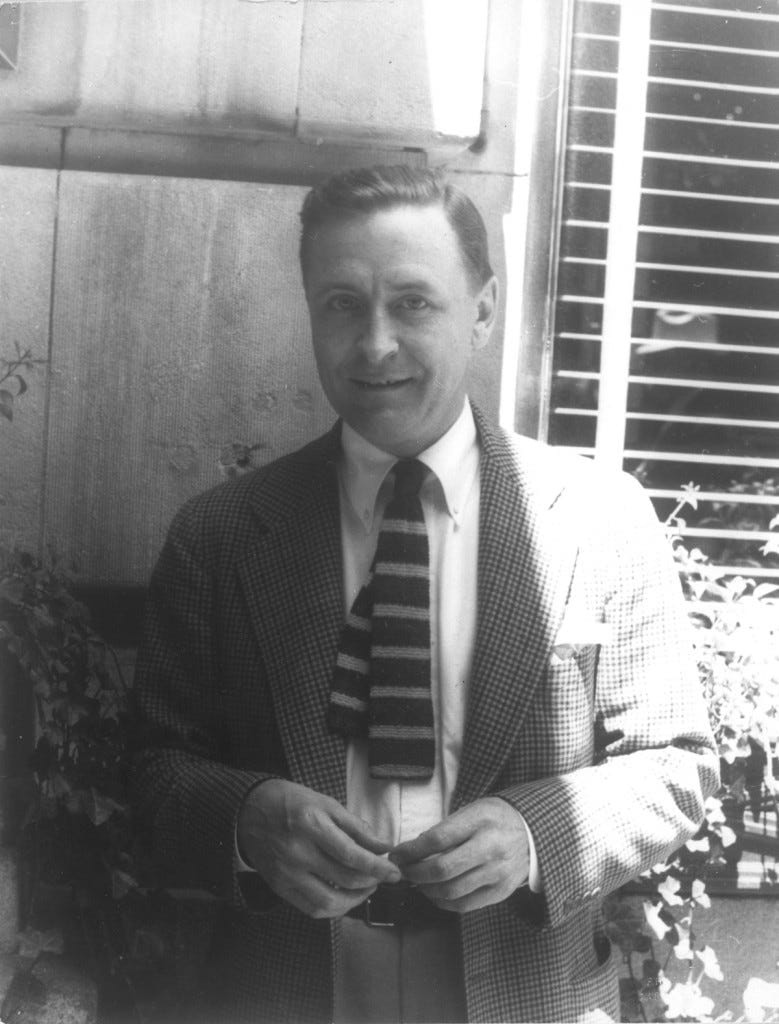
F. Scott Fitzgerald in Hollywood
Two possible narrative paths come to mind [I’m sure there are many more]. First, the aspiring screenwriter realizes she [let’s call her Victoria] has discovered an amazing way to be discovered by Hollywood: Deliver to them an original screenplay written by Fitzgerald and Victoria. The story itself is amazing. Then there is the story behind the story, the discovery of the script, her research, the writing of the third act. What a great hook to set her apart from thousands of other wannabe screenwriters.
As part of her research and in order to get into the mindset of Fitzgerald, I imagine Victoria learning as much as she can about the author’s habits and lifestyle in Hollywood. A lot of it, evidently he spent drinking and partying. Victoria could start to emulate his behavior, figuring that would help her to inhabit Fitzgerald’s mindset. She visit old haunts like Musso and Frank, where Fitzgerald is said to have spent many afternoons, drinking with Hollywood’s creative elite.
This story seems destined to go down the path of Barton Fink and Adaptation whereby the writer descends into a sort of psychic hellhole. I suppose Victoria could become so connected with Fitzgerald, she joins him in spirit on his road to destruction, maybe even her own death — a dark tale of possession, only not of the demonic sort, rather an aesthetic one.
The idea of a “spirit” raises another possibility, something along the lines of Play It Again, Sam, only instead of Humphrey Bogart’s character from Casablanca coming to life, what if Victoria somehow magically conjures up Fitzgerald’s ghost? He becomes her muse and ghost writer — pun intended — to finish his screenplay. In fact, maybe that’s the title: Ghost Writer. And one option, like The Ghost and Mrs. Muir, is Victoria and Fitzgerald fall in love.
Writing movies set in Hollywood is a challenge. Indeed the conventional wisdom is they are to be avoided for at least two reasons: (1) The inside nature of working in Hollywood narrows the audience because it is such an exclusive club. (2) Since everyone who will read the script works in Hollywood, the writer has a super high threshold to hit in terms of achieving a sense of verisimilitude. In other words, if you can’t create an authentic feel to the story’s take on Hollywood, anyone inside the industry will sniff that out in a New York second. Into the virtual waste basket the script goes!
That said, there are no rules. If you feel compelled to write a story set in the world of movies, go ahead. Just make sure the characters and themes are relatable to a wide audience… and create a sense of authenticity with your story world.
There you go: My fourteenth story idea for the month. And it’s yours. Free!
What would you do with it?
Each day this month, I invite you to join me in comments to do some brainstorming. Gender bend, genre bend, what if. Take each day’s story idea and see what it can become when we play around with it. These are all valuable skills for a writer to develop.
See you in comments (hit Reply to join the conversation). And come back tomorrow for another Story Idea Each Day For A Month.
Comment Archive