A Story Idea Each Day for a Month — Day 14
This is the seventh year in a row I’ve run this series in April. Last week I provided a daily explanation about why you should make it a habit to be generating story ideas. This week, I’ll give you some tips on how to come up with stories.
Tip: Go random.
This is going to sound really stupid. Well, it is really stupid. But all it takes is one time to pay off, then it becomes clever because as we know, there’s a fine line between clever and stupid.
Anyway the very first screenwriting class I taught 14 years ago was at UCLA. One night, I took two caps and some 3x5 inch index cards. I handed out 10 cards to each student, then instructed them on 5 cards to write a job [e.g., plumber, lawyer, dog catcher] and on the other 5 cards to write a location [e.g., shopping mall, swimming pool, church]. I collected the cards, jobs in one hat, locations in the other.
Then we went around the room, each student pulling a card from each hat, an exercise in generating totally random story conceits.
So someone pulls out “Doctor” and “Cruise Ship.” Nothing much there.
Then another person pulls out “Jockey” and “Restaurant.” Again nothing.
Then someone pulls outs “Cop” and “Kindergarten.”
I. Kid. You. Not. “Kindergarten Cop,” totally random, right there in that Westwood classroom. Okay, so the moment of inspiration was 12 years after the movie, but still it proved — sorta — that sometimes totally random, stupid ideas have the potential to generate story concepts… and even be a little clever.
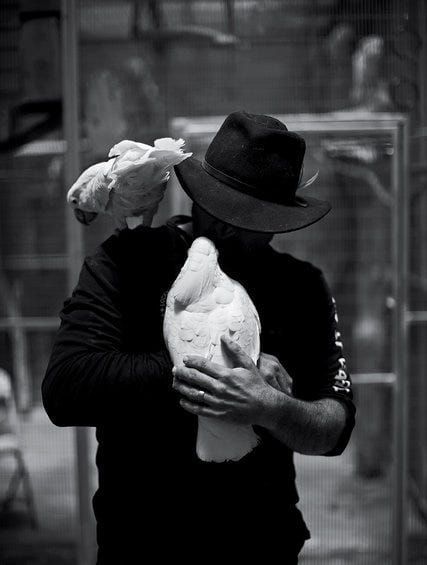
Today’s story: What Does a Parrot Know About PTSD?
Nearly 30 years ago, Lilly Love lost her way. She had just completed her five-year tour of duty as an Alaska-based Coast Guard helicopter rescue swimmer, one of an elite team of specialists who are lowered into rough, frigid seas to save foundering fishermen working in dangerous conditions. The day after she left active service, the helicopter she had flown in for the previous three years crashed in severe weather into the side of a mountain, killing six of her former crewmates. Devastated by the loss and overcome with guilt, Love chose as her penance to become one of the very fishermen she spent much of her time in the Coast Guard rescuing. In less than a year on the job, she nearly drowned twice after being dragged overboard in high seas by the hooks of heavy fishing lines.
Love would not formally receive a diagnosis of severe post-traumatic stress disorder for another 15 years. In that time, she was married and divorced three times, came out as transgender and retreated periodically to Yelapa, Mexico, where she lived in an isolated cabin accessible only by water. She eventually ended up living on a boat in a Los Angeles marina, drinking heavily and taking an array of psychotropic drugs that doctors at the West Los Angeles Veterans Administration Medical Center began to prescribe with increasing frequency as Love proved resistant to traditional treatments like counseling and group therapy. One night, after her fifth stay in the center’s psych ward, she crashed her boat into a sea wall. Finally, in 2006, she was in the veterans’ garden and happened to catch sight of the parrots being housed in an unusual facility that opened a year earlier on the grounds of the center.
‘‘This place is why I’m still here,’’ Love, now 54, told me one day last summer as I watched her undergo one of her daily therapy sessions at the facility, known as Serenity Park, a name that would seem an utter anomaly to anyone who has ever been within 200 yards of the place.
Inside one mesh-draped enclosure, Julius, a foot-high peach-white Moluccan cockatoo with a pink-feathered headdress, was madly pacing, muttering in the native tongue of the Korean woman who, along with her recently deceased husband, had owned him. Next door, a nearly three-foot-tall blue-and-gold macaw named Bacardi, abandoned by a truck driver who was spending too much time on the road, kept calling out for someone named Muffin, before abruptly rising up and knocking over his tray of food to surrounding squawks of delight. Across the way, Pinky, a Goffin’s cockatoo, the castoff of a bitter custody battle between his original female owner and the husband who threatened to spite her by cutting off her beloved pet’s wings, was mimicking a blue jay’s high-pitched power-saw plaint. More screams rang out and then, in the ensuing silences, random snippets of past conversations: ‘‘Hey, sweetheart!’’ ‘‘Whatever.’’ ‘‘Oh, well.’’ ‘‘Whoa! C’mon man!’’ Soon, from a far corner, came the whistling, slow and haunted, of the theme from ‘‘Bridge on the River Kwai.’’
‘‘They had me loaded up on so many kinds of medications, I was seeing little green men and spiders jumping out of trees,’’ Love continued, as a six-inch-tall female caique parrot from the Amazon Basin named Cashew dutifully paced across her shoulders. Back and forth she went, from one side to the other, in determined, near- circular waddles.
For the next 10 minutes, Love, her eyes closed, her arms still at her sides, continued to engage in one of the many daily duets she does with each one of Serenity Park’s winged residents, listing her shoulders up and down like a gently rocking ship, Cashew’s slow, feather-light paddings all the while putting Love further at ease. Now and again, Cashew would pause to give a gentle beak-brush of Love’s neck and ear, and then crane her head upward toward Love’s mouth to receive a couple of kisses. She made a few more passes, back and forth, then abruptly climbed atop Love’s head. Smiling broadly, Love let her loll around up there on her back for a time, Cashew using the same upward scooping wing flaps that caiques employ to bathe on wet rain-forest leaves.
I know. You’re thinking, “A movie? About parrots?” And you may remember the 1998 film Paulie:
But check this out:
Abandoned pet parrots are twice-traumatized beings: denied first their natural will to flock and then the company of the humans who owned them. In the wild, parrots ply the air, mostly, in the same way whales do the sea: together and intricately. Longtime pairs fly wing to wing within extended, close-knit social groupings in which individual members, scientists have recently discovered, each have unique identifiable calls, like human names. Parrots learn to speak them soon after birth, during a transitional period of vocalizing equivalent to human baby babbling known as ‘‘subsong,’’ in order to better communicate with members of their own flocks and with other flocks. This, it turns out, is the root of that vaunted gift for mimicry, which, along with their striking plumages and beguilingly fixed, wide-eyed stares, has long induced us to keep parrots — neuronally hard-wired flock animals with up to 60-to-70-year life spans and the cognitive capacities of 4-to-5-year-old children — all to ourselves in a parlor cage: a broken flight of human fancy; a keening kidnapee.
There were 34 parrots at Serenity Park when I was there last summer — representing a range of the more than 350 species in the psittaciformes order — a majority of them abandoned and now deeply traumatized former pets that had outlived either their owners or their owners’ patience. A parrot separated from its flock will flock fully and fiercely to the attentions and affections of its new human keeper. And when that individual, for whatever reason, fails to uphold his or her end of such an inherently exclusive relationship, the effects are devastating.
A wounded vet suffering from PTSD. An abandoned parrot also traumatized. The head of the parrot rescue center. And a variety of other animals and humans who develop a bond in attempting to overcome their inner ‘demons’. And how about this for a moment:
Nearing Serenity Park’s exit, I decided to turn back and step inside Cashew’s quarters for a moment. I had only to nestle close to her perch and she immediately hopped on my back. Crisscrossing my shoulders as I had watched her do with Lilly Love, she stopped at one point for what I assumed would be the parrot equivalent of a kiss. Instead, she began to clean my teeth: her beak lightly tapping against my enamel, the faint vibrations strangely soothing. Immediately afterward, she took a brief nap in my shirt’s left breast pocket — it felt as if I’d grown another heart — then re-emerged and crawled to the top of my head. She strolled about there for a time before plucking out one of her own deep blue-green feathers and then descending to gently place it on my left shoulder. I have it still.
When I lived in Los Angeles, there were about 20 wild parrots who used live in Crestview and Beverlywood. I saw and heard them hundreds of times when I was out for my daily jog. Bright golden green and yellow, flying in unison, squawking away. When I ran with my son Will with our jogging stroller, whenever we’d see them, we stop and wave. They were like neighbors.
Yes, this would be a small indie movie. But any story which promotes empathy… which calls on us to find the humanity in others… even if it involves parrots…
That’s a story worth telling in my book.
There you go: My fourteenth story idea for the month. And it’s yours. Free!
What would you do with it?
Each day this month, I invite you to join me in comments to do some brainstorming. Gender bend, genre bend, what if. Take each day’s story idea and see what it can become when we play around with it. These are all valuable skills for a writer to develop.
See you in comments (hit Reply to join the conversation). And come back tomorrow for another Story Idea Each Day For A Month.
Comment Archive