A Story Idea Each Day for a Month — Day 15
This is the third year in a row I’ve run this series in April. Last week I provided a daily explanation about why you should make it a habit to be generating story ideas. This week, I’ll give you some tips on how to come up with stories.
Tip #7: Public domain
Laws vary from country to country, but if a person, event, book is considered to be in the public domain, then from a writer’s perspective, it is free content, you don’t need to secure any rights.
You want to adapt “Romeo and Juliet” into a contemporary gang shoot-em-up love story, you can do that.
You want to turn Abraham Lincoln into a vampire hunter, you can do that.
Straight adaptation, genre bend, gender bend, whatever you want to do, you can do it with a public domain entity. Plus the added benefit: Pre-awareness.
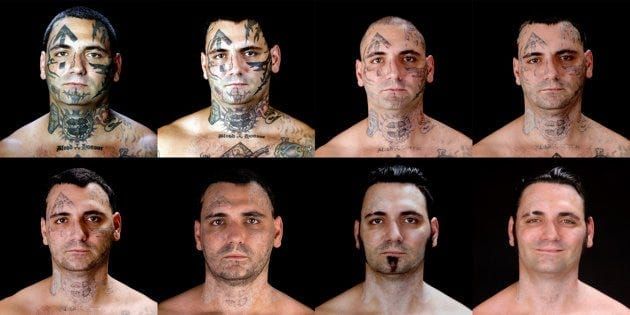
Today’s story: Reformed skinhead endures agony to remove tattoos.
Julie Widner was terrified — afraid her husband would do something reckless, even disfigure himself.
“We had come so far,” she says. “We had left the movement, had created a good family life. We had so much to live for. I just thought there has to be someone out there who will help us.”
After getting married in 2006, the couple, former pillars of the white power movement (she as a member of the National Alliance, he a founder of the Vinlanders gang of skinheads) had worked hard to put their racist past behind them. They had settled down and had a baby; her younger children had embraced him as a father.
And yet, the past was ever-present — tattooed in brutish symbols all over his body and face: a blood-soaked razor, swastikas, the letters “HATE” stamped across his knuckles.
Wherever he turned Widner was shunned — on job sites, in stores and restaurants. People saw a menacing thug, not a loving father. He felt like an utter failure.
The couple had scoured the Internet trying to learn how to safely remove the facial tattoos. But extensive facial tattoos are extremely rare, and few doctors have performed such complicated surgery. Besides, they couldn’t afford it. They had little money and no health insurance.
So Widner began investigating homemade recipes, looking at dermal acids and other solutions. He reached the point, he said, where “I was totally prepared to douse my face in acid.”
In desperation, Julie did something that once would have been unimaginable. She reached out to a black man whom white supremacists consider their sworn enemy.
This is a series of photos of Widner:
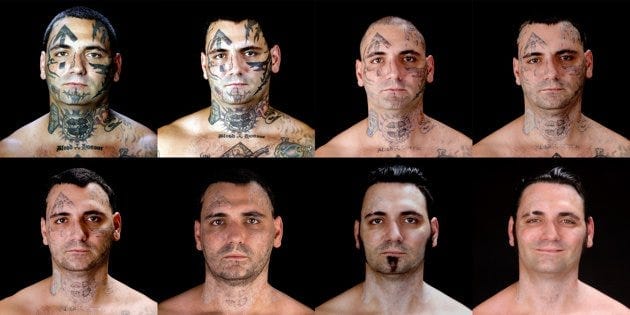
It’s a remarkable set of narrative elements, isn’t it. Reformed skinhead. Wife. Child. Seeking out the help of an African-American activist.
And then there are the tattoos.
I wondered if each tattoo had a specific story in the Protagonist’s past. And with each removal, he relives that experience, confronting the violence and hatred of his past. Perhaps an interesting way of constructing a narrative.
What would you do with this story?
HT to Ned Kilgannon for the link.
Comment Archive