A Story Idea Each Day for a Month — Day 20
This is the sixth year in a row I’ve run this series in April.
Today’s story: You Could Wake Up Convinced You’re In a Duplicate World.
Or, at least, that you’re in a duplicate town, house, and hospital. Reduplicative paramnesia victims believe that someone or something has constructed a duplicate structure, that looks exactly like the one they remember being in. What part of the brain can make you think you’re on the set of your own life?
One day, a 71-year-old man went missing after he left a friend’s party. His family at first thought that his bus home was late. After some time, they became alarmed and wondered how to find him. Fortunately for them, about five hours after he was initially expected back, he came home in a taxi. His daughter, concerned for him, ran out to the taxi to see how he was and ask why he was missing for so long. He recognized her and seemed perfectly fine, but had a question for her. What was she doing “in this place.” When asked why she wouldn’t be there, he told her that this was not his house, but an identical duplicate house. He was immediately admitted to the hospital.
Another man was already in the hospital, after a head injury. He spoke perfectly well with his friends, family, and hospital personnel, but insisted that he was in a duplicate hospital. A woman with the same delusion was asked whether the other hospital had different doctors and staff working there. She said no. The doctors in her hospital also worked at the other hospital.
All these people have reduplicative paramnesia — which most doctors think is a fancy way of saying a lesion in the frontal lobe of their brain. Doctors first suspected a physical cause to this seemingly psychological delusion when they noticed that it was (relatively) often found in soldiers, or people who had hurt themselves.
The most common characteristic of this condition is the conviction — in people who are otherwise entirely rational — that they are in a duplicate setting. Although they freely admit that this makes no sense, they are still entirely sure of the falseness of their surroundings. Occasionally it spreads to duplicate events as well as settings — one woman believed that her dead husband was in the hospital with her, and another believed that a mugger who had given her the brain injury had actually mugged her on two separate occasions — but most of the time the syndrome is confined to the idea that the patient is living in a set.
This reminded me of some movies notable for playing with paranoia as a narrative element. For example, the 1956 science fiction movie Invasion of the Body Snatchers:
IMDb plot summary: A small-town doctor learns that the population of his community is being replaced by emotionless alien duplicates.
How about The Stepford Wives:
IMDb plot summary: Joanna Eberhart has come to the quaint little town of Stepford, Connecticut with her family, but soon discovers there lies a sinister truth in the all too perfect behavior of the female residents.
Rosemary’s Baby… The Conversation… Enemy of the State… Black Swan… those are some other paranoia-centric movies off the top of my head.
One dynamic that lies at the heart of paranoia movies is this question: Can you trust the world around you — people, places, things? Trust is one of the earliest stages of childhood psychological development, so to put it into play is to go deep, deep into a character’s psyche — and by extension script reader and moviegoer.
So I’m thinking high school as a setting. What type of character would be ideal to go through a journey into her paranoia, believing that the world around her is — person by person, place by place — not original, but a duplicate of her ‘real’ world?
We could go with a young woman who is at the top of the social pecking order. In fact, what if she — let’s call her Claire — is the universally acclaimed leader of the most influential clique in school? Being in this position, Claire would have a lot invested in things being the way they are. Then reduplicative paramnesia sets in… at least that’s what the doctors call it. Of course, Claire can’t trust them because… well, they’re duplicates, not the real doctors.
Or what if we went the other direction entirely? Abby is an edgy cynic who stands outside all of the cliques, very much in judgment of them, ostensibly because of their exclusionary tactics. Perhaps her sharp wit and snappy rejoinders are a defense mechanism developed over time as she was steered into an outcast role. She loathes these people, hates this town, can’t wait to graduate to go off to the big city and start her own life. But then she starts noticing the tiniest of things suggesting to her that these people are somehow not real, but duplicates. “You’re unhappy living here,” her psychiatrist says, “So you’ve developed this paranoia as a way of distancing yourself from your peers.” But that’s what he would say because… yeah, that’s right… he’s a duplicate, too.
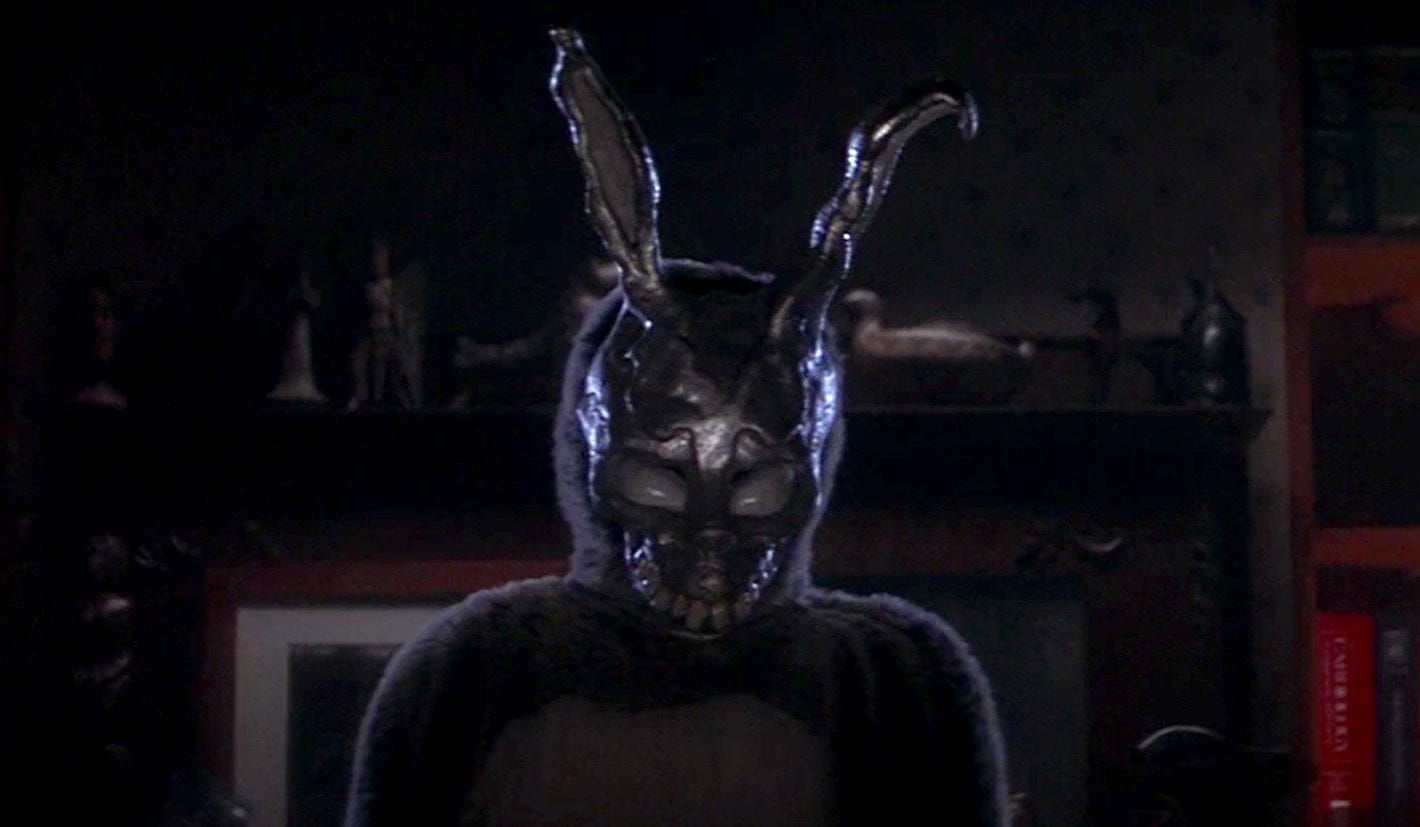
Perhaps this becomes an homage to one of my favorite movies Donnie Darko by Richard Kelly which does a wonderful job of playing with what is reality and what is not reality. And while we couldn’t invite this six foot tall bunny named Frank into our story…
…how about if we come up with an elusive Trickster figure looming at the fringes of either Claire or Abby’s experience.
Is there a giant conspiracy? Is it all an illusion? Or merely an actual medical condition caused by a lesion in her brain? It’s an interesting setup to jump-start the brainstorming process.
There you go: My twentieth story idea for the month. And it’s yours. Free!
What would you do with it?
Each day this month, I invite you to join me in comments to do some brainstorming. Gender bend, genre bend, what if. Take each day’s story idea and see what it can become when we play around with it. These are all valuable skills for a writer to develop.
See you in comments (hit Reply to join the conversation). And come back tomorrow for another Story Idea Each Day For A Month.
Comment Archive