A Story Idea Each Day for a Month — Day 21
This is the seventh year in a row I’ve run this series in April.
Today’s story: Providing the Soundtrack for Life’s Last Moments.
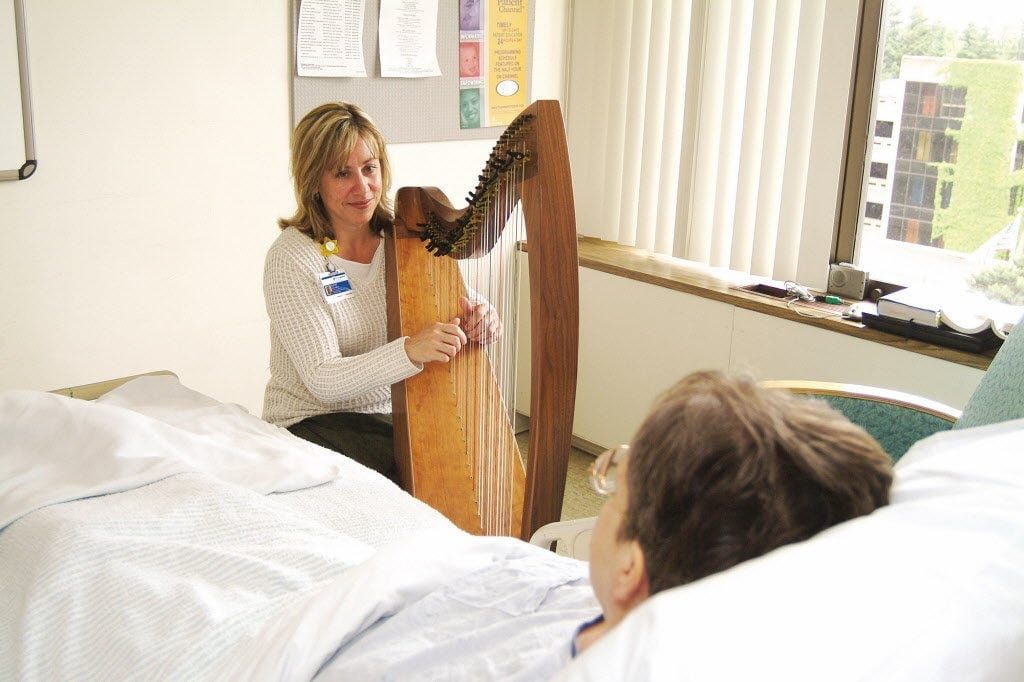
I’ve been called an angel more times than I care to admit. That’s what happens when you walk down hospital hallways with a harp and have a job that primarily serves people who are dying.
When I went to school to become a music thanatologist, I was in my early 20s. Patients and families were sometimes surprised when I showed up at their deathbed vigil during my training. The wife of one elderly patient met me at the door and cupped my face with her hands. “You’re so young,” she said. “What are you doing here?” It was the question of my life.
Music thanatologists care for dying patients using harp and vocal music as prescription rather than performance. With the raw materials of music, we offer vigils that are tailored to a patient’s diagnosis, vital signs and responses in the moment. Rather than providing a concert of familiar songs, a music vigil offers a quiet space for reflection, rest and, sometimes, for finding meaning as death approaches.
A music thanatologist doing a musical vigil
As I sit at my harp, I am invited to witness profound and tender gestures of human connection. The families I meet show me what it means to let go of life and of the ones we love. Adult children tell their fathers how much they mean to them. Men reach for the hand of a spouse. Daughters close their eyes and lay their heads on their mothers’ beds. Again and again, I hear these words: “It’s all right. We love you. You can go.”
— —
But this education comes with its own sorrow. When my family gathers for a holiday or a birthday, a grief haunts me. Anything can bring it on: my stepchildren’s quick banter, my brother telling a joke from our childhood, my parents’ careful attention to my young son’s stories. Some future self begs me to linger and breathe it in: my husband reading in bed next to me or handing me a slice of tomato to taste. One of us will, eventually, be plucked from this scene. We cannot save time up, though it may seem that we could.
This story idea really all starts with this character: A woman who wanted to “be a creative person and to save the world”. So she brings her talent to taking her harp to perform a musical vigil for dying patients. A vigil of this type can last for 30–60 minutes.
I could see establishing the type of work Hannah (let’s call her that) does. I imagine she’s a single woman, probably divorced. Grown children. She lives a pretty isolated life. I wonder if she is beginning to sense her own mortality, perhaps even question the value of her career path.
What if she gets a call for a new client? She shows up at the house. Pulls her harp inside. Meets a hospice nurse who ushers Hannah into a bedroom where she sees…
Her mother. Her estranged mother. A woman Hannah hasn’t spoken to in years.
Why not? That’s a damn good question, one fit for much brainstorming. But I like that setup. Mother forces her daughter to come by for a series of music vigils and conversations, all leading to the mother’s death.
I think the hospice nurse can be a great Mentor character. She’s from Africa. Has a grounded sense of the world. There would be times when Hannah would come tumbling out of her mother’s room, infuriated or a sobbing heap. The nurse would be there to help process the moment.
A small indie drama with some humor with a strong central conceit: A woman who plays music for the dying.
There you go: My twenty first story idea for the month. And it’s yours. Free!
What would you do with it?
Each day this month, I invite you to join me in comments to do some brainstorming. Gender bend, genre bend, what if. Take each day’s story idea and see what it can become when we play around with it. These are all valuable skills for a writer to develop.
See you in comments (hit Reply to join the conversation). And come back tomorrow for another Story Idea Each Day For A Month.