A Story Idea Each Day for a Month — Day 21
This is the fifth year in a row I’ve run this series in April.
Today’s story: Ten Days in a Madhouse: The Woman Who Got Herself Committed.
“The insane asylum on Blackwell’s Island is a human rat-trap. It is easy to get in, but once there it is impossible to get out.”
Those words, describing New York City’s most notorious mental institution, were written by journalist Nellie Bly in 1887. It was no mere armchair observation, because Bly got herself committed to Blackwell’s and wrote a shocking exposé called Ten Days In A Madhouse. The series of articles became a best-selling book, launching Bly’s career as a world-famous investigative reporter and also helping bring reform to the asylum.
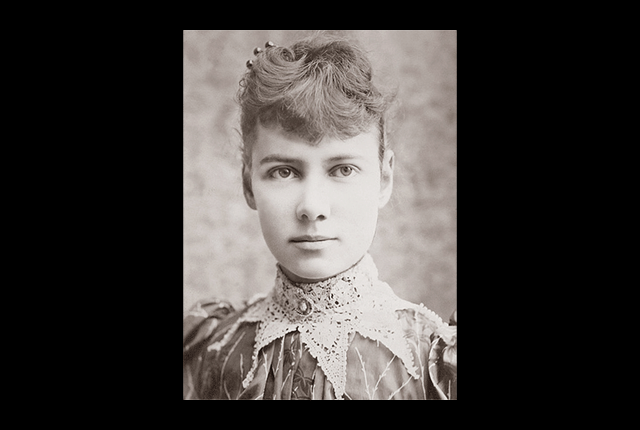
Nellie Bly
She dressed in tattered second-hand clothes. She stopped bathing and brushing her teeth. And for hours, she practiced looking like a lunatic in front of the mirror. “Faraway expressions look crazy,” she wrote. Soon she was wandering the streets in a daze. Posing as Nellie Moreno, a Cuban immigrant, she checked herself into a temporary boarding house for women. Within twenty-four hours, her irrational, hostile rants had all of the other residents fearing for their lives. “It was the greatest night of my life,” Bly later wrote.
The police hauled Bly off, and within a matter of days, she bounced from court to Bellevue Hospital’s psychiatric ward. When she professed to not remembering how she ended up in New York, the chief doctor diagnosed her as “delusional and undoubtedly insane.” Meanwhile, several of the city’s other newspapers took an interest in what one called the “mysterious waif with the wild, hunted look in her eyes.” Bly had everyone hoodwinked, and soon enough, she was aboard the “filthy ferry” to Blackwell’s Island.

Although other writers had reported on conditions at the asylum (notably Charles Dickens, in 1842, who described its “listless, madhouse air” as “very painful”), Bly was the first reporter to go undercover. What she found exceeded her worst expectations. There were “oblivious doctors” and “coarse, massive” orderlies who “choked, beat and harassed” patients, and “expectorated tobacco juice about on the floor in a manner more skillful than charming.” There were foreign women, completely sane, who were committed simply because they couldn’t make themselves understood. Add to that rancid food, dirty linens, no warm clothing and ice-cold baths that were like a precursor to water boarding. Bly described the latter:
“My teeth chattered and my limbs were goose-fleshed and blue with cold. Suddenly I got, one after the other, three buckets of water over my head — ice-cold water, too — into my eyes, my ears, my nose and my mouth. I think I experienced the sensation of a drowning person as they dragged me, gasping, shivering and quaking, from the tub. For once I did look insane.”
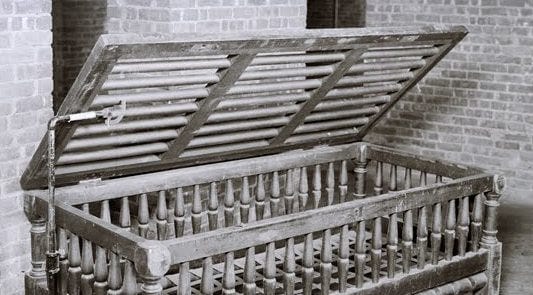
The infamous Utica crib
Finally, after ten days, The World sent an attorney to arrange for Nellie Moreno’s release.
Two days later, the paper ran the first installment of Bly’s story, entitled “Behind Asylum Bars.” The psychiatric doctors who’d been fooled offered apologies, excuses and defenses. The story traveled across the country, with papers lauding Bly’s courageous achievement. Almost overnight, she became a star journalist.
But for Bly, it wasn’t about the fame. “I have one consolation for my work,” she wrote. “On the strength of my story, the committee of appropriation provides $1,000,000 more than was ever before given, for the benefit of the insane.”
Despite the conventional wisdom that period pieces are harder to sell, I’m going with a snapshot drama, not a traditional biopic, but rather a compressed time frame story over the course of 2 weeks in which Bly goes undercover at a mental asylum. Strong role for a female lead. Powerful dramatic material. Public domain. Similar but different than One Flew Over the Cuckoo’s Nest which won all sorts of awards. Plus a chance to take readers into a deep, dark asylum subculture of the last century.
I’m also reminded of a script called “Devil’s At Play,” which won a Nicholl Fellowship in 2012 and also made the Black List that same year. Written by James DiLapo, it is set in the world of a Soviet gulag, and is a fascinating study of that distressing environment. Again similar but different.
I’d research the hell out of mental institutions of that era, looking for every single aspect of life behind those bars that could suggest a set piece or memorable scene.
I would explore Bly as a character, digging deep into the fundamental question: Why did she opt to do this and by being incarcerated expose herself to personal danger and trauma.
What type of transformation did she undergo in the process? Perhaps she starts off seeing this as her ticket to becoming a big-time reporter, but over her time in the asylum and through her connection to one or more of the other inmates, her attitude changes as she begins to see their humanity beyond their insanity.
Now I’m thinking with a strong Nemesis figure — the head of the asylum — the story can recall The Shawshank Redemption where one of the existential questions is, “Can Andy’s humanity survive in prison?” Similarly, can Bly retain her sanity or will she lose her mind… or even her life?
There you go: My twenty first story idea for the month. And it’s yours. Free!
What would you do with it?
Each day this month, I invite you to join me in comments to do some brainstorming. Gender bend, genre bend, what if. Take each day’s story idea and see what it can become when we play around with it. These are all valuable skills for a writer to develop.
See you in comments (hit Reply to join the conversation). And come back tomorrow for another Story Idea Each Day For A Month.
Comment Archive