A Story Idea Each Day for a Month — Day 24
This is the seventh year in a row I’ve run this series in April.
Today’s story: The Rise of the Rocket Girls.
In “The Rise of the Rocket Girls: The Women Who Propelled Us, from Missiles to the Moon to Mars,” microbiologist Nathalia Holt reclaims the role of these unheralded women scientists in the field that has enchanted humanity’s collective imagination more powerfully than any other: space exploration.
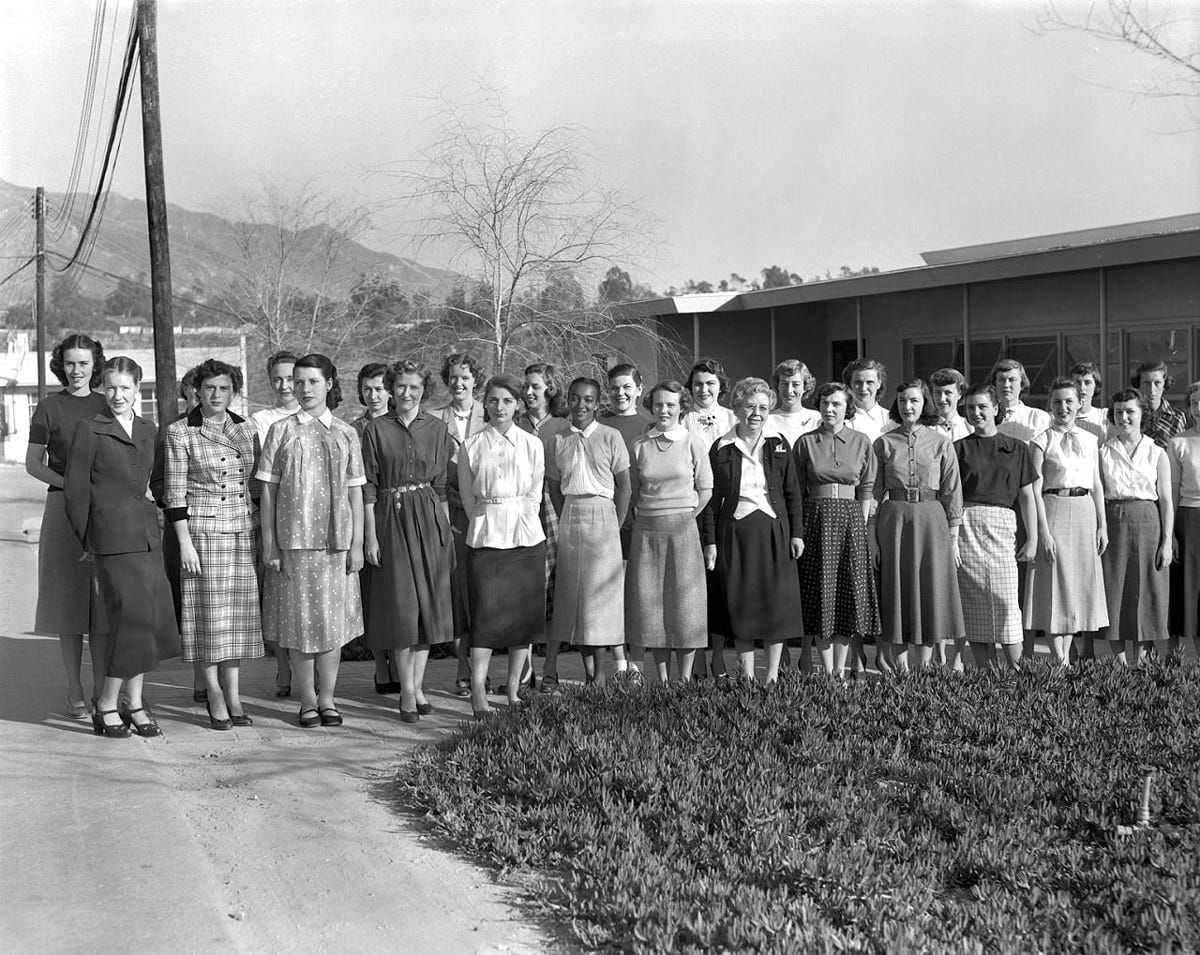
The computers, 1953. First row, left to right: Ann Dye, Gail Arnett, Shirley Clow, Mary Lawrence, Sally Platt, Janez Lawson, Patsy Nyeholt, Macie Roberts, Patty Bandy, Glee Wright, Janet Chandler, Marie Crowley, Rachel Sarason, and Elaine Chappell. Second row: Isabel deWaard, Pat Beveridge, Jean O’Neill, Olga Sampias, Leontine Wilson, Thais Szabados, Coleen Veeck, Barbara Lewis, Patsy Riddell, Phyllis Buwalda, Shelley Sonleitner, Ginny Swanson, Jean Hinton, and Nancy Schirmer. (Photograph courtesy of NASA/JPL-Caltech)
In the 1940s, NASA’s Jet Propulsion Lab, managed by Caltech, began recruiting these “human computers” — mathematically skilled women with fingers callused from gripping a pencil eight hours a day as they performed calculations that launched the first American satellite and directed the earliest missions exploring the Solar System. When Neil Armstrong made his “giant leap for mankind,” there was womankind in the control room. When the Voyager carried humanity’s message into the cosmos, the “computers” had calculated and scrutinized its trajectory. When the science boyband of Carl Sagan, Ray Bradbury, and Arthur C. Clarke sat down to discuss Mars and the future of space exploration on national television as the Mariner 9 mission was about to become the first spacecraft to orbit another planet, the women whose meticulous computations had powered the mission were nowhere to be seen.
Every moonshot, every so-called “manned” or “unmanned” mission hailed as a feat of human ingenuity, was womanned behind the scenes.
Check out this one anecdote:
The young woman’s heart was pounding. Her palms were sweaty as she gripped the pencil. She quickly scribbled down the numbers coming across the Teletype. She had been awake for more than sixteen hours but felt no fatigue. Instead, the experience seemed to be heightening her senses. Behind her she could sense Richard Feynman, the famous physicist, peeking at her graph paper. He stood looking over her shoulder, occasionally sighing. She knew that her every move was being carefully watched, her calculations closely studied. Her work would inform mission control if the first American satellite would be a success or a crushing failure.
Hours earlier, before the satellite had been launched, her boyfriend had wished her luck. He hadn’t quite gotten used to the fact that his girlfriend worked late nights as an integral part of the American space program. Before leaving, he gave her a quick kiss. “I love you even if the dang thing falls in the ocean,” he said with a smile.
— —
Her pride was similarly tied to the fate of the satellite. She’d been here at the Jet Propulsion Laboratory from its earliest days, helping to design the rockets powering the tube-shaped spacecraft that was no heavier than a toddler. Now the project’s ultimate fate was hers to reveal.
As she plotted a curved line across the orange graph paper, she realized the trajectory was coming close to the point of no return. If the satellite passed this point, it would leave the atmosphere, begin circling the globe, and become the first American space-success story. The future of space exploration rested on this moment.
— —
Her pride was similarly tied to the fate of the satellite. She’d been here at the Jet Propulsion Laboratory from its earliest days, helping to design the rockets powering the tube-shaped spacecraft that was no heavier than a toddler. Now the project’s ultimate fate was hers to reveal.
As she plotted a curved line across the orange graph paper, she realized the trajectory was coming close to the point of no return. If the satellite passed this point, it would leave the atmosphere, begin circling the globe, and become the first American space-success story. The future of space exploration rested on this moment.
This is a story of hard science and sexism. At the time, only 1% of engineers were female and it wasn’t until the 70s Cal Tech opened admission to women.
There are dozens of women profiled in the book “The Rise of the Rocket Girls”. Pick a select few who worked at the same time and you’ve got the makings of a movie.
First thing: See if the book’s rights are available for option.
There you go: My twenty fourth story idea for the month. And it’s yours. Free!
What would you do with it?
Each day this month, I invite you to join me in comments to do some brainstorming. Gender bend, genre bend, what if. Take each day’s story idea and see what it can become when we play around with it. These are all valuable skills for a writer to develop.
See you in comments (hit Reply to join the conversation). And come back tomorrow for another Story Idea Each Day For A Month.
Comment Archive