A Story Idea Each Day for a Month — Day 25
This is the fourth year in a row I’ve run this series in April.
Today’s story idea: Killer On The Road:
What would highway killers do without highways?
In 1956, Congress passed the Federal-Aid Highway Act, authorizing the construction of 42,795 miles of an interstate road system. In 1958, while the first stretch of highway (I-80 between Omaha and Lincoln, Neb.) was still under construction, America’s first highway killer, 19-year-old Charles Starkweather — who already had one murder under his belt — jumped into his secondhand Ford with his 14-year-old girlfriend and hit the road on a killing spree that began in Nebraska, ended in Wyoming and left 10 people dead.
Coincidence? Ginger Strand thinks not. In “Killer on the Road: Violence and the American Interstate,” Strand, the author of “Inventing Niagara,” draws startling parallels between the inexorable advance of the Interstate System and the proliferation of killers who were pathologically stimulated by that long, open road. By transforming established travel habits, the new highways certainly enabled the swift and anonymous mobility conducive to criminal behavior. But speed and anonymity are precisely the features that make highway travel attractive, so it was inevitable that the nation should have reservations about its new roads.
“The highway killer, like the train robber, the gangster and the mobster before him, has entered the cast of American outlaws,” Strand writes, noting that such iconic figures are powerful signifiers of both admiration and anxiety. Specifically, “the disproportionate fear of the killer on the road reveals cultural misgivings about highways and the values they represent.” More than half a century since that first stretch of asphalt cooled, she concludes, we are still of two minds about our interstates: “We can’t decide if they are delivering the American dream or destroying it.”
The originality of Strand’s thesis comes from the way she tracks the evolution of these cultural qualms by scrutinizing the various types of “bogeymen” who came to represent them. Each of the chapters in her book concentrates on an infamous highway killer and the particular threat he personified to his generation.
Strand makes a lucid case for Charlie Starkweather as the embodiment of America’s unease about teenagers — especially teenagers in cars — during the 1950s. To James Dean wannabes who came of age in this materialistic postwar era, a car was a means of escape from the restrictions of home life, income level and social class. “All we wanted to do is get out of town,” Starkweather wrote his parents from his jail cell, sounding like any other restless kid who went out for a drive on a Saturday night and forgot to come home. Except for the fact that Starkweather expressed his rebelliousness by shooting and stabbing a lot of people.
— —
The idea of the highway killer was so strong that a sociopathic serial killer like Ted Bundy, who plucked his victims from “safe” locations like shopping mall parking lots, was considered a highway predator because he moved around the country in search of new hunting grounds. By applying that loose definition, the Justice Department caused a panic in 1983 by estimating that between 30 and 35 of these free-range killers were claiming 4,000 victims a year. As the serial killer grew in stature during this period, he underwent yet another transformation, becoming something of a celebrity, “debased, condemned, yet eerily glorified,” as Joyce Carol Oates put it in 1994, as the nation’s “Noble Savage.”
By Strand’s reckoning, the road killer was issued his official ticket to ride by the Motor Carrier Act of 1980, which deregulated the trucking industry. As unionized trucking outfits were squeezed off the road and loose regulations led to substandard conditions, a new demographic of the long-haul trucker emerged: “less educated, less stable, less tied to unions, less rooted in family life,” and more likely to land on the suspect list in a homicide case.
In 2009, the F.B.I. undertook its Highway Serial Killings Initiative to coordinate investigations into the hundreds of unsolved highway murders in its databank. The map issued by the initiative, indicating bodies clustered at transfer roads all along the interstate network, looks like the M.R.I. of an advanced case of arterial disease. If there is, as Strand suggests, something sick about the rampant growth of the nation’s highway system and the blighted landscapes it leaves in its wake, the “new and insidious kind of serial killer” she’s writing about here seems an appropriate metaphor for that systemic disease.
This is not a news item. This is a book review. Here are excerpts from another one:
This book’s most unsettling chapter takes its name from one of the great, literate rock bands in this country: Drive-By Truckers. This chapter gives us Ms. Strand at her angriest, grisliest and most convincing. In it she proposes that America’s 10,000 or so truck stops breed serious crime, including serial murder, at a terrible (and largely preventable) level.
She commences by observing that “at least 25 former truckers are currently serving time in American prisons for serial murder.” Trucking has become a job that attracts marginal characters, she writes, “less educated, less stable, less tied to unions, less rooted in family life” than they once were. She quotes the economist Michael Belzer, who calls trucks “sweatshops on wheels.”
The bars to entry are low: criminal records and even drunken-driving convictions are often overlooked. The pay is abysmal. Many drivers are lonely and depressed. Annual turnover at some trucking companies, she says, is around 100 percent.
This information is clearly not enough to suggest that even a fraction of America’s 18-wheelers have sociopaths at the wheel. But in 2009 the F.B.I. went public with its Highway Serial Killings initiative, noting the numbers of women, often truck-stop prostitutes, killed each year, and suggesting the suspects are mostly long-haul truckers.
When I read these, I was creeped out.
Know what? For a writer, that is a good thing. We want our stories to elicit an emotional response from readers. And both the lure and fear of driving on a lonely highway do just that.
One of the reviews has a title that sounds like a movie: “Haunted Highways.”
So at first, I was thinking a straight ahead serial killer action-thriller. But this idea of haunted highways, that took me way back to my youth, hearing stories about unfortunate travelers who found themselves stranded on the side of the road being attacked by a psychotic killer.
I’m thinking we zero in on some sort of supernatural murderous being with a connection to trucking. On a road like this:
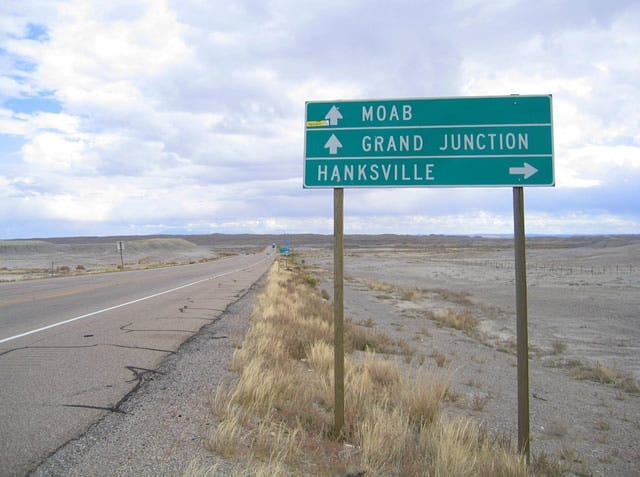
I’ve been on this road: Route 50 through Utah. Driving from the Bay Area to the Telluride, Colorado. Middle of the night. No cars in either direction for hours. No towns for 50, 60, 70 miles or more.
What if I break down? What if I’m stranded on the side of the road? No cell reception in this incredibly rural environment.
And then… headlights. Oh, thank God! Someone to help me.
What’s this? It’s a truck. High beams on. I wave. Will it stop?. Doesn’t look like it. I step into the middle of the road, frantically trying to get the driver’s attention. The truck zooms past…
Then the jarring sound of its brakes. It slows to a stop. Engine off. Silence.
The truck door opens. A figure emerges. Boot heels clicking on the uneven road surface. Approaching me.
I call out, “Hello.”
Nothing. Click. Click. Heels on pavement.
For some reason, I feel scared. I stumble back toward my car. Drop my keys.
Click. Click.
A glint of something in the truck driver’s hand. Could that be…
A knife?
And now the figure vanishes. I crane my neck. What the hell?
Suddenly the knife is planted against my throat…
That’s what I’ve got. How about you?
Each day this month, I invite you to join me in comments to do some brainstorming. Gender bend, genre bend, what if. Take each day’s story idea and see what it can become when we play around with it. These are all valuable skills for a writer to develop.
See you in comments. And come back tomorrow for another Story Idea Each Day For A Month.
Comment Archive