A Story Idea Each Day for a Month — Day 4
This is the seventh year in a row I’ve run this series in April. Why a story idea each day for the month? Several reasons which I’ll work my through during this series of posts. Here’ s another one:
You can evolve into being a writer-producer.
Let’s face it, you can only write so much. But sitting on your side of the table, all those story meetings you’ve had to endure, you’ve probably developed a pretty good sense of what it takes to be a producer at least on a creative level.
Why not don that hat, too?
A quick way to jump start you producing career: Come up with story ideas. Here’s a great example: “Woogles”, a pitch that sold a while back from writers Nick Antosca and Ned Vizzini. Who is producing the movie? Screenwriter Max Landis (Chronicle) who came up with the story idea for the project that sold.
That could be you.
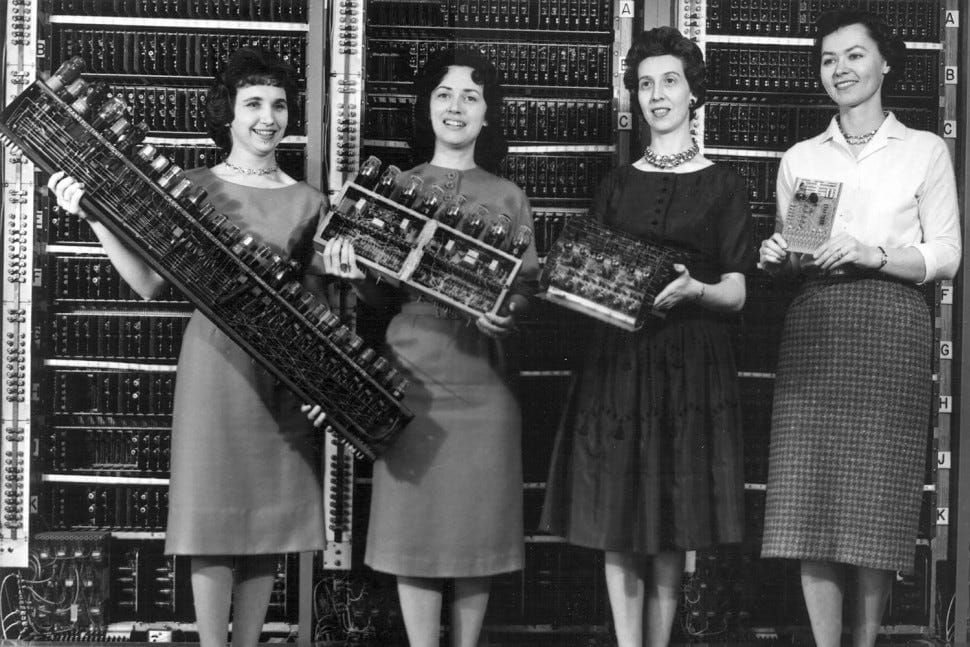
Today’s story idea: Before Gates, Zuckerberg, or Jobs, 6 women programmed the first digital computer.
The Electronic Numerical Integrator And Computer, or ENIAC, was the world’s first electronic digital computer, a landmark accomplishment on our journey towards the technological era we’re living in at present. Financed by the United States Army, it would prove to be an invaluable tool in calculating artillery firing tables and early research into the hydrogen bomb.
The creation of ENIAC is a remarkable story in its own right, but there’s an extra facet hidden just beneath its surface. While the design of the computer is credited to John Mauchly and J. Presper Eckert of the University of Pennsylvania, the programming of the system fell to a remarkable group of women; Fran Bilas, Betty Jennings, Ruth Lichterman, Kay McNulty, Betty Snyder and Marlyn Wescoff.
Despite the trailblazing work those six women did, they’re likely not names that you’re familiar with. Back then, computers were programmed through a physical system of adjusting switches and cables manually — ‘debugging’ a program meant climbing inside the ENIAC in search of faulty connections. A new program had to first be sketched out on paper, then implemented with extreme precision. Setting up a single calculation could take days, and a full program could take weeks.
Looking for some insight on the prominence of the ENIAC programmers today, I spoke to the CEO of Women Who Code, Alaina Percival.”These people were pioneers of the tech industry — and they were predominantly women,” she said. “It’s not something that’s commonly known, and it’s not something that’s being emphasized to people.”
One would think computer programming would be the least visual material for a movie. But then: The Imitation Game. And since Hollywood operates on the business principles of ‘similar but different,’ maybe there’s something here.
Six women, different backgrounds, forced to work together as a team, working under the auspices of the U.S. Army, pressure to obtain the hydrogen bomb before the Soviet Union.
Would they have had to do their work secretly? That could have created tension on the home front. Mothers, wives, programmers on what was then cutting edge technology which laid the groundwork for modern computing.
It’s a stretch, but an idea worth considering. And more broadly, always good to keep an eye out for historically based stories which provide a surprising angle such as the unknown fact that women programmed the world’s first electronic digital computer.
How about you? What would you do with this story setup?
There you go: My fourth story idea for the month. And it’s yours. Free!
Each day this month, I invite you to join me in comments to do some brainstorming. Gender bend, genre bend, what if. Take each day’s story idea and see what it can become when we play around with it. These are all valuable skills for a writer to develop.
See you in comments. And come back tomorrow for another Story Idea Each Day For A Month.
Comment Archive