Analysis: “The Master” [Part 1: Background]

Like many people, I was both amazed and confounded by The Master, equal parts “oh, my God” and “what the hell”. Weeks after seeing the movie, I am still thinking about it.
What I propose to do is use the next few days to parse the story and see what emerges. Honestly I don’t know where I’ll end up. Bear with me. These posts will be pretty much brain dumps as I sort through various ideas.
Those of you who have not seen the movie yet, do not click to read more as it’s spoiler alert city. If you have screened The Master and want to engage in a conversation about what it could possibly mean, follow me below the fold.
There are three aspects of my personal history which provide a specific tie-in to The Master. First I know the movie’s connection to L. Ron Hubbard and dianetics, acknowledged here by the film’s writer-director Paul Thomas Anderson:
But the idea of therapy based upon working with patients and their past lives is also central to the work of Edgar Cayce who founded the Association for Research and Enightenment which is headquartered in Virginia Beach, Virginia.
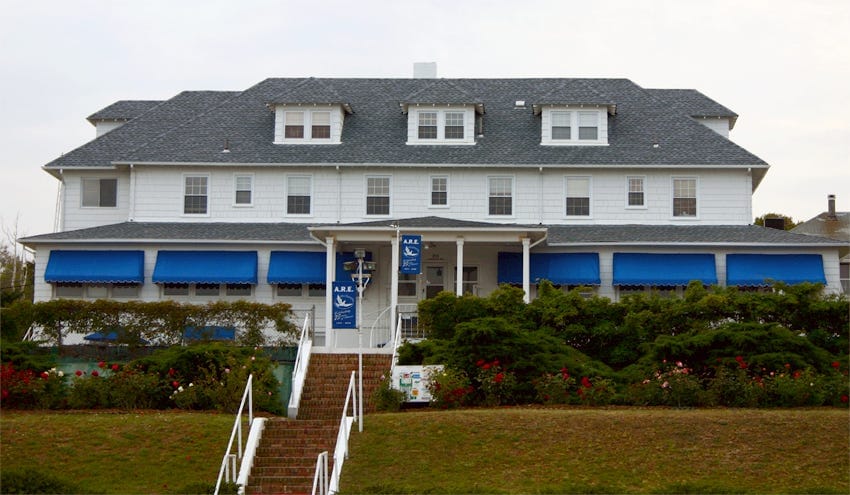
When my father retired from the Air Force, our family moved back to his hometown of Virginia Beach. So my last two years of high school, A.R.E.’s hospital at 67th Street was a common sight:
I read books on Cayce and in fact Uncle Bill, my father’s brother, told me about visiting one of Cayce’s therapy sessions with a patient in which Cayce delved into the person’s past lives.
Second when I was in college, I was a religious studies major. One course I took was American Religious History. As I watched The Master, I was reminded of this fact: The United States has a long history of cults and religious communities including The Shakers, Oneida Community, Christian Science, Jehovah’s Witnesses, Latter Day Saint Movement, a multitude of various Pentecostal groups, and hundreds of sectarian groups, both big and small.
Third when I was in college, I dated a woman who became a charismatic Christian. So for a short period of time, I attended services at her religious community where I witnessed people speaking in tongues, prophesying, laying on of hands and so forth.
Based on all that, here is my unscientific take on the subject: In order to have a cult, you need two things: A charismatic leader with bold ideas that offer a path toward wholeness and enlightenment; and people in need who become believers and followers in order to pursue salvation.
In The Master, we have such a leader in Lancaster Dodd [Philip Seymour Hoffman] and such a believer in Freddie Quell [Joaquin Phoenix]. They are the two primary faces in the story which although having something of an historical sweep [soldiers returning home after World War II, a rise in spiritualism in the late 40s and early 50s] is at its core an intense, intimate study of this pair of men. They are in effect a ‘couple,’ attached at the psychic hip, and the movie follows their circuitous path, a decidedly psychological journey.
A final thought: I think it is helpful to look at The Master as part of a trilogy of Paul Thomas Anderson films, along with Boogie Nights and There Will Be Blood. Each explores America through the lens of a specific cultural phenomenon: Pornography [Boogie Nights], Oil [There Will Be Blood], Spiritualism [The Master].
There are themes common to all three: capitalism, greed, indulgence, corruption, and perhaps most significantly key characters who subscribe to that profoundly American belief — how through effort and hard work, we can make something of ourselves, improve our lot in life, become a success.
The fact that none of the Protagonists in the three movies achieves wholeness or salvation, metaphorically or theologically, suggests something important about Anderson’s storytelling instincts.
Tomorrow: Freddie Quell.
Comment Archive