Analysis: “The Master” [Part 2: Freddie Quell]
![Analysis: “The Master” [Part 2: Freddie Quell]](https://storage.ghost.io/c/8f/29/8f29b0a7-49e5-431c-a9bb-3ade9c0a785e/content/images/size/w2000/2026/08/0_FZcArdXfZxrHAzBg.jpg)
Like many people, I was both amazed and confounded by The Master, equal parts “oh, my God” and “what the hell”. Weeks after seeing the movie, I am still thinking about it.
What I propose to do is use the next few days to parse the story and see what emerges. Honestly I don’t know where I’ll end up. Bear with me. These posts will be pretty much brain dumps as I sort through various ideas.
Those of you who have not seen the movie yet, do not click to read more as it’s spoiler alert city. If you have screened The Master and want to engage in a conversation about what it could possibly mean, follow me below the fold.
Protagonist: Freddie Quell.
Per my language system, Freddie [played masterfully by Joaquin Phoenix] begins the story in an extreme state of Disunity. He is a raging alcoholic, even if he doesn’t admit it. He is a warrior [ex-military in WWII] who is expected to return to normal civilian life. Indeed he lands a respectable job as a department store photographer, but is unable to cope with ‘normal’ life, undermining his ability to transition into society due to his inner ‘demons,’ Post Traumatic Stress Disorder or otherwise.
At this point, we need to consider Freddie’s last name which is Quell. The word means to subdue, vanquish, suppress. Random choice of names? I don’t think so. On his journey, one of his main life-challenges will be to squash his baser instincts.
Having lost his job as a photographer, then accidentally poisoning a fellow farm worker with his noxious brew [Freddie is both an alcoholic and an ‘alchemist’], he becomes a wanderer until he stumbles across a boat named Alethia [Greek for “truth”].
At that point in his Hero’s Journey, he departs the ordinary world — which was War [Military] and Peace [Post-Military]. His state of disjunction and predilection for self-destruction is too powerful for him to simply live a ‘normal’ life.
He needs to change. He needs someone to help him change. He needs someone to force him to change.
He needs Lancaster Dodd.
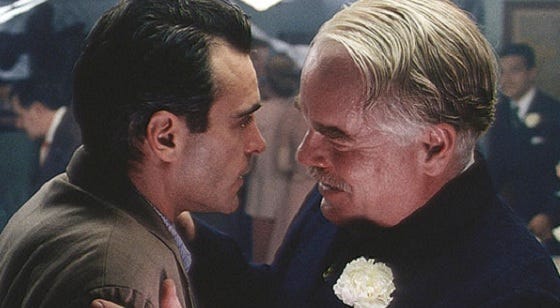
I will consider Dodd’s character more fully tomorrow. Today let’s consider him in relation to Freddie. The name Dodd rhymes with “God,” and indeed he becomes a surrogate father figure to Freddie. In this regard, Dodd is a Mentor to the Freddie’s Protagonist albeit a Dark Mentor.
Once under the sway of Dodd, who takes a perplexing immediate liking to this broken down drunk, Freddie moves into the Extraordinary / New World and with it Deconstruction.
The first step: Dodd exposing Freddie to something known as Processing, a series of pointed, personal questions into Freddie’s past. Eventually Freddie reveals some key aspects of his backstory: His father is dead, his mother institutionalized, and he likely had an incestuous relationship with his aunt.
Most notably Freddie confesses he once was in love with a young girl named Doris and the narrative goes back in time to show key moments in their relationship. She is young [still in high school] and presumably virginal, an idealized version of Romance in contrast to the ‘defiled’ relations Freddie had with his aunt, other women, and the Sand Woman we see him have ‘sex’ with on the beach during the war.
Clearly Doris functions as the story’s Attractor. And apparently she has strong feelings for him, too. So why does Freddie suddenly show up, announcing to her he has signed up to go back to sea, but will return for her?
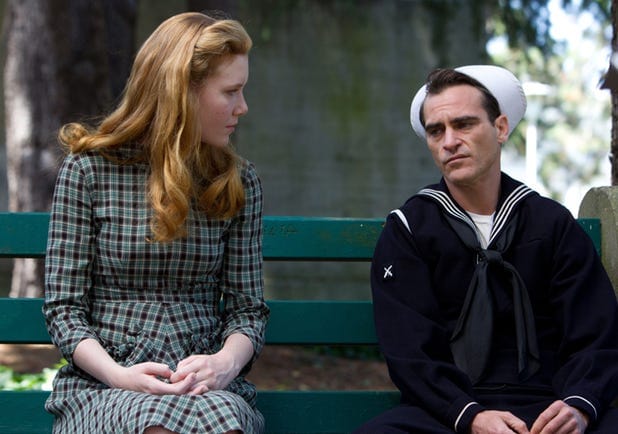
On a pragmatic level, he will have to wait for her to get out of high school and so I suspect he figures he can best do that at sea, save some money, and make the time go faster.
But my guess is the more powerful drive is this: He doesn’t believe he deserves her. Indeed Freddie feels enormous shame about who he is, which both fuels his anger [projecting his shame onto the world] and his recurring instinct to run away from a normal, good life [as he did from his photography job].
The Processing Dodd does with Freddie reveals a first level of his the character’s psyche — to us and to Freddie — and this [among other things] causes Freddie to develop a sense of loyalty to Dodd. And that giving of one’s self to something larger than the self is the essence of what it is to be a hero. Freddie tries to do that by giving himself over to Dodd.
However as the roaming tribe of Dodd’s family and believers makes their way to New York, the war raging inside Freddie — his impulsive instincts grounded in anger and shame versus his intention to live up to Dodd’s expectations — manifests itself in some ugly ways.
For example, when a guest publicly questions Dodd’s beliefs leading to Dodd having an outburst of his own [“You pigfuck!”], Freddie tracks down the man and beats him up.
Freddie’s erratic behavior creates dissension among Dodd’s family — his son-in-law, daughter and wife all wonder aloud to Dodd if Freddie is insane or worse a spy. Dodd rejects their pleas to cut Freddie loose, ostensibly for noble reasons, but soon we realize Dodd has other ideas.
In Philadelphia, Dodd works with Freddie, a strange exercise requiring Freddie to pace back and forth in a room filled with people — from the wall to the window — describing what he feels, all the while with his eyes closed. Combined with Freddie attempting to give up drinking, this marks a transition for his character into Reconstruction.
Here Reconstruction is about Freddie plunging into deeper levels of his psyche and in perhaps the most memorable scene of the movie, Dodd and Freddie end up in side-by-side jail cells, Dodd having been arrested for financial malfeasance and Freddie for fighting with the arresting officers.
Freddie unleashes his anger in full fury, smashing the toilet, ramming his body against the walls, bashing his head against the bunk bed, over and over and over again, a stark visualization of his wrath and his shame. Meanwhile Dodd remains calm telling Freddie that nobody likes him, that Dodd is the only person who likes him. Of course, this would only reinforce Freddie’s negative sense of self… and cement Dodd’s power over Freddie.
The scene is cathartic. Later the two hug and rekindle their tortured relationship, then Freddie throwing himself into the pacing exercise — wall, window, wall, window — desperately looking for the key to understanding himself.
Eventually Freddie has seen enough of Dodd and his ‘kingdom’ to realize something of the fraudulent nature of things, leading to him taking off on a motorcycle — another of Dodd’s exercises — and leaving The Cause.
Freddie returns to his home town to inquire about Doris who as it turns out got married and became a mother [she married a guy name whose last name is Day so she has become Doris Day, ironic in that the actress was known for her ‘virginal’ roles, thus Freddie’s idealized Attractor can remain just that — an ideal — for the rest of his life].
Then an odd scene: Freddie alone and asleep in a movie theater while a “Casper the Ghost” cartoon plays off-screen [I suppose the ghost relevant thematically to suggest ghosts from Freddie’s past are about to appear]. Indeed an attendant brings a phone to Freddie. It’s Dodd. How did he track down Freddie in a movie theater? Evidently this is a dream. The message: Go to England where Dodd has set up a university.
Freddie does go to England. Meeting with Dodd and his wife, the latter provides her assessment of Freddie: He is a hopeless drunk. Then she departs.
Dodd makes this offer to Freddie: Stay with The Cause and devote himself to it for the rest of his life, or leave and never come back. A clear fork-in-the-road. Freddie declines the offer. Dodd then says something insightful about his own character: If they are to meet in another life, he and Freddie will be “mortal enemies.”
Freddie departs, then ends up picking up a young woman in a pub and having sex with her. But it is less about the act of physical than social intercourse as they have an intriguing conversation in which a seemingly happy [at least in the moment] Freddie repeats to her some key lines spoken to him by Dodd.
Does this mean Freddie has taken Dodd’s message to heart?
Does this signify that Freddie has achieved a sense of Unity?
Does this suggest he will be able to give up his idealized attachment to Doris and end up in an actual authentic relationship with an actual human being [the young woman’s name is Winn, so does Freddie ‘win’ by being with her]?
One might think that… except this is not the final image of the movie. That image is this:

Freddie curled up on the beach embracing the Sand Woman whom he had previously defiled.
Typically the final act of a movie is about the Protagonist achieving some sense of Unity in their psychological journey. Hollywood likes happy endings so that is a character arc we have come to expect. But as with so many aspects of The Master, the narrative leaves much up in the air, multiple ways to interpret what is transpiring in the moment.
Personally my take — at least as I sit here today — is that Freddie isn’t much changed at all. That even though he is the story’s Protagonist, his role in the narrative — from a macro perspective — is more of a functionary tied to the personal journey Dodd goes on, something I will explore tomorrow.
Comment Archive