Analysis: “The Master” [Part 4: “The Odyssey”]
![Analysis: “The Master” [Part 4: “The Odyssey”]](https://storage.ghost.io/c/8f/29/8f29b0a7-49e5-431c-a9bb-3ade9c0a785e/content/images/size/w2000/2026/08/0_WOOa1MuufK7IriVH.jpg)
Like many people, I was both amazed and confounded by The Master, equal parts “oh, my God” and “what the hell”. Weeks after seeing the movie, I am still thinking about it.
What I propose to do is use the next few days to parse the story and see what emerges. Honestly I don’t know where I’ll end up. Bear with me. These posts will be pretty much brain dumps as I sort through various ideas.
Those of you who have not seen the movie yet, do not click to read more as it’s spoiler alert city. If you have screened The Master and want to engage in a conversation about what it could possibly mean, follow me below the fold.
Consider these images from The Master:
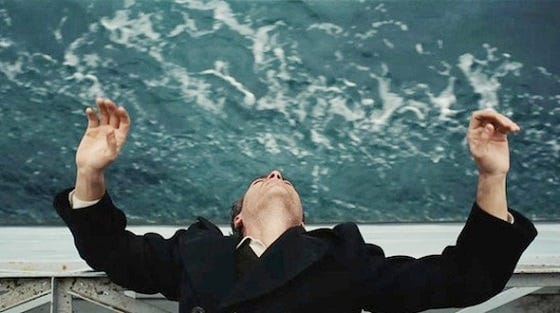
What do they have in common? Two things: Freddie. And the sea.
Indeed the opening image of the movie [as I recall] is an overhead shot, presumably from a ship, of the ocean. It is an image featured at least 3 times during the film.
I could go off on a Jungian tangent about how the sea represents the unconscious. There is probably some truth to that. But I was struck by something else as I watched The Master, themes arising into my mind from one of the most famous and important stories in Western civilization: “The Odyssey”.
Consider the parallels:
* Odysseus was a warrior. Freddie was in the military.
* Odysseus’ travels to the Trojan War and back home to Ithaca involved considerable sea travel. So, too, Freddie’s experiences in The Master.
* Odysseus gets stranded on an island [Ogygia]. So does Freddie as exhibited in the opening sequence.
* Odysseus is connected to a false lover [Calypso]. Freddie is connected to the Sand Woman [he feigns making love to her, plays with her ‘nipples,’ then in the final scene of the movie is seen curling up next to her].
And if we take a macro view of the two stories, we see an even more significant point of comparison: Both are Hero’s Journeys. They depart their old word [Separation], go through a series of significant events and challenges in the new world [Initiation], then go back home [Return].
Furthermore if we take the view that Lancaster Dodd shape-shifts into many different character types, there are other potential parallels:
* When Freddie makes his way onto the boat “Aletheia” [which is Greek for ‘truth’], he is welcomed by Dodd and invited to participate in the wedding festivities, reminiscent of the hospitality practiced by King Altinous when Odysseus lands on the island of the Phaecians.
* Dodd has seemingly magical transformational powers over his followers, recalling the supernatural abilities of Círcë, the witch who turned Odysseus’ crew into pigs.
* Dodd’s insistence on Freddie’s training — the repetition of walking wall to window, window to wall, again and again — can be looked at as equivalent of Odysseus’ descent into Hades, a necessary confrontation of the Protagonist’s ‘shadow’ self.
* Freddie’s conflicted relationship with Dodd conjures up images of Odysseus’ connection to Calypso, both sets of characters emotionally engaged with each other.
But mostly what struck me by way of comparison was this:

Odysseus stranded, yearning for his one true love, separated from her by the sea. Likewise Freddie who longs for his beloved [Doris].
There is something of “The Odyssey” in every story that recalls the Hero’s Journey. Likewise, perhaps, with The Master.
I doubt Paul Thomas Anderson had “The Odyssey” in mind when he wrote the script for The Master, but that doesn’t preclude it arising as a background influence based upon Anderson’s exposure — at some point — to Homer’s epic poem and the mysterious workings of synchronicity.
Previous posts in this series:
What are your thoughts about The Master?
Comment Archive